Fix Shopify No Results: UX, Search & Discovery, or Managed Search
Run a 5 to 10 minute diagnostic, tweak Search & Discovery, and improve no results UX. If null rates persist, try a managed AI search pilot.

Fix Shopify No Results: UX, Search & Discovery, or Managed Search
Run a five-minute diagnostic first: preserve the exact search query, remove any active filters, then try the same term in an incognito window. If the product still doesn’t appear, check whether it’s published and indexed in Shopify’s Search & Discovery settings. Fixes fail on a stubborn subset of stores, and if your null rate stays high after that, a managed search layer with typo tolerance and semantic matching is worth considering.
TL;DR:
- Most zero-result issues stem from filter logic, indexing delays, or display rules, which can often be identified through a quick diagnostic checklist.
- Ensuring products are published, properly indexed, and using broad or synonym-based queries can prevent many common search failures.
- Optimizing no-results pages with clear recovery options, related suggestions, and accessible design reduces shopper frustration and abandonment.
- Shopify’s Search & Discovery app supports synonym management, predictive search, and correct product indexing, but ongoing tuning is necessary for large catalogs.
- For persistent null search rates, managed AI search layers like Indexa improve typo tolerance and semantic understanding, especially for complex, multilingual, or high-volume stores.
Table of Contents
- Quick diagnostic checklist: 5 tests you can run in 5 to 10 minutes
- Why Shopify shows zero results: the common root causes
- Designing a helpful no-results page and recovery UX
- Shopify-specific fixes: Search & Discovery settings, indexing, and tests
- Measure, prioritize, and iterate: metrics and a 30-day recovery plan
- Author perspective: why merchants still struggle and the managed-search tradeoff
- A practical option: how a managed AI search service can stop zero-result losses
- Sources
- FAQ
Quick diagnostic checklist: 5 tests you can run in 5 to 10 minutes
Before touching any settings, write down the exact query, the filters applied, and the device used. This lets you reproduce the failure and confirm a fix actually worked instead of guessing.
- Remove every active filter and rerun the search: if results appear, the cause is filter logic, not indexing.
- Search the exact product title or SKU: if that also returns nothing, the product likely isn’t indexed or published.
- Broaden the query by dropping a word or trying a synonym: this reveals whether the problem is a strict match rule.
- Repeat the test in a private or incognito browser: cached results can hide a real fix.
- Check the product’s visibility and publish status in Shopify admin, and confirm nothing changed recently in your theme or a search app.
Test on both desktop and mobile, since some themes load predictive search differently on each. A result that appears after removing filters points to display rules; one that appears only after broadening the query points to a matching or metadata gap.
Why Shopify shows zero results: the common root causes
Zero results rarely come from one problem. Shopify’s own guidance on improving no-results pages points to typos, synonym mismatches, and unindexed content as the most frequent culprits, and recommends expanding metadata and synonyms as a first response.
- Typo or synonym mismatches: built-in typo tolerance can still fail on brand names, plurals, or regional spelling variants.
- Indexing delays: unpublished products, slow catalog syncs, or Storefront API errors can leave live products invisible to search.
- Filter and display rules: out-of-stock handling and collection size limits can hide products that technically match a query.
- Theme or app overrides: a recently installed app or a custom storefront query parameter can quietly return empty responses.
- Overly specific queries: a shopper typing a long, exact phrase often needs query relaxation or richer metadata to find a match.
Any one of these can produce the same symptom on the front end, which is why the diagnostic checklist matters more than guessing at a single cause.
Designing a helpful no-results page and recovery UX
A no-results page is not a dead end if it’s built right. Baymard’s research on no-results page design found that about half of sites fail to give shoppers any path forward after a failed search, which is a direct driver of abandonment.
- State clearly that no matches were found, and keep the original query and filters visible so the shopper isn’t starting over.
- Offer recovery actions: a button to clear filters, a way to broaden the search, and two or three suggested alternative queries with product previews.
- Add fallback content: related categories, bestsellers, personalized recommendations, or a link to contact support.
- Keep the layout accessible with a large, visible search box and non-blaming copy. Nielsen Norman Group’s guidelines for no-results pages specifically warn against language that implies user error.
Pro Tip: Show the top three alternative queries with small product thumbnails right on the no-results page. It cuts the number of clicks a shopper needs to reach their first relevant product.
Shopify-specific fixes: Search & Discovery settings, indexing, and tests
Shopify’s Search & Discovery app handles most of the mechanics you’ll need to adjust. According to the Shopify Help Center, the app supports predictive search, synonym groups, and configurable result types, all editable without code.
- Open Search & Discovery and build synonym groups for known variants of your top products (brand misspellings, regional terms, abbreviations).
- Adjust predictive search settings so it surfaces close matches instead of returning nothing on a near-miss query.
- Confirm every new product is published to the online store channel and has finished syncing before assuming it’s a search bug.
- Check collection size and out-of-stock display rules, since large collections and hidden inventory can affect what filters show.
- For custom storefronts, validate that Storefront API queries are structured correctly and that search tracking is enabled so the index learns from real queries.
Keep a simple change log of what you adjust and when, and always retest in incognito. Cached results are a common reason a fix looks like it isn’t working when it already is.
Measure, prioritize, and iterate: metrics and a 30-day recovery plan
Fixing zero results without measuring it is guesswork. Track four numbers: null search rate, search exit rate, search refinement rate, and conversion after a search.
- Prioritize by impact times effort: fix the queries that fail most often before chasing rare edge cases.
- Export your top ten failed queries and address them with synonyms or metadata first, since Baymard’s research treats high-volume null queries as the best return on effort.
- Run a 30-day test: implement fixes for those top queries, then compare null rate and post-search conversion before and after.
- Log every change with a date so a metric regression can be traced back to a specific update.
Author perspective: why merchants still struggle and the managed-search tradeoff
Most stores can fix the obvious problems themselves: a missing synonym, an unpublished product, a filter that’s too aggressive. Where DIY breaks down is scale. A catalog with thousands of SKUs, multiple languages, or a small team with no time to keep tuning synonyms every month tends to drift back into a high null rate within a few weeks. That’s the real argument for a managed layer like Indexa’s: not that merchants can’t fix search, but that most don’t have the bandwidth to keep fixing it.
— Barikreativa
A practical option: how a managed AI search service can stop zero-result losses
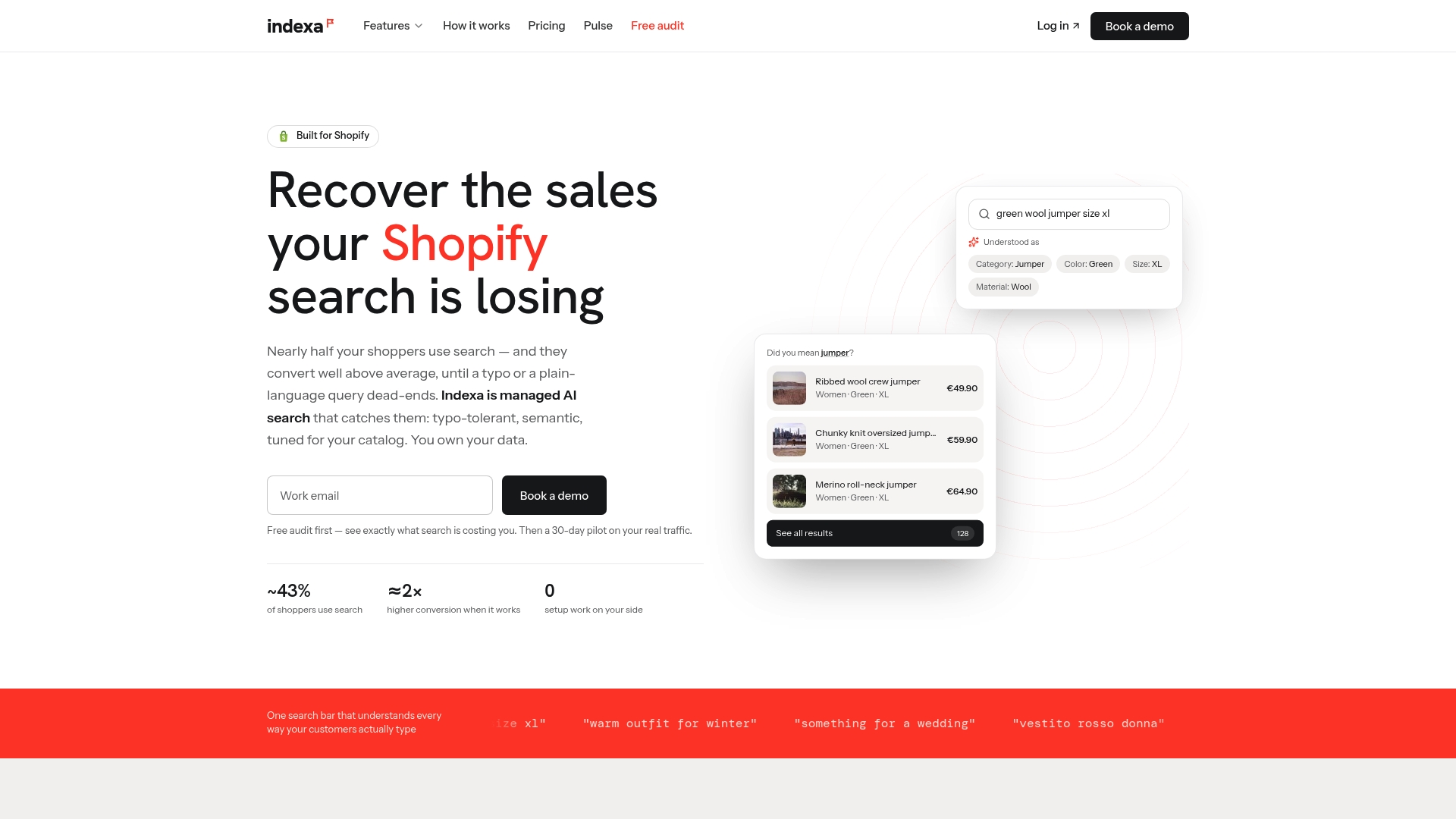
If your null rate stays stubborn after working through the checklist above, the gap usually isn’t effort, it’s ongoing attention. Indexa runs a fully managed search layer for Shopify stores, built to catch what synonym lists and manual fixes miss. It adds typo-tolerant and semantic query understanding, so a shopper’s misspelling or natural-language phrase still finds the right product, plus synonym mapping, a visual merchandising grid, and continuous tuning based on your store’s actual search data. There’s no setup required on your end, and it runs natively on Shopify, including Hydrogen storefronts.
Indexa offers a free audit to see where your search is losing shoppers, and a 30-day pilot to measure recoverable revenue before committing to anything. It tends to make the most sense for stores with large or multilingual catalogs, persistently high null rates, or a small team that can’t own search tuning as an ongoing task. Check current plans and setup details to see if a pilot fits your store.
Sources
- 5 Proven UX Strategies For “No Results” Pages – Baymard
- How To Improve No Results Found Pages in Your Online Store (2025) - Shopify
- Shopify Help Center | Storefront search
- 3 Guidelines for Search Engine “No Results” Pages - NN/G
FAQ
Is Shopify still worth it in 2026?
Shopify remains a viable platform for most online retailers, and its ongoing updates to Search & Discovery and analytics tools address common friction points like zero-result searches. Whether it’s “worth it” depends more on how well a store manages product data, search, and merchandising than on the platform itself.
Why is nothing selling on Shopify?
Low or zero sales are usually tied to visibility problems rather than the platform: unpublished products, poor search matching, weak product metadata, or a no-results page that gives shoppers no way forward. Running the diagnostic checklist above often reveals which of these is blocking conversions.
How much does Shopify take from a $20 sale?
Shopify’s fees depend on the specific plan and payment processing setup a merchant has, so there’s no single flat figure that applies to every store. Merchants should check their own plan’s transaction and payment fees directly in Shopify’s pricing documentation for an accurate number.
Can you make $10,000 a month on Shopify?
Reaching that level of monthly revenue is possible on Shopify, but it depends heavily on traffic, product-market fit, and how well the store converts visitors, including recovering shoppers who hit a zero-results search. Fixing search failures and no-results pages is one of the more direct ways to lift conversion without adding new traffic.
Recommended
Make discovery work harder.
See what your Shopify search could do better with a free, hands-on audit.
Get your free search audit