Shopify Teams: Fix Zero Click Search with ShopifyQL and Hydrogen
Fix zero click search on Shopify: use the Searches with no results and Searches with no clicks reports, query ShopifyQL, verify Hydrogen tracking, and...

Shopify Teams: Fix Zero Click Search with ShopifyQL and Hydrogen
Zero-click search happens when a shopper types a query into your Shopify search bar and either gets no results or gets results they never click. The fastest way to see how much revenue this costs you is to open your Searches with no results and Searches with no clicks reports today and sort by search volume. Start with your highest-volume queries and your top SKUs, since fixing those first recovers the most lost sales with the least effort.
TL;DR:
- Fixing high-volume zero-result queries with synonym groups can recover significant lost sales without extensive catalog changes.
- Regularly review Searches with no results and Searches with no clicks reports to identify persistent issues affecting revenue.
- For stores with many frequent failures, automated managed search services can continuously resolve issues more efficiently than manual updates.
- Reindex your catalog and check for theme or app overrides if queries that previously failed start returning results unexpectedly.
- Tracking the impact of fixes on search-driven revenue and maintaining an organized log helps prevent recurring failures over time.
Table of Contents
- How to find and classify failing queries using Shopify reports
- Tactical fixes you can apply now
- Operational changes and analytics to stop failures coming back
- What teams actually see when they dig into search data
- Get a managed fix for recurring zero-click searches
- FAQ
- Sources
How to find and classify failing queries using Shopify reports
Before you fix anything, you need an accurate list of what’s actually broken. Shopify gives you two separate reports because they capture two different failure modes, and treating them as one problem leads to the wrong fix.
- Open the Behavior reports section in your Shopify admin and pull Searches with no results, which lists search terms that returned zero products along with session counts.
- Pull Searches with no clicks separately. These are queries where products did appear, but shoppers didn’t click any of them, usually a sign of weak relevance or poor merchandising rather than a missing product.
- Cross-reference both lists against your top-selling products and categories so you know which failures touch real revenue.
For a more granular view, especially if you want to segment by device or day of week, query the ShopifyQL schemas directly. The search_queries and searches datasets expose fields like search_results_were_returned and search_result_was_clicked, plus is_product_search_query to filter out navigational noise.
- Rank every failing query by volume multiplied by an estimated lost conversion rate, so you work on impact first.
- Segment results by device and day of week; mobile typos and weekend browsing patterns often behave differently.
- Flag queries that match a product you know you carry but that didn’t return it: these point to metadata problems, not catalog gaps.
If you run a custom storefront on Hydrogen, standard Shopify analytics won’t automatically capture click attribution. Search and predictive search responses return trackingParameters that you need to append to product URLs yourself, and you have to confirm hasUserConsent cookies are set correctly or the tracking parameters get stripped and you lose the attribution chain entirely.
Pro Tip: Run your top 20 no-result queries through both predictive and full search before you touch any settings: a query that fails in one surface but works in the other usually points to a theme override, not a search engine problem.

Tactical fixes you can apply now
Once you have a prioritized list, most of the fixes are configuration changes rather than development work. Shopify’s Search & Discovery settings let you build synonym groups, so a repeated no-result term like “hoodie” that only matches “sweatshirt” in your catalog gets paired without you renaming a single product.
- Build synonym groups for every repeated no-result term, and add the same vocabulary to product titles and tags where it fits naturally.
- Configure fallback rules so a no-results page shows bestsellers, a related category, or suggested alternate queries instead of a dead end.
- Check out-of-stock handling and filter logic: Shopify lets you show, hide, or push out-of-stock items to the bottom of results, and an overly restrictive default filter can silently zero out an otherwise valid query.
- Make the “clear filters” control impossible to miss on no-results pages; shoppers often don’t realize their own filter combination is the problem.
- For queries that return results but get no clicks, use merchandising or promoted placements to surface higher-margin or better-converting alternatives near the top.
A no-results page doesn’t always mean you’re out of stock. Common causes include missing synonyms, content that never got indexed, overly strict filters, or a theme override changing what the search app would normally return.
- Reproduce the exact failing query in both predictive and full search.
- Check whether an installed theme or app is overriding default result types.
- Re-index the catalog if a recent product or metadata change hasn’t propagated yet.
Pro Tip: Fix synonyms and fallback rules before you touch ranking weights: ranking changes without query-level verification tend to create new zero-click problems while you’re chasing old ones.
Operational changes and analytics to stop failures coming back
One-time fixes drift out of date as your catalog and shopper vocabulary change, so the fixes above need a repeatable cadence behind them, not a single afternoon of cleanup.
- Mine failed queries weekly from the same two Behavior reports, classify each by root cause (typo, synonym gap, filter issue, indexing lag, or theme override), apply one targeted change per query, then re-measure the same query the following week to confirm the fix worked.
- Track downstream impact, not just whether a click happened, using ShopifyQL fields for search-driven conversions against session counts as your denominator, so you can see whether a fix actually moved revenue with help from this ultimate guide to testing and optimising your sales funnel.
- Keep an edit log tied to your query list, with a named owner for each metadata or ranking change and a documented rollback step, since search tuning without accountability tends to accumulate contradictory edits over time.
- Treat catalog hygiene as ongoing work: product titles, descriptions, and tags should include the words shoppers actually type, and any internal SKU codes customers search by need to be indexed, not just listed in the back office.
When the same high-volume queries keep failing week after week despite synonym updates and fallback rules, that’s usually a sign the manual loop has hit its ceiling. At that point a continuously tuned, managed search service can apply the same classify-and-fix loop automatically across your full query list rather than one query at a time.
Pro Tip: Keep your edit log and your query list in the same place: when a fix doesn’t hold, you want to see exactly what changed and when without digging through separate spreadsheets.
What teams actually see when they dig into search data
In practice, the queries that hurt revenue most aren’t exotic. They’re common product names typed with a small variation, seasonal terms that outrun a catalog’s tagging, or filter defaults nobody revisited after launch. The no-results and no-clicks reports catch both patterns, but only if someone checks them on a schedule rather than after a quarter of declining conversion.
What tends to separate a quick win from a recurring headache is volume and persistence: a handful of failing queries is a weekly cleanup task, but hundreds of unique failing queries across a large catalog is a different problem that benefits from automated classification.
- Store teams that review failed queries weekly catch vocabulary drift before it compounds across a full product catalog.
- Stores with large or fast-changing catalogs tend to outgrow manual synonym mapping the fastest.
- A free Shopify search audit and the accompanying checklist give you a structured starting point before deciding whether DIY fixes or a managed service fits your volume.
— Barikreativa
Get a managed fix for recurring zero-click searches
We built Indexa to take the closed-loop process described above and run it continuously, so you’re not re-mining the same reports every week by hand. Our managed AI search and discovery service adds typo tolerance and semantic matching natively to your Shopify store, with no setup work required on your end and ongoing tuning based on your store’s own query data.
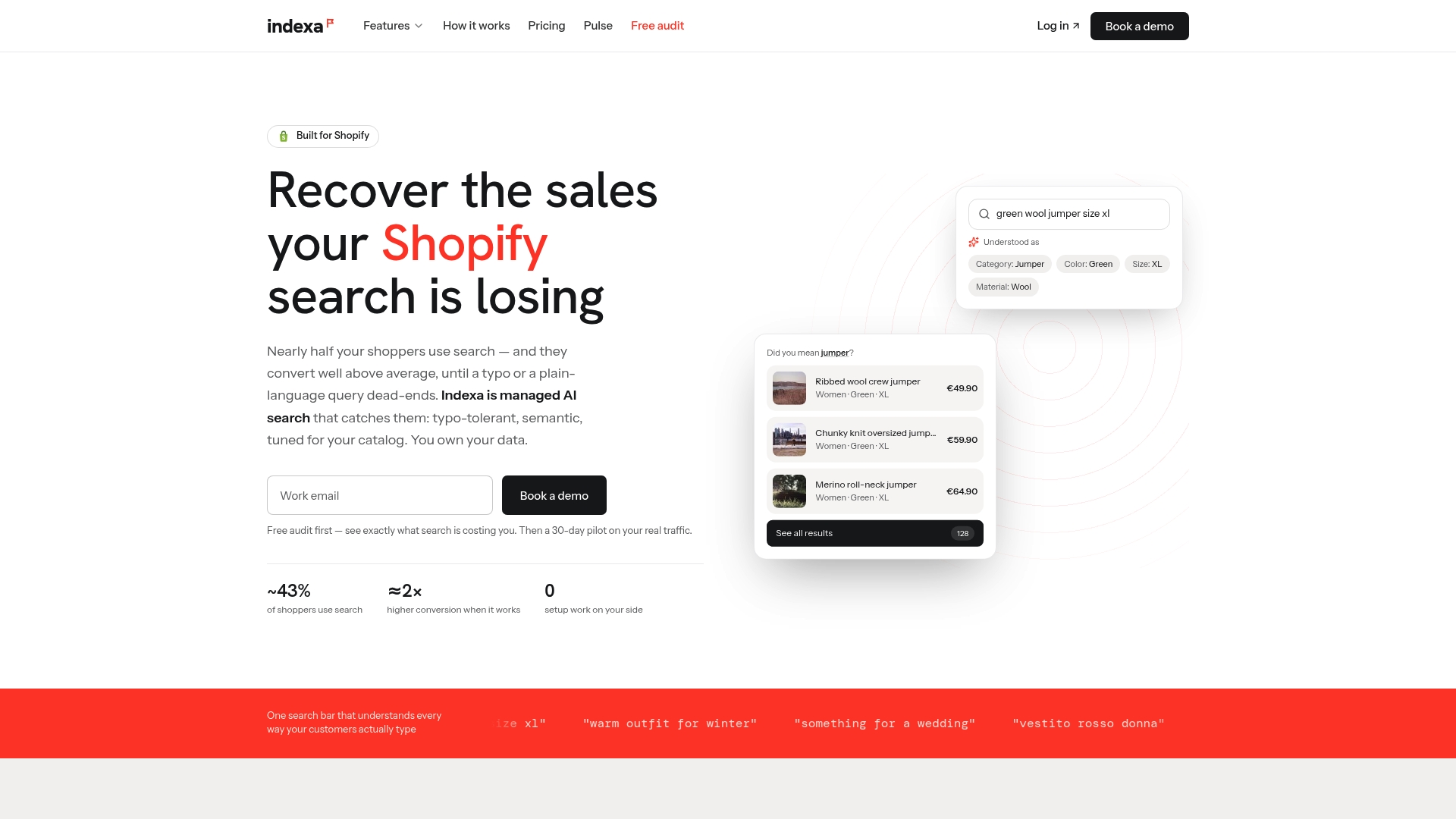
- We activate quickly without requiring code changes to your theme.
- We tune continuously against your real shopper queries, not a one-time configuration.
- We bill on a monthly retainer without per-request fees, and you keep ownership of your data.
| Option | What it requires from you | Ongoing effort |
|---|---|---|
| Manual Shopify fixes | Weekly report review, synonym edits, fallback rules | Recurring, scales with catalog size |
| Managed service (Indexa) | Initial audit, no setup | Continuous, handled for you |
Pro Tip: Start with the free Shopify search audit even if you’re not ready to commit: it gives you a concrete list of failing queries you can act on either way.
If you want a structured read on where your queries are failing before deciding anything, the free Shopify search audit reviews your Searches with no results and Searches with no clicks data and flags the highest-impact fixes. From there, the 30-day pilot lets you run managed search on your store with a one-time setup fee and a flat monthly retainer, so you can measure the difference against your own baseline before committing further.
- Request the free audit and review your current zero-click query list.
- Compare the audit findings against your own Behavior reports.
- Start the 30-day pilot if the volume justifies a managed approach.
FAQ
What’s the difference between zero-result and zero-click searches?
A zero-result search returns no products at all for a given query, usually from a missing synonym, an unindexed item, or an overly strict filter. A zero-click search returns products, but the shopper doesn’t click any of them, which usually points to a relevance or merchandising problem rather than a missing catalog match.
Which Shopify reports show zero-click searches?
The Searches with no results and Searches with no clicks reports in your Behavior reports section show both failure types separately. Reviewing them together gives you a full picture of where on-site search is losing conversions.
Can I track zero-click searches on a custom Hydrogen storefront?
Yes, but you need to handle it manually: Hydrogen’s search tracking returns trackingParameters from search and predictive search responses that you append to result URLs yourself. Without correctly set consent cookies, those parameters can be stripped and attribution is lost.
What’s a quick first fix for repeated no-result queries?
Build a synonym group in your Search & Discovery settings that maps the shopper’s wording to your product’s actual title or tags. This is usually faster than renaming products and fixes the issue for every future shopper who types the same term.
When does it make sense to move from manual fixes to a managed service?
If the same high-volume queries keep failing despite synonym and fallback updates, or your catalog is large enough that weekly manual review isn’t keeping pace, a continuously tuned option like our managed AI search and discovery service applies the same fix-and-measure loop automatically. A free audit can show you whether your current failure volume justifies that step.
Sources
Recommended
Make discovery work harder.
See what your Shopify search could do better with a free, hands-on audit.
Get your free search audit