Synonym Governance for Ecommerce Search: A Merchant's Guide
Synonym governance is how you own, document and review the synonym rules in your store search. Learn the rules, the audit routine and how to measure results.

Synonym Governance for Ecommerce Search: A Merchant’s Guide
Synonym governance is the set of rules, owners and review habits that decide which words your store search treats as the same thing, and who is allowed to change that. Without it, a synonym list becomes a pile of one-off fixes that nobody remembers, and the list starts to hide products as often as it finds them. With it, every mapping has a reason, a record and a test. We built our managed search service for Shopify stores around that discipline, so the merchant does not have to carry it alone.
TL;DR
- A synonym is a business decision, not a vocabulary fact: each mapping should have a direction, a scope, an owner and a reason written down.
- Related terms are not interchangeable. In one audit of synonym expansions, 14.5% were irrelevant and 33.1% were only relevant in context, so every rule needs contextual review.
- Find gaps in your own data: zero-result queries, reformulated searches and searches that end without a click.
- Judge each change on sparse-result rate, defects found on review and sales, not on whether the new rule sounds sensible.
- Brand names, sizes and fashion terms are where governance pays off first.
Table of Contents
- What synonym governance actually covers
- Why an unmanaged synonym list fails
- Build the rulebook: how to document synonyms
- Find your synonym gaps
- Fashion vocabulary needs extra care
- Handling brand names and alternate product names
- Managing and testing synonyms in a Shopify store
- Measure whether it worked
- A quarterly review that keeps the list healthy
- Where our managed service fits
- Our perspective
- FAQ
- Sources
What synonym governance actually covers
Search engines match the words a shopper types against the words in your catalog. When the two differ, a shopper typing “sneakers” misses the products you titled “trainers”. Researchers call this vocabulary mismatch, and an e-commerce study that tested synonym expansion in an online experiment tracked sales, sparse-result rate and human-assessed defects to see whether bridging that gap helped.
A synonym list bridges the gap by hand. Governance is everything around the list:
- Ownership: one named person approves changes, so two teammates do not add conflicting rules in the same week.
- Documentation: each rule records what it maps, why, and what evidence supported it.
- Review cadence: rules are rechecked against fresh search data on a schedule.
- Testing: a change is checked on real queries before and after it goes live.
- Retirement: rules that stop earning their place are removed.
The term is used more broadly in search engineering too. Elasticsearch Labs describes ecommerce search governance as a decision layer that classifies intent and applies business policies before choosing how to retrieve results. Synonyms are one of the policies that layer applies, and for most Shopify merchants they are the one they touch most often.
Why an unmanaged synonym list fails
Synonym lists rarely fail on day one. They fail around month six, when the list has forty rules and nobody knows why “slip” maps to “dress” and “skirt”.
Three failure patterns show up again and again.
Over-broad mappings. A rule that treats two related words as identical widens results past what the shopper wanted. The audit cited above found that only about half of the expansions it examined, 52.4%, were fully interchangeable. The rest needed context or were simply wrong. A merchant who assumes every related word is safe will ship the 14.5% that are not.
Collisions. Two rules that each look fine can contradict each other once combined. “Jumper” maps to “sweater” in one rule while “sweater” maps to “cardigan” in another, and a search for one now returns the other. Our guide on fixing synonym collisions with quick tests walks through how to spot this.
Orphaned rules. A seasonal mapping for a collection that no longer exists still fires, quietly pulling in stray products.
If you want a deeper look at why expansion can go wrong, the same tension appears in research on the impact and risks of synonym expansion alongside keyword work, where choosing the right terms matters as much as adding more of them.

Build the rulebook: how to document synonyms
A rulebook can be a shared spreadsheet. What matters is that every row answers the same questions.
| Field | What to record | Example |
|---|---|---|
| Search term | What the shopper types | joggers |
| Maps to | What it should also match | sweatpants, track pants |
| Direction | One-way or two-way | One-way: joggers finds sweatpants, not the reverse |
| Scope | Whole store or one category | Menswear and womenswear only |
| Reason | The evidence behind it | 38 searches last quarter, zero results |
| Owner | Who approved it | Merchandising lead |
| Date added / next review | When to revisit | Added March, review in September |
| Test result | Outcome of the check | Top 10 reviewed, no defects |
One-way or two-way
This is the most important decision per rule. A two-way rule treats the words as equals. A one-way rule expands only from the shopper’s term to the alternatives. Coveo’s documentation illustrates the difference: with a one-way rule from “laptop” to “notebook”, a search for “notebook” does not return laptop-only listings. In fashion, one-way rules are often the safer default. “Trousers” can reasonably find “pants”, but a broad term such as “shoes” should not be forced onto every narrow term like “loafers”.
Write the reason, not just the rule
A reason makes the rule reviewable. “Added because 40 shoppers a month typed this and saw nothing” is a reason you can check later. “Seemed right” is not.
Find your synonym gaps
Gaps are visible in what shoppers already do. You do not have to guess vocabulary; you can read it.
- Export zero-result searches. These are the clearest signal that your catalog words and shopper words differ.
- Look at low-result searches. A query that returns one or two products often hides a mismatch, because the engine found a partial match on a different word.
- Read the reformulations. When a shopper searches, sees poor results and retypes with different words, the second query tells you what they meant. The 2020 SIGIR paper Query Reformulation in E-Commerce Search studied exactly this on eBay search logs, comparing how reformulations changed the retrieved results and the clicks and purchases that followed.
- Check searches with results but no clicks. The page loaded, nobody found anything worth opening.
- Compare with your product data. If shoppers say “hoodie” and your titles say “pullover”, that pair belongs on the list. If shoppers say “kicks” and you sell furniture, it does not.
Sort the findings by volume and fix the top 20 first. Long-tail guesses rarely repay the effort. Our piece on fixing the top 20 search failures follows the same prioritization logic.
Fashion vocabulary needs extra care
Fashion shoppers describe products by silhouette, occasion, fabric and slang, and the words shift by region and season. A few areas deserve their own governance notes.
- Regional pairs: sneakers and trainers, pants and trousers, sweater and jumper. Decide once, document the direction, and apply it consistently.
- Style terms: “boyfriend jeans”, “mom jeans” and “relaxed fit” overlap but are not the same cut. Mapping them as equals will cost you relevance.
- Colors: “navy” and “blue” is usually a one-way relationship, blue finding navy, not the reverse.
- Sizes: “XL”, “extra large” and “1X” often mean different things across brands. Our practical guide to size synonyms covers how to map them without mixing fits.
- Seasonal language: “puffer”, “quilted” and “down jacket” return in autumn; schedule a review before each season rather than after the complaints.
Handling brand names and alternate product names
Brand synonyms behave differently from ordinary words. Shoppers misspell brands, shorten them (“Levi’s”, “Levis”), or use a product line name instead of the brand. Treat these in three layers:
- Spelling variants belong to typo tolerance, not the synonym list. Keep the list for real meaning differences.
- Abbreviations and nicknames map one-way to the official name.
- Product-line names map to the category they belong to only when you actually stock it.
Never map your own brand to a competitor’s brand name to catch their traffic; the shopper who finds the wrong product leaves. For setup detail, see our walkthrough of Shopify search synonyms for brands.
Managing and testing synonyms in a Shopify store
Shopify’s own Search & Discovery app lets you group terms so that they return the same results, and our guide to Shopify search synonyms, setup and limits explains what to map and where the native tools stop. Whatever tool you use, the test routine is the same:
- Pick 25 to 50 real queries from your data, including the ones the new rule should fix and a handful it should not touch.
- Record the top 10 results before the change.
- Apply the rule and record the top 10 again.
- Mark each result as relevant, acceptable or wrong. Any wrong result is a defect.
- Keep or roll back. If defects outweigh fixes, narrow the scope or make the rule one-way.
For a fuller method, read how to test search relevance on Shopify.
Measure whether it worked
Three measures, borrowed from the study design above, give you a fair read.
| Measure | What it tells you | Direction you want |
|---|---|---|
| Sparse-result rate | Share of searches returning few or no products | Down |
| Defect rate on review | Share of top results a person marks wrong | Flat or down |
| Sales from search sessions | Revenue from shoppers who used search | Up |
The online experiment in the synonym extraction report tracked those same three signals, which is a useful template for a store of any size. Compare like with like: same weeks, same traffic mix, and avoid a promotion period when you read the result. Give changes enough time to collect searches before you decide.
A quarterly review that keeps the list healthy
Put this on the calendar and it takes an hour or two.
- Export the last 90 days of zero-result and low-result searches.
- Add rules for the top recurring gaps, each with a reason.
- Re-run your 25 to 50 test queries against the full list.
- Delete rules that match no recent searches.
- Look for collisions between rules that touch the same words.
- Update the rulebook and note the next review date.
Where our managed service fits
Most small teams can write the rulebook. What they struggle with is keeping it current while running a store. That is the gap our managed service is built for: we handle the installation, with no setup or coding required on your side, and we tune relevance continuously on your real store data. The service includes synonym mapping, typo-tolerant and semantic search, multilingual support, a no-code console and integrated analytics, and your data stays yours. Billing is a flat monthly retainer plus a one-time setup fee, with no per-request fees.
If you want to see where your current search loses shoppers before committing to anything, start with the free audit. A 30-day pilot is also available, and the pricing page lists the structure.
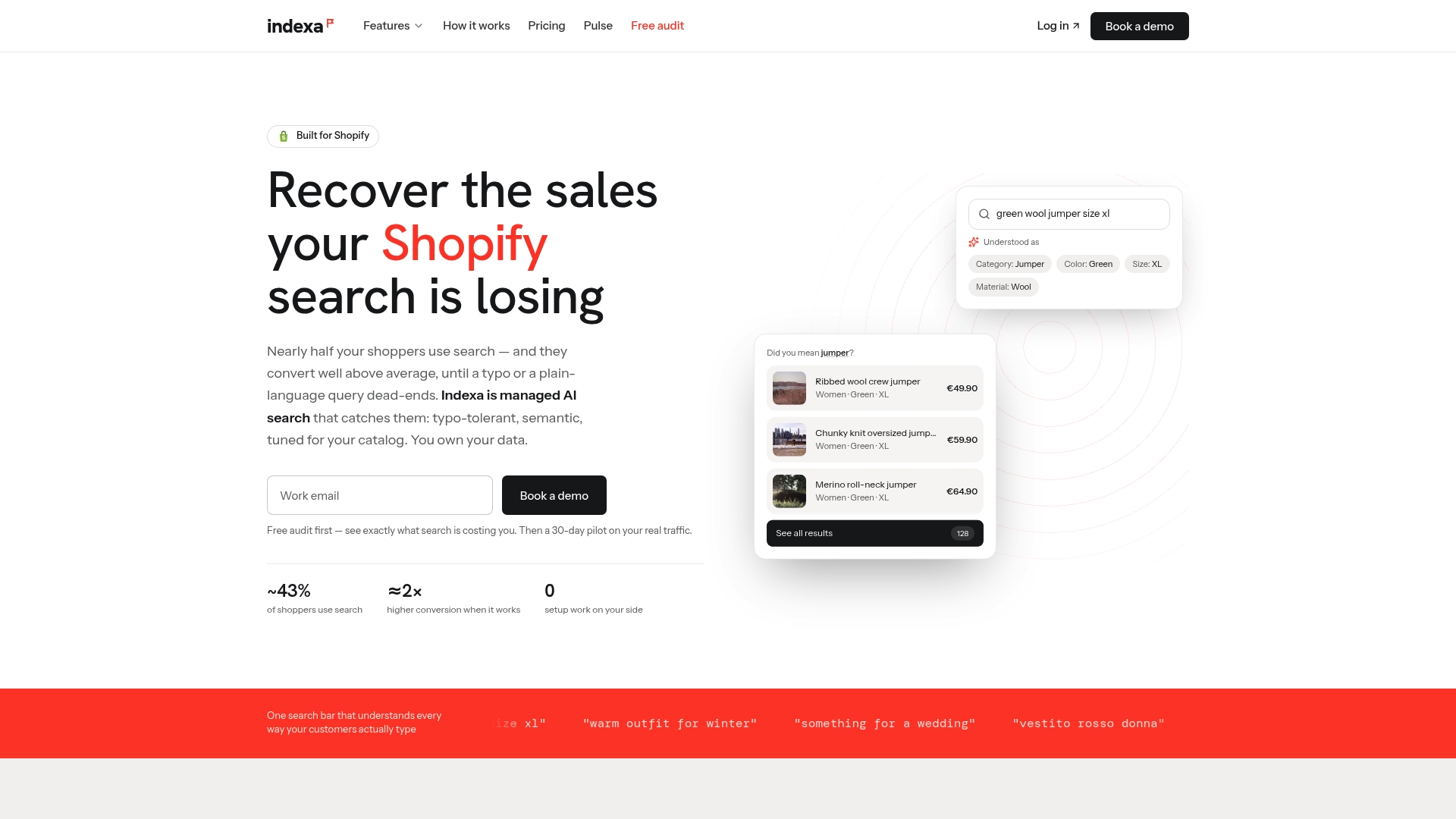
For the broader picture of how the pieces fit, see our features overview.
Our perspective
We think of synonyms as a living part of merchandising, not a one-time setup task. Shoppers invent new words every season, and a list that was right in spring is quietly wrong by autumn.
That is why we pair semantic search with managed tuning. Semantic understanding catches the many phrasings nobody could list by hand, and ongoing tuning on your own store data handles the vocabulary that belongs only to your catalog and your customers.
Governance is what keeps both honest: a reason for every rule, a test before it ships, and a review after. A small brand should not need a search engineer to do that, and with a fully managed service it does not.
Barikreativa
FAQ
What is the difference between synonym management and synonym governance?
Management is the act of adding and editing rules. Governance adds the structure around it: who approves a change, how it is documented, how it is tested and when it is reviewed. A store can manage synonyms without governance, but the list will drift.
How many synonyms should a store have?
There is no right number. Start with the gaps your zero-result and low-result searches reveal, and let each rule earn its place with evidence. A short, well-documented list outperforms a long one nobody understands.
Should synonym rules be one-way or two-way?
Use two-way only when the words are truly interchangeable in your catalog. When one term is broader or less precise than the other, a one-way rule from the shopper’s term to your product term is safer, because it avoids pulling unrelated products into narrow searches.
How do I know if a synonym rule is hurting results?
Re-run a fixed set of real queries and review the top 10 results. Wrong products appearing after a rule goes live, a rise in the sparse-result rate or falling sales from search sessions all point to a rule that needs a narrower scope or removal.
Sources
- Why ecommerce search needs governance and how it improves retrieval, Elasticsearch Labs
- Query Reformulation in E-Commerce Search, ACM SIGIR 2020
- Unsupervised synonym extraction for document enhancement in e-commerce
- Synonym rules for search, Coveo documentation
- Boost Online Sales: Proven Ecommerce Keyword Research Tips
Recommended
Make discovery work harder.
See what your Shopify search could do better with a free, hands-on audit.
Get your free search audit