Stop Guessing: Stemming vs Lemmatization for Millions of Documents
Practical comparison of stemming and lemmatization with examples, precision, recall, speed trade-offs, library and pipeline tips, and when to use hybrids...

Stop Guessing: Stemming vs Lemmatization for Millions of Documents
Stemming chops words down to a rough root using fixed rules, favoring speed and recall at the cost of accuracy. Lemmatization looks up each word’s dictionary form using part-of-speech context, favoring precision at the cost of processing time. If you’re building a high-volume search index and can tolerate noise, use stemming. If you need clean, readable output for classification or extraction, use lemmatization, or blend both.
TL;DR:
- Stemming is suitable for high-volume indexing when speed is critical and some noise can be tolerated, but it risks merging unrelated words like university and universe.
- Lemmatization offers more accurate base forms by using a lexicon and part-of-speech tagging, but it requires more processing time and infrastructure.
- Combining light stemming for nouns with lemmatization for verbs can balance speed and accuracy in production systems.
- For product or catalog searches involving brand names and domain-specific terms, preprocessing should exclude key tokens from normalization to prevent damaging matches.
- Relying solely on normalization techniques overlooks the effectiveness of semantic search and query understanding, which address common shopper phrasing issues more reliably.
Table of Contents
- Stemming vs Lemmatization: How Each One Actually Works
- Side-by-Side: Where They Agree and Where They Split
- Precision, Recall, Speed: The Real Trade-Offs
- Building It: Libraries, Pipeline Placement, and Tuning
- When to Choose Stemming, Lemmatization, or a Hybrid
- Why Semantic Search Is Replacing Brittle Normalization in E-Commerce
- Get Your Shopify Search Evaluated Instead of Guessing
- The Practitioner’s Take: Stop Treating Normalization as a Binary Choice
- Sources
- FAQ
Stemming vs Lemmatization: How Each One Actually Works
Stemming is mechanical. A rule-based stemmer like the Porter stemmer strips suffixes in a fixed sequence, chopping “running” to “run” and “argued” to “argu” without checking whether the result is even a real word. The Snowball stemmer improved on Porter with more consistent rule sets across languages, but the logic stays the same: pattern match, cut, done. Some implementations run “light stemming” (removing only plural or verb endings) versus “aggressive stemming” (stripping deeper, which produces more collisions).

Lemmatization works differently. It uses a lexicon (commonly WordNet) plus part-of-speech tagging to map a word to its dictionary base form, so “better” correctly resolves to “good” and “was” resolves to “be,” something no suffix-stripping rule could catch, according to IBM’s technical breakdown.
That dependency on tagging is also where things break:
- Over-stemming: unrelated words collapse into the same root, like “university” and “universe” both reducing toward “univers.”
- Under-stemming: related words that should merge stay separate, hurting recall.
- POS ambiguity: a lemmatizer without accurate tagging can mislabel a word’s role and return the wrong base form entirely.
Side-by-Side: Where They Agree and Where They Split
Regular verbs are where stemming and lemmatization mostly agree. “Running” becomes “run” either way, and for high-frequency, regular inflections, the two techniques produce nearly identical output. The split shows up with irregulars and ambiguous words.
- running → run (stem) / run (lemma): agreement, no issue.
- studies → studi (stem) / study (lemma): stemmer produces a nonword.
- better → better (stem) / good (lemma): lemmatizer catches the irregular, stemmer misses it entirely.
- was → wa (stem) / be (lemma): stemmer output isn’t even readable.
- meeting (noun) → meet (stem) / meeting (lemma, noun sense): lemmatizer preserves the correct sense.
- meeting (verb, “I’m meeting him”) → meet (stem) / meet (lemma, verb sense): both agree once POS is correct.
- university → univers (stem, over-stemmed) / university (lemma): stemmer creates a false match risk.
- geese → gees (stem) / goose (lemma): another irregular the stemmer can’t resolve.
Search relying on raw stemmed tokens will quietly merge “university” searches with unrelated “universe” content, a real failure mode documented in the Stanford IR book.
Precision, Recall, Speed: The Real Trade-Offs
Stemming increases recall but tends to hurt precision, while lemmatization returns linguistically valid words but only delivers modest aggregate retrieval gains for English overall, per the Stanford NLP IR book. That’s a critical nuance: lemmatization sounds like the obvious upgrade, but its retrieval benefit is often query-dependent rather than universal.
Statistic callout: Stemming’s recall boost comes with a documented precision cost, and lemmatization’s precision gains are often modest and query-dependent, according to Stanford’s own analysis.
Cost differences matter too:
- Stemmers run in microseconds with no external lookups, ideal for indexing millions of documents.
- Lemmatizers need a lexicon in memory and a POS tagger in the pipeline, adding latency and infrastructure weight.
- Morphologically rich languages (Finnish, Turkish, Arabic) tend to break simple stemmers, making lemmatization or morphological analyzers more worthwhile there.
- Domain vocabulary (medical, legal, technical) often needs custom lemmatization dictionaries since general-purpose lexicons miss specialized terms.
Hybrid pipelines, lemmatizing verbs while lightly stemming nouns, are common in production because they split the difference between speed and accuracy, according to practical full-text search guidance.
Building It: Libraries, Pipeline Placement, and Tuning
Consistency matters more than which technique you pick. If you stem at index time, you must apply the identical stemmer to queries at search time, or matches silently fail. The same rule applies to lemmatization.
For tooling, NLTK’s WordNetLemmatizer and spaCy both handle POS-aware lemmatization out of the box, while Porter and Snowball stemmers ship with nearly every NLP library, per GeeksforGeeks’ comparison. If you’re running search on Elasticsearch, the platform ships algorithmic and dictionary-based stemmer token filters, plus controls like stemmer_override and keyword_marker to stop specific tokens (brand names, SKUs) from being mangled, according to Elastic’s documentation.
- Cache your lexicon in memory rather than reloading it per request.
- Choose a lighter stemmer first, then escalate to aggressive stemming only if recall testing demands it.
- Precompute lemmas at index time for static catalogs instead of lemmatizing every query live.
- Batch POS tagging where possible; per-token tagging calls are slow at scale.
Pro Tip: Exclude brand names and SKUs from stemming and lemmatization entirely using a keyword marker or override list. A stemmer that turns “Nikes” into “nike” seems harmless until it starts merging your brand with unrelated results.
When to Choose Stemming, Lemmatization, or a Hybrid
- Large-scale full-text retrieval with tight latency budgets → use stemming. Speed and recall matter more than clean output.
- Sentiment analysis, information extraction, or question answering → use lemmatization. Readable, correct base words feed downstream models better.
- Product-title or catalog search → use a hybrid or a semantic mapping layer. Neither raw stemming nor generic lemmatization handles brand names, model numbers, or domain jargon well.
- Uncertain which fits your data → prototype both on a representative sample, then A/B test retrieval metrics (precision, recall) and measure the downstream impact on whatever model consumes the text.
- If your vocabulary is highly technical or multilingual → lean toward lemmatization or a custom dictionary; general stemmers underperform outside common English patterns.
Why Semantic Search Is Replacing Brittle Normalization in E-Commerce
Stemming and lemmatization were built for general text retrieval, not shopper queries riddled with typos, brand names, and natural language phrasing. Semantic search, synonym mapping, and typo tolerance now handle much of what normalization used to attempt, and often more reliably, since they interpret intent rather than truncating strings. Indexa’s query understanding layer works this way for Shopify stores, matching shoppers to relevant products even when their search terms don’t match any stem or lemma in the catalog. Before committing to a global normalization strategy, run an empirical audit on real query logs, not just a naive assumption.
Get Your Shopify Search Evaluated Instead of Guessing
Most merchants never test whether stemming or lemmatization is even the right lever for their search problem. Bounce rates from failed searches usually trace back to typos, phrasing, or missing synonyms, issues a managed layer solves without you touching a tokenizer. Indexa’s free Shopify search audit shows exactly where your current search setup is losing shoppers, before you spend engineering hours tuning a stemmer that was never the actual problem.
The Practitioner’s Take: Stop Treating Normalization as a Binary Choice
The stemming versus lemmatization debate gets framed as a technical purity contest, pick the “smarter” one and move on. That framing misses the point. Stanford’s own research shows lemmatization’s aggregate retrieval gains are often modest, so treating it as an automatic upgrade over stemming is a mistake plenty of teams make without checking their own data first.
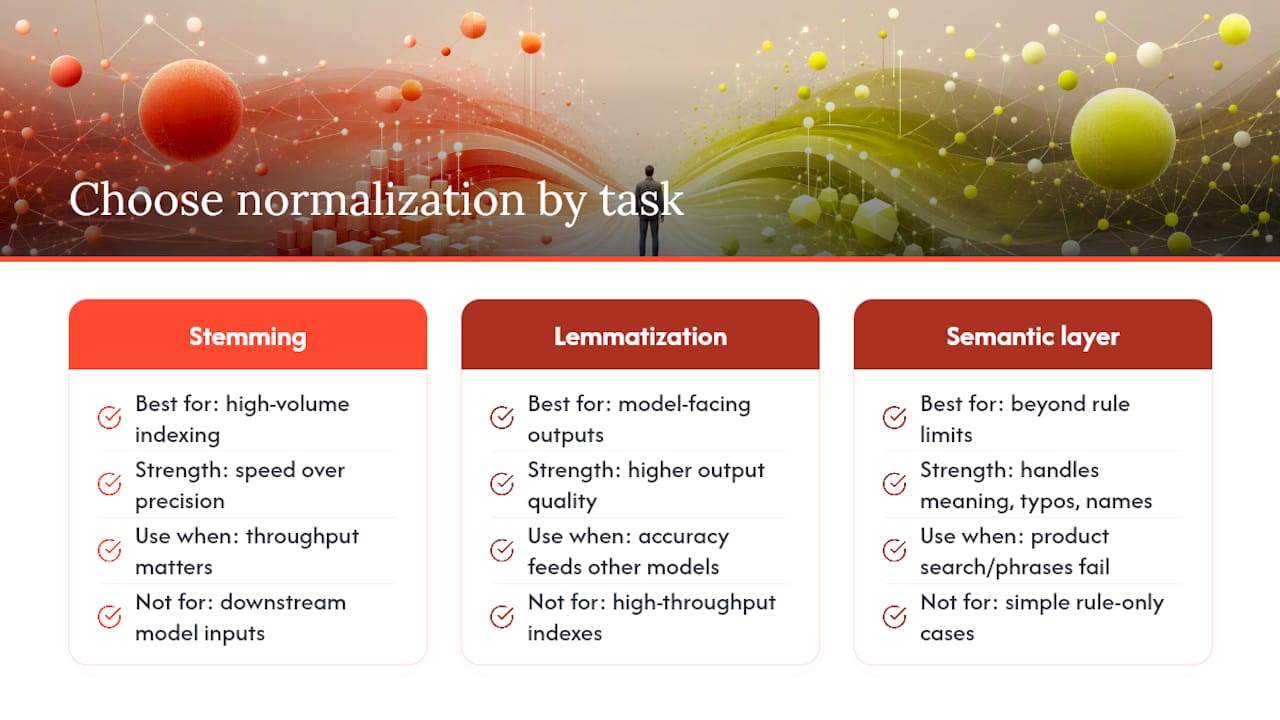
What the evidence actually supports is narrower: match the technique to the task, not to whichever sounds more sophisticated. Stemming earns its keep in high-volume indexing where speed outweighs precision. Lemmatization earns its keep where output quality feeds directly into another model’s accuracy. Neither earns its keep in a modern product search box, where shoppers type brand names, typos, and phrases no stemmer or lexicon was built to handle.
The bigger shift worth prioritizing isn’t choosing better rules. It’s recognizing when rule-based normalization has hit its ceiling and a semantic layer picks up where it can’t.
— Barikreativa
Sources
Stanford’s IR book chapter, IBM’s stemming and lemmatization explainer, GeeksforGeeks’ practical comparison, and Elastic’s stemming documentation all cover these mechanics in more depth, and Babylovegrowth’s guide to NLP in search ranking connects normalization choices back to ranking outcomes.
- Stemming and lemmatization — Stanford NLP IR book
- Lemmatization vs. Stemming — GeeksforGeeks
- What are stemming and lemmatization? — IBM
- Stemming — Elastic documentation
FAQ
Is stemming the same as lemmatization?
No. Stemming chops words down using fixed rules without checking real-word validity, while lemmatization uses a dictionary and part-of-speech context to return a word’s correct base form, per IBM’s explainer.
What is an example of stemming?
A stemmer like Porter or Snowball turns “studies” into “studi” and “argued” into “argu,” cutting suffixes mechanically regardless of whether the output is a real word.
What is an example of lemmatization?
A lemmatizer resolves “better” to “good” and “was” to “be” by checking a lexicon such as WordNet along with the word’s part of speech, something a suffix-stripping stemmer can’t do.
What does lemma mean in NLP?
A lemma is the dictionary base form of a word, the canonical version you’d look up in an actual dictionary, as opposed to a stem, which is just whatever remains after a rule-based algorithm trims common endings.
Recommended
Make discovery work harder.
See what your Shopify search could do better with a free, hands-on audit.
Get your free search audit