Shopify Merchants: Run a Safe Search Migration in Parallel
Low risk Shopify search migration: deploy the new index in parallel, stage traffic, and use GraphQL exports with webhooks. Start with a free audit or 30...

Shopify Merchants: Run a Safe Search Migration in Parallel
A Shopify search migration replaces your store’s product search index with a Shopify native, fully managed AI search layer, not a full platform move. The safest path is to run the new index in parallel behind a feature flag, benchmark it against your current search, and only cut over once the numbers hold up. Managed options exist for teams who want this without building it themselves.
TL;DR:
- Migration should be preceded by a thorough analysis of search query logs, focusing on zero results, click-through rates, bounce rates, and session search usage.
- Before migration, ensure product data quality by fixing missing descriptions, inconsistent metadata, duplicate tags, and unstructured attributes to prevent indexing issues.
- A phased rollout with dual indexing behind feature flags minimizes risk, with gradual traffic increases and a 30-day rollback window to resolve unexpected issues.
- Continuous operational maintenance is essential, including regular review of zero-result reports, search latency, and merchandising relevance to prevent relevance decay.
- Most ongoing work involves management and tuning, making managed services like Indexa attractive for small teams to maintain search quality over time.
Table of Contents
- When to migrate: diagnostic checklist and metrics
- Pre-migration audit: product data and merchandising readiness
- Technical migration checklist: export, index design, and sync
- Rollout and testing: dual-run, feature flags, and rollback
- Common pitfalls and operational maintenance
- Build in-house or hand it off: a practical view
- Next steps: audit, pilot, and migration help from Indexa
- Sources
- FAQ
When to migrate: diagnostic checklist and metrics
Before picking a vendor, find out whether search is actually the problem. Pull query logs from Shopify’s analytics and cross reference them with GA4 site search reports to see what shoppers type and where they drop off.
Watch these signals:
- Zero-result rate: the share of searches returning nothing; a high rate points to synonym gaps, typo intolerance, or thin catalog data.
- Search-to-PDP click-through rate: how often a search result actually gets clicked; a low rate suggests ranking or relevance problems.
- Search exit or bounce rate: shoppers who search then leave, a strong sign the results did not match intent.
- Percent of sessions using search: tells you how much weight search actually carries in your funnel.
Once you have baselines, do the revenue math. If search drives a meaningful share of sessions and converts even slightly worse than browse-only paths, a small lift in search conversion compounds across every session that touches the search bar. Stores with growing catalogs and filter-heavy browsing tend to hit Shopify’s native search limits first, including a 25-filter cap that pushes merchants toward third-party or AI-driven search as catalogs and query volume grow. Measure first. Vendor selection comes after you know what you are fixing.
Pre-migration audit: product data and merchandising readiness
A new search engine cannot fix bad product data. Before you touch any index, audit the catalog itself.
Check for:
- Missing or thin titles and descriptions that starve the index of matchable text.
- Inconsistent metafields across similar products, which breaks faceting.
- Duplicate or conflicting tags that confuse filters and category pages.
- Facetable attributes (size, color, material) that exist but are not structured consistently enough to filter on.
Separate merchandising problems from algorithm problems before you blame the search engine. If a query returns zero results because the product simply is not tagged with that term, no amount of relevance tuning fixes it. If a query returns results but ranks the wrong ones first, that is a ranking and weighting issue, which a new engine can address.
Set acceptance criteria before you start building: every product needs a title, at least one facetable attribute per category, and no unresolved duplicate tags. Treat this as a gate, not a nice-to-have.
Pro Tip: Run the audit on a sample of your worst-performing search terms first. Fixing the top 20 zero-result queries often resolves a disproportionate share of the problem.
Technical migration checklist: export, index design, and sync
Once the catalog is clean, the engineering work follows a predictable sequence. Custom search architectures built for Shopify favor GraphQL cursor pagination over REST for bulk exports, since REST’s Link-header pagination gets fragile at scale.
- Export with GraphQL bulk operations, using cursor pagination to pull the full catalog without hitting rate limits or fragile pagination headers.
- Flatten the data into denormalized records, embedding variant price and inventory directly into the product record so queries return accurate pricing without extra lookups.
- Decide whether to embed variant attributes in the same record; this speeds up attribute-driven queries but grows index size, so weigh the tradeoff against your catalog’s variant density.
- Deduplicate results back to a single product card using product_id keys so shoppers see one card per product, not one per variant.
- Wire up webhooks for product, inventory, and price updates so the index reflects changes in near real time.
- Schedule a full re-index on a recurring basis (daily or weekly, depending on catalog volatility) as a backstop against missed webhook events.
- Use search-only API keys in the storefront frontend, never admin keys, to limit blast radius if a key leaks.
- Validate record counts and run sample queries against known SKUs before flipping any traffic to the new index.
Decoupling search into its own dedicated index also protects the storefront: architectures that lean on SQL-based search directly against the database have caused checkout-blocking cascades under load, which a separate index avoids.
Pro Tip: Run your export script against a staging duplicate of the catalog first. Catching a malformed metafield in staging costs you an hour; catching it in production costs you a broken facet in front of customers.
Rollout and testing: dual-run, feature flags, and rollback

The rollout itself is where most of the risk lives, and where most of it gets eliminated. Staged rollout guidance for Shopify search replacements recommends running the new index alongside the existing one behind a feature flag rather than switching all at once.
Move traffic in stages:
- 10% of sessions first, watching for errors, latency spikes, or obviously broken results.
- 50% of sessions once the first stage looks stable, comparing zero-result rate, search-to-PDP click-through, and conversion side by side with the old engine.
- 100% cutover only after both stages hold, with a rollback flag kept live in production for 30 days to catch slow-failure modes and give merchandisers time to adjust.
A merchandiser acceptance test works as your go/no-go gate: within 15 minutes, someone on the team should be able to pin a product, create a synonym, set up a promotion rule, and fix a top zero-result query. If that takes longer, the new system is not ready for full traffic regardless of what the metrics say.
Common pitfalls and operational maintenance
Migrations do not end at cutover. The most common failure mode afterward is sync drift: webhooks occasionally drop events, silently leaving the index stale on price or inventory. Combining webhook-driven updates with a scheduled full re-index catches what webhooks miss, and neither approach alone is reliable long term.
Variant indexing brings its own tradeoff. Indexing every variant as a separate record helps attribute-heavy queries but risks showing shoppers five rows for one product; deduplicating back to the parent product_id at query time keeps the storefront clean.
Ongoing maintenance worth building into a weekly routine:
- Review zero-result reports to catch new gaps as the catalog changes.
- Monitor search latency so a slow index does not quietly become the new bottleneck.
- Run periodic merchandising reviews to confirm pinned products and synonyms still match current promotions.
Build in-house or hand it off: a practical view
Most merchants underestimate how much of a search migration is not the index build but the maintenance after it: the synonym updates, the re-tuning after a catalog refresh, the merchandising tweaks every promotion cycle demands. Teams that treat migration as a one-time project tend to watch relevance quietly decay within a few months, because nobody owns the ongoing tuning.
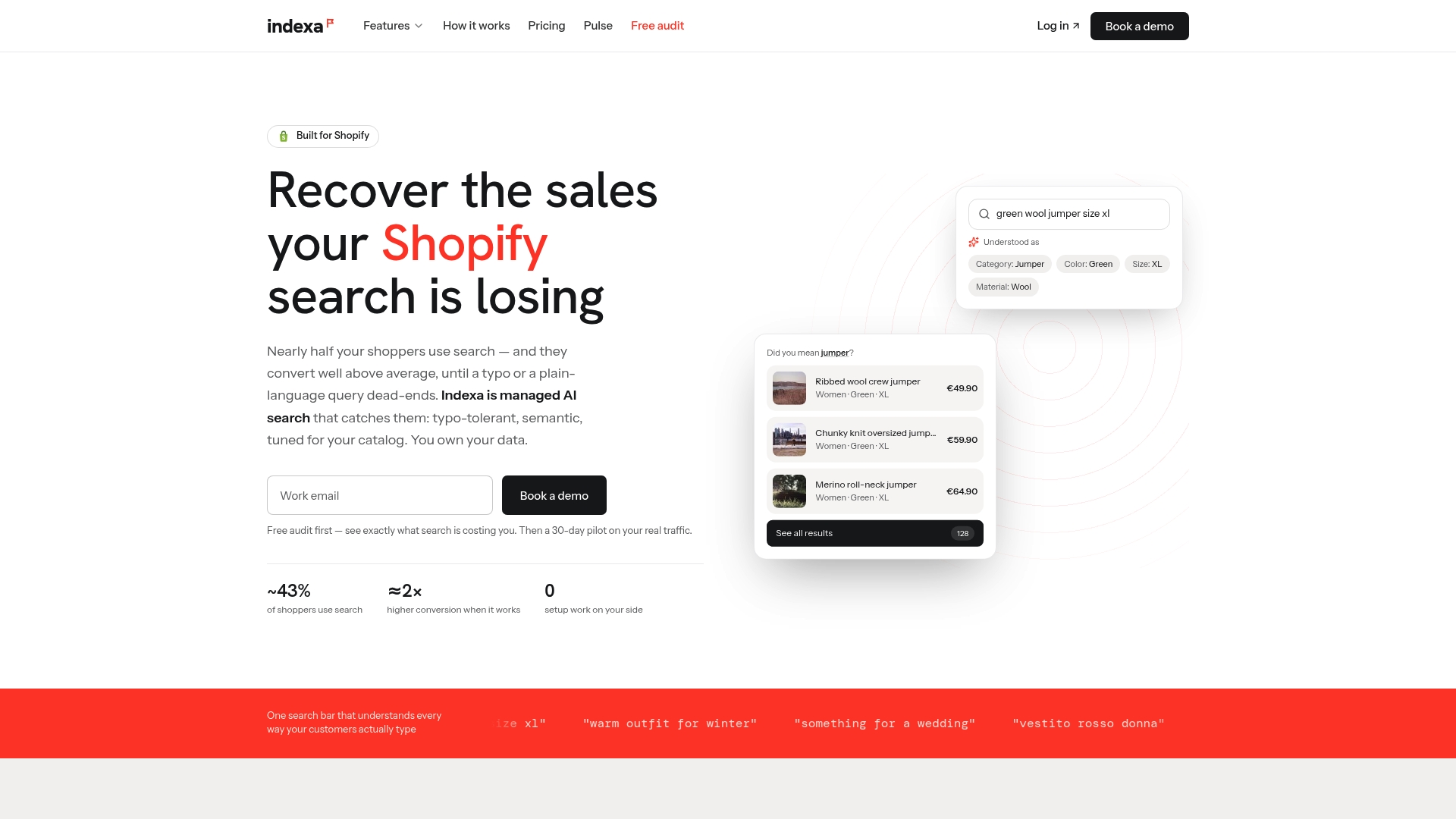
That is the real decision point, not whether to use GraphQL or how to structure the index. A small technical team can build the pipeline described above; keeping it accurate over time is the harder, less visible cost. Indexa runs a fully managed AI-driven search and discovery service for Shopify, built specifically around typo-tolerant and semantic search with no setup required on the merchant’s end. For a lean team, that ongoing tuning work is often the better argument for a managed service than the initial build ever is.
— Barikreativa
Next steps: audit, pilot, and migration help from Indexa
If you are not sure whether your search is actually leaking sales, start with a free Shopify search audit rather than committing to a rebuild. It flags zero-result spikes and merchandising gaps before you spend engineering time on a new index.
From there, a number of providers offer ways to move forward:
- Free audit: pinpoints where current search is losing shoppers before you commit to anything.
- 30-day pilot: validates real improvements on your own catalog and traffic before a full switch.
- Managed migration: Indexa activates in minutes with no setup on your end and keeps tuning relevance as your catalog changes.
Pricing for the pilot, setup, and monthly retainer is available on Indexa’s pricing page.
Sources
For implementation details, Shopify’s own Predictive Search API documentation covers suggestion limits and parameters engineers need before assuming feature parity with a new engine. If your migration touches broader site changes, the Ecommerce Replatforming and Migration Guide covers post-launch monitoring, and 4 to 8 week SEO migration planning covers redirect and ranking protection.
- Building a Custom Search Application for Shopify: Advanced E-commerce Search
- When to Replace Shopify’s Native Search (And With What) · 72Technologies
FAQ
What is a Shopify search migration exactly?
It is the process of moving your store’s product search index and configuration, including synonyms, relevance rules, and merchandising settings, to a new search engine while keeping Shopify as your storefront platform. It is not a full replatforming of your store.
How long should I run the old and new search in parallel?
Most staged rollouts move through 10%, 50%, and full traffic stages, with a rollback flag kept live for about 30 days after full cutover. That window gives merchandisers time to catch slow-developing issues before removing the fallback.
Should I index every product variant separately?
Index variants when attribute-driven queries exceed roughly 25% of search volume; otherwise, index products and surface variant attributes selectively, as recommended in Shopify search replacement guidance. Deduplicating variant records back to a single product card keeps results clean either way.
Does a search migration affect my Shopify SEO?
Search-index migrations are separate from the URL and sitemap changes that affect SEO, but general ecommerce migration guidance still applies if you touch site structure alongside the search change. Monitoring Search Console after any change to the storefront remains good practice.
Can Indexa handle the migration for me?
Indexa offers a fully managed AI search and discovery service built specifically for Shopify, including typo-tolerant and semantic search with no setup required from the merchant. A free audit is the usual starting point to see where current search is underperforming before moving to a pilot.
Recommended
Make discovery work harder.
See what your Shopify search could do better with a free, hands-on audit.
Get your free search audit