Shopify Plus Search: Use Native Until Zero-Result Rate Tops 3%
Run a search audit and enable Shopify Search & Discovery first. If your zero result rate exceeds 2–3%, this Shopify Plus guide shows when to upgrade,...

Shopify Plus Search: Use Native Until Zero-Result Rate Tops 3%
Start by auditing your search logs, then run Shopify’s native Search & Discovery app before spending a dollar on anything else. If not, or if your catalog and query volume have outgrown what the free app can tune, that’s your signal to evaluate a managed AI search service.
TL;DR:
- For high search volume, multilingual catalogs, or over 2-3% zero-results, native tools often require additional tuning, making third-party services more cost-effective.
- Shopify Plus exposes API queries that enable custom search features, but building a fully differentiated experience needs significant developer effort.
- Managed AI search services offer automatic relevance tuning, typo tolerance, and merchandising tools without extensive engineering, ideal for stores with complex catalogs and high revenue dependence on search.
- Evaluating search vendors requires checking update frequency, support quality, scalability, data ownership, and proven success over at least a year of live operation.
Table of Contents
- When Is Native Search & Discovery Enough for Shopify Plus?
- What Does Shopify Plus Expose Through the Storefront API?
- Third-Party Shopify Plus Search Apps: What You’re Actually Paying For
- How Do You Evaluate a Shopify Plus Search Vendor?
- Building Search for Hydrogen and Headless Plus Storefronts
- What KPIs Actually Prove a Search Upgrade Worked?
- What an Enterprise Search Practitioner Would Tell You
- Getting Shopify Plus Search Right Without the Engineering Lift
- Where These Recommendations Come From
- Sources
- FAQ
When Is Native Search & Discovery Enough for Shopify Plus?
Most Shopify Plus merchants overbuild before they’ve even tested what ships for free. Shopify Search & Discovery already handles synonym groups, boosted search terms, and control over how unavailable products appear in results. That covers a lot of ground for stores with a few thousand SKUs and predictable query patterns.
The decision hinges on scale and complexity, not preference. Run through this checklist before you touch a third-party app:
- Catalog size: For stores with a moderate catalog size, native tools usually keep pace. Past that, variant sprawl and combined listings start exposing gaps.
- Query volume: Low-thousands of searches per day rarely justifies enterprise tooling. High-volume stores need faster relevance tuning cycles than manual synonym edits allow.
- Revenue share from search: If search sessions drive a significant portion of revenue, even small conversion gains translate into real money.
- Internationalization: Multilingual catalogs or region-specific merchandising often outpace what native synonym mapping can handle cleanly.
- Zero-result rate and time to index: Anything above 2 to 3% zero-results, or noticeable lag between a product update and its appearance in search, points to a structural limitation.
Analysts covering search platforms consistently tell smaller stores to configure native tools fully before paying for enterprise search infrastructure, and the data backs that caution up. A lot of “we need enterprise search” conversations start before anyone has actually turned on synonyms.
Pro Tip: Pull your last 30 days of search terms and manually sort the top 50 by frequency. If more than a handful of return zero results or clearly irrelevant products, you have a tuning problem native tools can’t fix fast enough on their own.
What Does Shopify Plus Expose Through the Storefront API?
Shopify Plus gives developers direct access to the Storefront API, and two queries matter most for search: predictiveSearch and search. Understanding what each returns changes how you scope a build.

PredictiveSearch powers type-ahead as customers type, returning suggested products, collections, pages, and articles. It supports limitScope, which controls how results distribute across those resource types, and handling for unavailable products so a discontinued item doesn’t dead-end a search.
The Search query does the heavier lifting for full results pages. Key parameters include:
prefix: Enables partial word matching, so “runn” starts surfacing “running shoes” before the customer finishes typing.unavailable_products: Determines whether out-of-stock items show, hide, or appear last.productFilters: Returns available filter facets, which is what any custom faceted UI is built on.sort_byand relevance ordering: Controls how results rank beyond simple text match.
Here’s the part merchants underestimate: these queries give you raw building blocks, not a finished experience. Faceted filtering, type-ahead components, and merchandising logic all need custom development on top of the API. Shopify’s own enterprise guidance is direct about this — building a genuinely differentiated search experience through the Storefront API takes real developer time, especially for headless or Hydrogen storefronts where you’re rendering every result yourself.
Third-Party Shopify Plus Search Apps: What You’re Actually Paying For
Third-party and mid-market apps exist to close the gap between “functional search” and “search that sells.” The good ones earn their subscription fee in a handful of specific ways:
- Merchandising controls. Visual grid editors let merchandisers pin products, insert banners, and rearrange results without a developer ticket. This is usually the single biggest conversion lever, because it lets marketing react to inventory and promotions in real time.
- Faceted filtering at scale. Native filters can strain once you’re combining variants, metafields, and multiple filter dimensions. Third-party apps typically index differently to keep filter response times fast even on large catalogs.
- URL and SEO behavior. Filter combinations can generate enormous numbers of crawlable URL variants. Poorly configured apps create duplicate-content sprawl; well-configured ones use canonical tags and controlled indexing.
- Semantic search and typo tolerance. This is where “sneaker” finds “sneakers,” and “flannel shrit” still returns flannel shirts. Native search struggles here more than most merchants realize.
- Recommendations. Cross-sell and related-product modules often ride on the same relevance engine as search.
The trade-offs are real, though. Some apps add client-side script weight that slows page load. Reindex time after a catalog update can lag from minutes to hours depending on the vendor. And pricing rarely stays flat: many apps scale cost with query volume or catalog size, and the sales page price is often just the starting line before engineering hours get added for customization.
How Do You Evaluate a Shopify Plus Search Vendor?
Treat vendor selection like a real procurement exercise, not a features checklist. Ask specific, checkable questions before you sign anything.
- How often does the index update after a product or inventory change? Real-time sync matters more than most demos let on.
- Does it support metafields and combined listings natively, or does that require custom mapping work?
- What’s the actual support model? Onboarding help is common; ongoing relevance tuning as a standing service is rarer, and reviewers on platforms like G2 consistently say hands-on support matters more to merchants than raw AI marketing claims.
- How does pricing scale? Get a straight answer on whether cost tracks revenue, SKU count, or query volume, and whether engineering time is billed separately.
- Who owns the data? Analytics and index data ownership should be explicit in the contract, not assumed.
Feed accuracy deserves its own line item. Mismatches between your product feed and what a search app indexes have caused real merchant visibility problems on shopping surfaces, so ask exactly how sync errors get caught and resolved.
Pro Tip: Ask for two customer references who’ve been live for over a year, not six months. Relevance tuning problems tend to surface only after the honeymoon period.
Building Search for Hydrogen and Headless Plus Storefronts
Headless changes the math entirely. There’s no theme doing the heavy lifting anymore, so you’re building type-ahead components, faceted UIs, and result rendering directly against the Storefront API’s predictiveSearch and search queries.
Common pitfalls show up fast:
- Client-side rendering delays. If search results render only after JavaScript executes, both user experience and crawlability suffer.
- Filter URL sprawl. Faceted headless UIs can generate thousands of parameter combinations that need deliberate canonical and robots handling, something Shopify’s technical SEO guidance flags directly for merchants making this jump.
- Reindexing delays between catalog updates and search visibility, which compound in headless setups with custom caching layers.
- Sitemap and robots configuration that doesn’t automatically inherit from theme defaults the way it does on Online Store 2.0.
This is exactly the scenario where a managed service earns its keep. Managed AI search services can integrate with Shopify storefronts, including Hydrogen, without requiring merchants to build or maintain the search layer themselves. There’s no setup burden on the client side, and relevance tuning runs continuously against real store data instead of a one-time configuration.
What KPIs Actually Prove a Search Upgrade Worked?
Track three numbers before and after any search change: search conversion rate, revenue per search session, and zero-result rate. Everything else is secondary.
- Search conversion rate: Sessions that use search and complete a purchase, compared against sessions that don’t use search at all.
- Revenue per search session: Catches value even when conversion rate itself barely moves.
- Zero-result and abandonment rate: The clearest proxy for “customers who gave up looking.”
Run a genuine pilot rather than eyeballing a dashboard for a week. Give any change at least 2 to 4 weeks and a large enough sample to smooth out weekday and promotional noise, and track events at the query level, not just the session level, so you can isolate which search behaviors actually changed. Recoverable revenue gets calculated by comparing baseline zero-result sessions against the same query volume post-change, then applying your site’s average order value to the sessions that convert instead of bouncing.
What an Enterprise Search Practitioner Would Tell You
The DIY-versus-managed decision on Plus stores usually comes down to a resource question disguised as a technology question. Building custom search against the Storefront API is entirely doable, but it’s rarely a one-sprint project. Realistic headless builds run 6 to 12 weeks before relevance tuning even starts, and tuning itself is ongoing work, not a launch task you check off once.
Most teams underestimate that second part. A launched search feature that nobody revisits degrades quietly as the catalog changes. Before starting any upgrade project, get honest answers to three questions: What’s your actual zero-result rate today? Who owns relevance tuning after launch? And does that person have time for it next quarter, or is this the fifth thing on their list?
— Barikreativa
Getting Shopify Plus Search Right Without the Engineering Lift
Indexa is built for exactly the merchant profile that outgrows native tools fastest: high catalog complexity, meaningful revenue tied to search, and a dev team that has better things to do than rebuild relevance logic every quarter. Some managed search services activate with no setup required on the merchant’s side, provide typo-tolerant and semantic search, and keep tuning results against actual store data rather than a generic model.
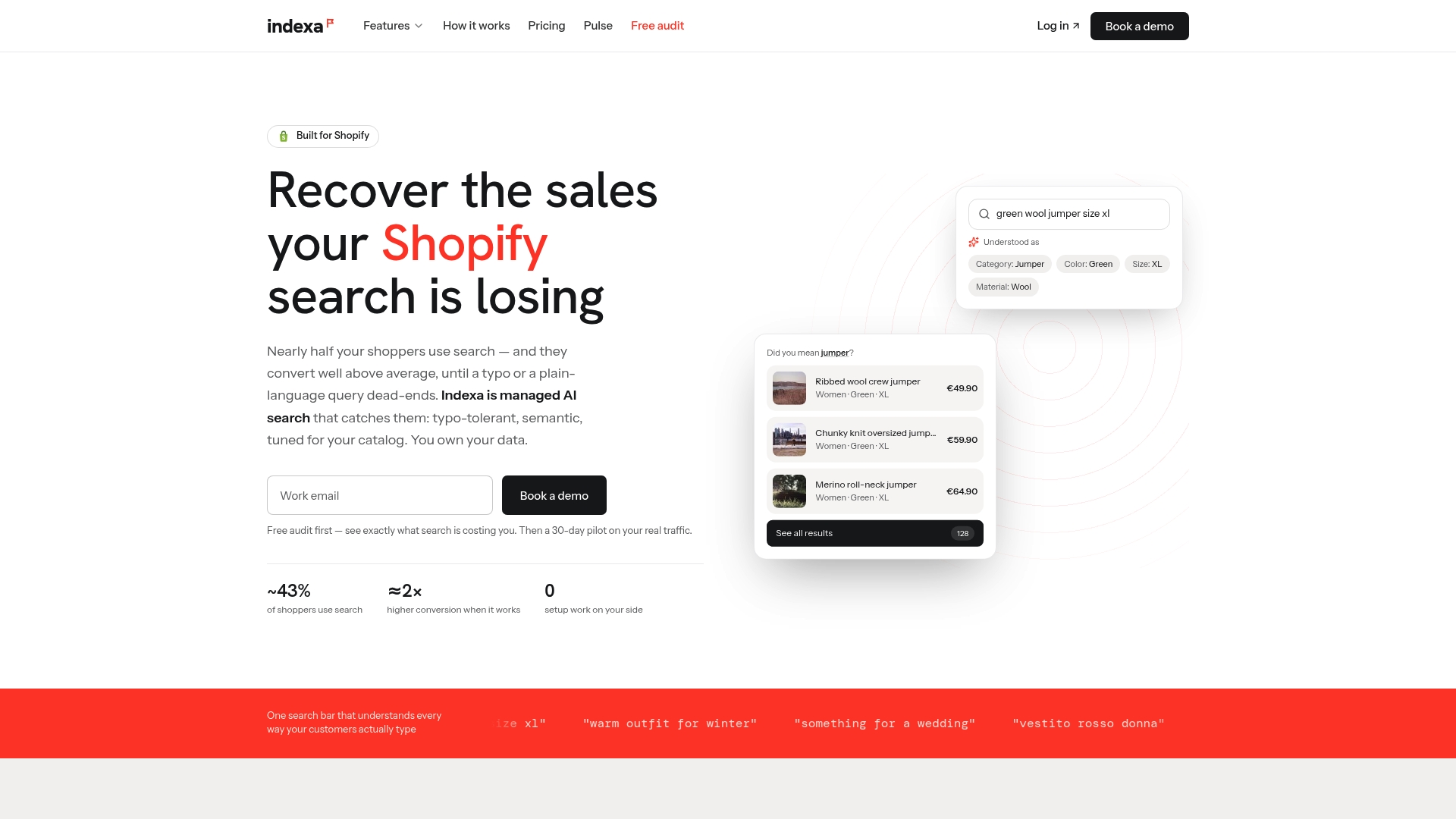
If your zero-result rate or search abandonment numbers looked rough in the audit checklist above, start with a free Shopify search audit to see where revenue is leaking. Merchants who want to test results before committing can run a 30-day pilot, and the full breakdown of merchandising tools, typo tolerance, and recommendations lives on the Indexa features page. For stores currently on Search & Discovery and wondering what an upgrade actually looks like, this comparison walks through the practical differences.
Where These Recommendations Come From
- PredictiveSearch — Shopify Storefront API: the reference for type-ahead behavior and scope controls.
- Search — Shopify Storefront API: the query definition for filters, prefix matching, and pagination.
- Search & Discovery configuration guide — Shopify Help Center: the native app’s synonym and boosting controls.
- Shopify enterprise blog on ecommerce APIs: guidance on custom and headless search builds.
- For broader technical SEO practices around search-driven URL structures, see this Shopify SEO automation resource.
Sources
- PredictiveSearch — Shopify Storefront API (2026-07)
- Modifying search with Shopify Search & Discovery — Shopify Help Center
- Shopify enterprise blog — ecommerce API
FAQ
What Does Shopify Plus Include for Search?
Shopify Plus includes the same native Search & Discovery app available on standard plans, plus full Storefront API access for custom search builds. The difference is scale: Plus stores typically have the catalog size and traffic volume where custom search development and third-party apps start paying off.
What Is the Best Search and Filter App for Shopify Plus Stores?
There’s no single best app across every store. The right fit depends on catalog size, query volume, and how much developer time you have available. For high-volume stores with limited engineering capacity, a fully managed option like Indexa removes the setup and ongoing tuning burden entirely, while mid-market apps suit teams that want more direct control.
Is Shopify Plus Still Worth It in 2026?
For merchants with complex catalogs, high traffic, or multi-market operations, Shopify Plus remains worth it largely because of what it unlocks technically, including full Storefront API access and headless flexibility through Hydrogen. The value shows up most clearly when a store actually uses those capabilities rather than running Plus like a standard plan.
How Do I Know if I’m on Shopify Plus?
Check your Shopify admin under Settings > Plan, where your current plan name is listed directly. Plus merchants also typically have access to a dedicated account team and features like the Shopify Flow automation tool that aren’t available on standard tiers.
How Much Does a Managed Search Upgrade Cost?
Pricing depends on your catalog size and setup needs, and current rates are listed on Indexa’s pricing page, which also covers the one-time setup fee and flat monthly retainer structure. A free audit is available first for merchants who want a specific recommendation before committing.
Recommended
Make discovery work harder.
See what your Shopify search could do better with a free, hands-on audit.
Get your free search audit