30 Day Audit to Recover Shopify Sales With Search Spell Correction
Run a 30 day audit to find zero result searches, fix high value typos, and recover lost Shopify sales. Checklist and a managed service option included.

30 Day Audit to Recover Shopify Sales With Search Spell Correction
Search spell correction is query-level typo tolerance and autocorrect that rewrites misspelled shopper queries so your product search still returns relevant results. It reduces zero-results pages and recovers sales you’re currently losing to typos, transpositions, and phonetic misspellings. The fastest first step is exporting your zero-results search log for the last 30 days and flagging your top misspelled queries, or requesting a free Shopify search audit to see exactly what’s slipping through.
TL;DR:
- Similar to the typical 19% of ecommerce searches that return zero results, most issues stem from misspelled queries rather than catalog gaps.
- Prioritizing high-value queries, such as those for expensive products or major brands, can yield greater recovery of potential revenue.
- Modern transformer-based spell correction outperforms traditional edit-distance methods, especially for phonetic and compound errors, but may require automatic fine-tuning.
- Shopify’s native typo correction is limited, fixing only some character swaps, and often underperforms on larger catalogs or complex search terms.
- Implementing managed AI search services rapidly improves typo tolerance and relevance without the ongoing engineering effort of building in-house solutions.
Table of Contents
- How Do You Audit Your Store for Typo-Related Search Losses?
- How Does Modern Spell Correction Actually Work?
- What Are Your Options as a Shopify Store?
- When Does Typo Tolerance Hurt More Than It Helps?
- Why Consider a Managed Search Service Instead of Building It Yourself?
- What Should You Fix First?
- Ready to See What Typos Are Costing You?
- Sources
- FAQ
How Do You Audit Your Store for Typo-Related Search Losses?
Before fixing anything, find out how much revenue is actually on the table. Most Shopify merchants have never looked at their zero-results log, which usually lives in Shopify’s search analytics or a connected tool like Google Analytics 4 event tracking.
Here’s the process that surfaces the real problem, not guesses:
- Export zero-results and low-click-through queries for the past 30 to 90 days, sorted by search volume.
- Label the top 25 to 50 queries by intent: is this a misspelled brand name, a SKU, a category term, or a product attribute like “sleveless”?
- Calculate a recovery rate by manually correcting each flagged query and checking whether relevant products exist in your catalog under the correct spelling.
- Estimate conversion delta by comparing the conversion rate of sessions that eventually found the right product against sessions that bounced after a zero-results page.
- Apply quick fixes first: synonym groups for common misspellings, compound-form variants (tshirt vs. t shirt), and basic normalization rules for punctuation and spacing.
Industry data puts this in perspective. Roughly 19% of ecommerce site searches return zero results, and a majority of those failures trace back to incorrect spelling rather than genuinely missing inventory. That’s not a rounding error. That’s a chunk of shoppers who wanted to buy and hit a wall instead.
One caveat worth building into your audit from day one: exclude short queries, SKUs, and exact model numbers from auto-correction candidates. A query like “SM450X” or “XL” doesn’t need fuzzy matching. It needs exact precision.

Pro Tip: Sort your zero-results list by estimated order value, not just volume. A misspelled query for a $200 jacket searched 40 times a month can matter more than a $15 accessory searched 200 times.
How Does Modern Spell Correction Actually Work?
Older typo tolerance runs on edit distance, counting how many character changes separate a typed query from a real word. It catches “shooz” to “shoes” easily enough, but it stumbles on phonetic misspellings, compound-word splits, and keyboard-layout errors where someone typed in the wrong input mode entirely.
Modern systems layer in transformer-based sequence-to-sequence models, the same family of architecture behind neural machine translation, trained to treat a misspelled query like a sentence that needs translating into its correct form. These models learn from:
- Synthetic data generation that mimics real user error patterns, weighting common mistakes (missing letters, adjacent-key swaps) more heavily than rare ones.
- Phonetic and transliteration augmentation for errors that sound right but are typed wrong.
- Query reformulation chains mined from real search logs, where a shopper searches “birkinstock,” gets nothing, then searches “birkenstock” seconds later.
- Weak supervision from corrected-query click behavior, which lets the system improve over time without manually labeling every example.
Research from ACL Industry 2023 confirms transformer models trained this way meaningfully outperform pure edit-distance matching on ecommerce queries. The trade-off is speed. Full transformer inference is too slow for real-time search at scale, so production systems typically apply pruning, quantization, or distillation to shrink the model without gutting its accuracy.
What Are Your Options as a Shopify Store?
Shopify’s native storefront search already includes some Shopify SEO Automation typo tolerance. It’s more limited than most merchants assume.
The built-in system corrects one misplaced letter or two swapped characters, but it requires the first four letters of the search term to match product data, and it’s scoped mainly to product titles and variants rather than tags or descriptions. Predictive search (the type-ahead dropdown) behaves slightly differently, and treats hyphenated or spaced terms differently than closed compound words, so “T-shirt” and “tshirt” don’t always match the same way.
From there, you have four realistic paths:
- Native Shopify search works fine for small catalogs with straightforward naming, but the four-letter prefix rule leaves plenty of real typos uncorrected.
- DIY tuning in a search engine like Elasticsearch or a Postgres full-text setup gives you control over fuzziness settings, prefix length, and field weighting, but demands ongoing engineering time.
- Preprocessing layers that catch keyboard-layout mismatches and transliteration errors solve cases fuzzy matching alone can’t touch.
- Managed AI services activate without engineering setup and get tuned continuously against your actual query traffic, trading a monthly fee for speed and no internal maintenance burden.
The right choice usually comes down to catalog size, in-house engineering bandwidth, and how fast you need results. A comparison of managed search versus Shopify’s native tools is worth reading before committing engineering hours to a DIY build.
When Does Typo Tolerance Hurt More Than It Helps?
Widening fuzzy matching too aggressively backfires. Broad tolerance can pull in loosely related products that technically match the corrected spelling but miss what the shopper actually wanted, and that drags conversion down instead of up.
A few guardrails keep the fix from becoming a new problem:
- Use fuzziness settings like Elasticsearch’s
fuzziness: AUTOpaired with a query-length threshold and aprefix_lengthof around 2, which cuts zero-results significantly while limiting false matches. - Turn off fuzziness entirely for SKU, barcode, and model-number fields, where a “close enough” match is actually a wrong product.
- Protect exact brand matches through normalization rules rather than letting fuzzy logic touch brand names.
- Show a “Did you mean?” suggestion for low-confidence corrections, and reserve silent auto-correct for matches above a set confidence threshold.
- Track zero-results rate, recovered-session conversion delta, and search latency as your core KPIs, and A/B test any fuzziness change before rolling it out storewide.
Field-aware ranking and catalog normalization matter more than raw fuzziness strength. A tightly scoped fix on the right fields beats a loose fix applied everywhere.
Pro Tip: If you widen fuzziness and your average order value drops even slightly, check whether fuzzy matching is now surfacing accessories or lower-priced substitutes instead of the exact item shoppers searched for.
Why Consider a Managed Search Service Instead of Building It Yourself?
Building transformer-based spell correction in-house means data science time, ongoing model retraining, and latency engineering most Shopify teams don’t have sitting around. That’s the gap managed services are built to close.
Indexa runs as a fully managed, Shopify-native search and discovery layer that combines typo-tolerant matching with semantic understanding of what a shopper actually means, not just what they typed. Activation requires no setup work on your end, and tuning continues in the background as real query data comes in.
What to expect and request during evaluation:
- Fully managed activation with native integration into Shopify storefronts, including Hydrogen builds.
- Typo-tolerant and semantic search combined, so a misspelled query and a naturally phrased query both get handled.
- Continuous tuning based on your store’s actual search behavior rather than a one-time configuration.
- Measurable pilot metrics you can request up front: recovered zero-results sessions, conversion delta, and an estimate of recoverable revenue.
A managed route makes the most sense when your catalog is complex, your engineering team is thin, or you need results in weeks rather than a quarter of internal development.
What Should You Fix First?
Chasing every misspelled query at once is a mistake. Start with your highest-revenue and brand or SKU-adjacent queries first, since those carry the clearest, most measurable ROI. Fix catalog quality issues, like inconsistent brand naming and missing attributes, before you widen fuzziness settings; a cleaner catalog often solves half the problem before a single algorithm change ships. Then iterate with real A/B tests, and tighten your guardrails the moment top-result relevance starts slipping, rather than waiting for a quarterly review to notice.
— Barikreativa
Ready to See What Typos Are Costing You?
You’ve read the mechanics. Now you can either spend the next quarter building fuzziness rules, prefix thresholds, and a synonym dictionary by hand, or hand the whole problem to a system already built for it. A managed AI search service activates on your Shopify storefront with no setup on your end, combining typo-tolerant and semantic search that keeps improving as it learns from your actual shoppers.
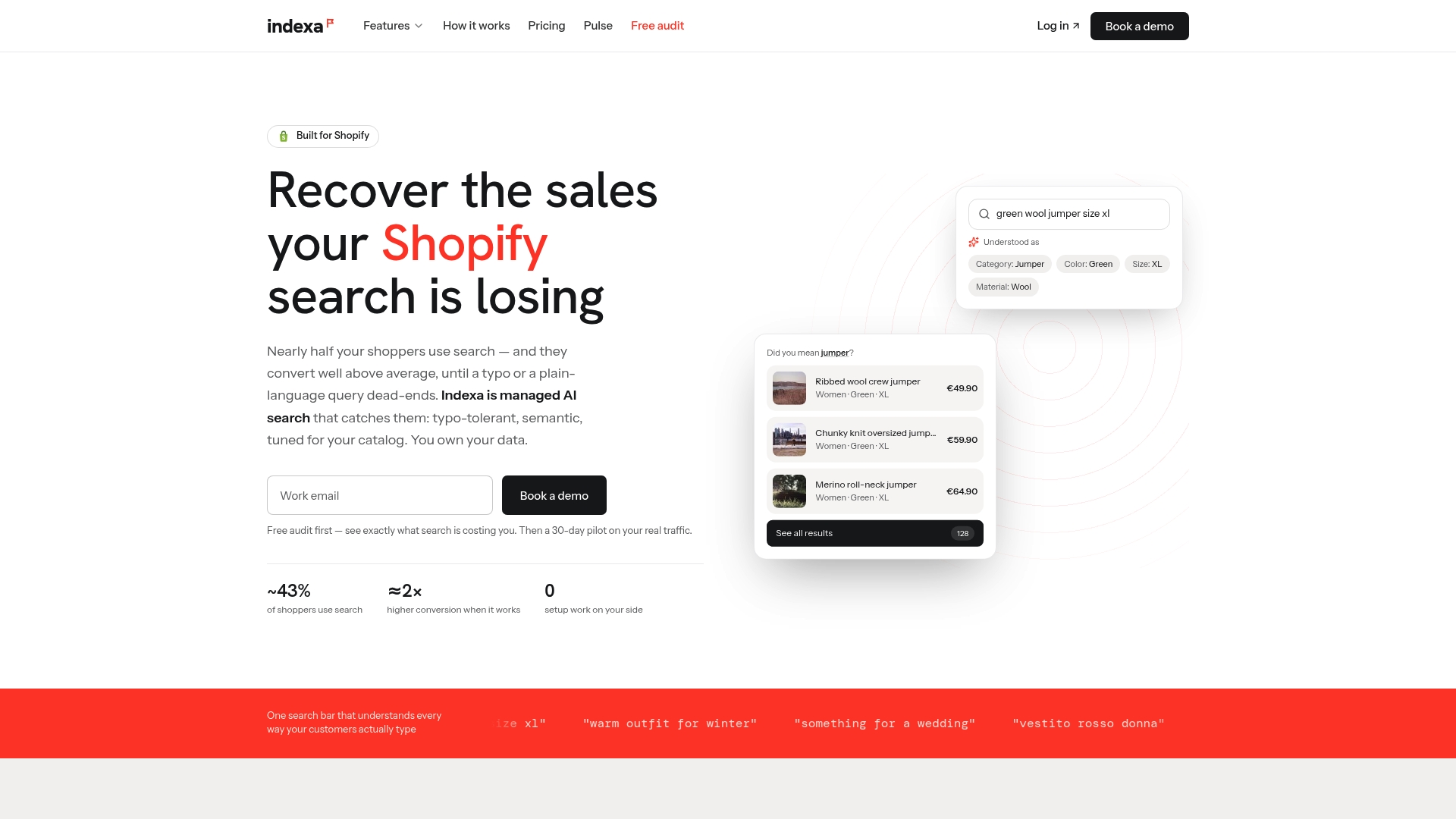
Start with the free Shopify search audit, which identifies your top zero-results drivers, flags the specific queries losing you sales, and estimates recoverable revenue before you commit to anything. From there, Indexa’s 30-day pilot gives you real numbers: conversion delta, reduced zero-results rate, and search latency, measured against your own traffic instead of a vendor’s demo store. Setup carries a one-time fee, and ongoing service runs on a flat monthly retainer, both listed on the pricing page. If the pilot doesn’t move your numbers, you’ll know within 30 days. Check your audit results here to get started.
Sources
- Shopify changelog — typo tolerance in storefront search
- ACL Industry 2023 — Transformer-based spell correction with synthetic and weakly supervised data
- Typo-Tolerant Product Search That Still Converts — FuzzyDirect
- Elasticsearch fuzzy search ecommerce — Ivan Ponamarev
- 90+ Ecommerce Site Search Statistics | 2026 ZipDo Report
FAQ
What Is Search Spell Correction in Ecommerce?
It’s query-level typo tolerance and autocorrect that rewrites a shopper’s misspelled search so your product search engine still returns relevant results. It differs from a general spell checker because it’s tuned specifically to product names, brands, and catalog vocabulary rather than dictionary words.
Does Shopify Have Built-In Typo Tolerance?
Yes, but it’s limited. Native Shopify search corrects one misplaced letter or two swapped characters, requires the first four letters of the query to match, and applies mainly to product titles and variants rather than tags or descriptions.
How Do I Know How Many Sales I’m Losing to Typos?
Export your zero-results search log, flag the top misspelled queries by volume and estimated order value, and calculate the conversion delta between sessions that found the right product and sessions that bounced. A free Shopify search audit can generate this analysis without engineering work on your side.
Can Typo Tolerance Ever Hurt Conversion?
Yes, if fuzziness settings are too broad. Loose fuzzy matching can surface unrelated products that technically match a corrected spelling but don’t match shopper intent, which lowers conversion instead of raising it. Field-aware ranking and confidence thresholds prevent this.
How Much Does Indexa Cost for a Shopify Store?
Indexa runs on a flat monthly retainer plus a one-time setup fee, both without a published rate since pricing depends on store size and catalog complexity. Current pricing is available on the Indexa pricing page.
Recommended
Make discovery work harder.
See what your Shopify search could do better with a free, hands-on audit.
Get your free search audit