Precision@10 to Sales: Test Search Relevance on Shopify
Test Shopify search relevance with Precision@10, MAP, and NDCG, then validate changes in live tests tracking zero results, clicks, and conversions.

Precision@10 to Sales: Test Search Relevance on Shopify
The fastest way to prove your Shopify search is getting better is to audit your query logs, run an offline Precision@10 check, and then confirm the result with a short live A/B test. Success looks like a lower zero-result rate, higher click-through on search results, and measurable conversion lift after a search query. Shopify’s native settings help, but they rarely close the gap alone.
TL;DR:
- Export 30 to 90 days of query logs and include long tail terms because top queries alone can miss catalog failures.
- Label 1,000 to 3,000 query product pairs, score Precision@10 and NDCG offline, then confirm gains with a controlled live test.
- Prioritize zero result queries, since they can represent buyers ready to purchase; track click through rate, conversion after search, and exits.
- Set a rollback threshold for rising null rates or falling conversions, and freeze catalog metadata during live tests to avoid contaminating results.
- For large or multilingual catalogs, ongoing managed tuning can replace quarterly manual relabeling when query volume or SKU growth outpaces audit capacity.
Table of Contents
- Quick Relevance Audit Checklist for Shopify Stores
- Which Relevance Metrics Actually Matter
- Offline vs Online Evaluation: When to Use Each
- A Practical Step-by-Step Test Plan You Can Run in 30 to 60 Days
- Why Continuous, Managed Tuning Is Often the Faster Route
- How Indexa Helps: Free Audit, 30-Day Pilot, and Next Steps
- FAQ
- Sources
Quick Relevance Audit Checklist for Shopify Stores
Before you touch a single setting, pull the data that tells you where search is actually failing. Export your top search queries and your zero-result terms from Shopify admin or your analytics platform, since that list is the shortest path to finding where shoppers are giving up.
From there, work through a short list of checks that typically surface the biggest wins:
- Audit product titles, tags, collections, and any manually assigned search terms for gaps against real customer language.
- Review Search & Discovery settings for semantic search eligibility, result-type configuration, boosts, and out-of-stock handling.
- Record baseline numbers for null rate, search click-through rate, conversion after search, and search exit rate so later changes have something to compare against.
- Test predictive search and autocomplete directly in your theme, since Shopify product filters and Liquid URL examples can show how theme overrides change result types even when your settings look correct.
- Check whether your native ranking, which weighs keyword frequency, field importance, and recent sales popularity, matches how shoppers actually search.
This pass usually takes a day or two and gives you a prioritized punch list before you commit to any deeper testing work.
Which Relevance Metrics Actually Matter
Two kinds of numbers matter here: offline metrics that score your search algorithm against a labeled dataset, and online metrics that show what real shoppers do. Precision@N measures what fraction of the top N results for a query are actually relevant, and Precision@5 or Precision@10 is the version most merchants should track because it mirrors what a shopper sees without scrolling.
MAP (mean average precision) and NDCG (normalized discounted cumulative gain) go a step further by rewarding relevant results that appear higher in the list, not just present somewhere on the page. Shopify Engineering recommends combining these offline metrics with online A/B testing before trusting any ranking change in production.
On the live side, track click-through rate on search results, conversion after search, null or zero-result rate, and how often shoppers refine or abandon a search session.

Null-result queries deserve first priority: Shopify’s own guidance notes that no-results pages often represent intent-ready buyers who simply couldn’t find a match, making them the fastest source of recoverable revenue.
A reasonable starting benchmark for most catalogs is a low null rate, a high Precision@10 on your top queries, and a measurable uptick in conversion after search once fixes ship.
Offline vs Online Evaluation: When to Use Each
Offline evaluation and live A/B testing solve different problems, and treating them as a sequence rather than a choice gets you to a trustworthy answer faster.
- Start offline with a labeled dataset of query-product pairs, scored on a binary or graded scale, and compute Precision@N, MAP, and NDCG to iterate quickly without touching live traffic.
- Keep labeling sets small and focused. A 1,000 to 3,000 pair sample is usually enough for a reliable offline signal.
- Once offline metrics improve, move to a controlled online A/B test with clear traffic assignment and predefined primary KPIs like conversion after search and click-through rate.
- Set rollout guardrails ahead of time: a defined rollback trigger, such as a null rate increase or a conversion drop past a set threshold, protects you from shipping a regression.
- Treat the online test as the final check, not a formality. Shopify Engineering’s framework treats offline gains as promising but unproven until a live test confirms them.
This two-step approach keeps iteration cheap while making sure nothing reaches every shopper until it’s actually validated.
A Practical Step-by-Step Test Plan You Can Run in 30 to 60 Days
A relevance testing program works best as a fixed calendar, not an open-ended project. Here’s a version built for a Shopify store with moderate query volume:
- Days 1 to 10: Pull 30 to 90 days of search logs, isolate your top-failure queries (highest volume with zero results or high exit rates), and sample a representative set across head and long-tail terms.
- Days 10 to 20: Label 1,000 to 3,000 query-product pairs for offline scoring, then run Precision@N and NDCG against your current setup to establish a real baseline, not a guess.
- Days 20 to 35: Implement targeted fixes, whether that means adding synonyms, adjusting boosts, fixing out-of-stock behavior in Search & Discovery, or updating product metadata as described in our guide to fixing common Shopify search failures.
- Days 35 to 50: Run a focused A/B test on a defined percentage of sessions, with conversion after search and click-through rate as your primary metrics and a predefined minimum detectable effect set before you start.
- Days 50 to 60: Build a recurring monitoring dashboard tracking null rate, CTR, and conversion after search, and schedule a monthly review so regressions get caught before they compound.
Pro Tip: Freeze your catalog metadata changes during the live test window, since an unrelated bulk edit can quietly contaminate your results.
Improving your underlying product copy and structure, as recommended for AI-driven discovery readiness, tends to pay off in both this test cycle and your broader SEO, since semantic clarity in product data helps both systems read your catalog the same way.

Why Continuous, Managed Tuning Is Often the Faster Route
Running this cycle manually works, but it demands ongoing attention: catalogs grow, seasonal queries shift, and a fix that worked in March can regress by August. Continuous tuning catches these drifts automatically, which matters most for large or multilingual catalogs where manual relabeling every quarter isn’t realistic. Merchants typically move from DIY testing to a managed approach once query volume or SKU count makes manual audits too slow to keep pace with actual shopping behavior.
— Barikreativa
How Indexa Helps: Free Audit, 30-Day Pilot, and Next Steps
We built our managed search service for merchants who want the testing framework above applied to their store without running every step themselves. Our team activates typo-tolerant and semantic search with no setup required on your end, then keeps tuning relevance against your real query data on an ongoing basis.
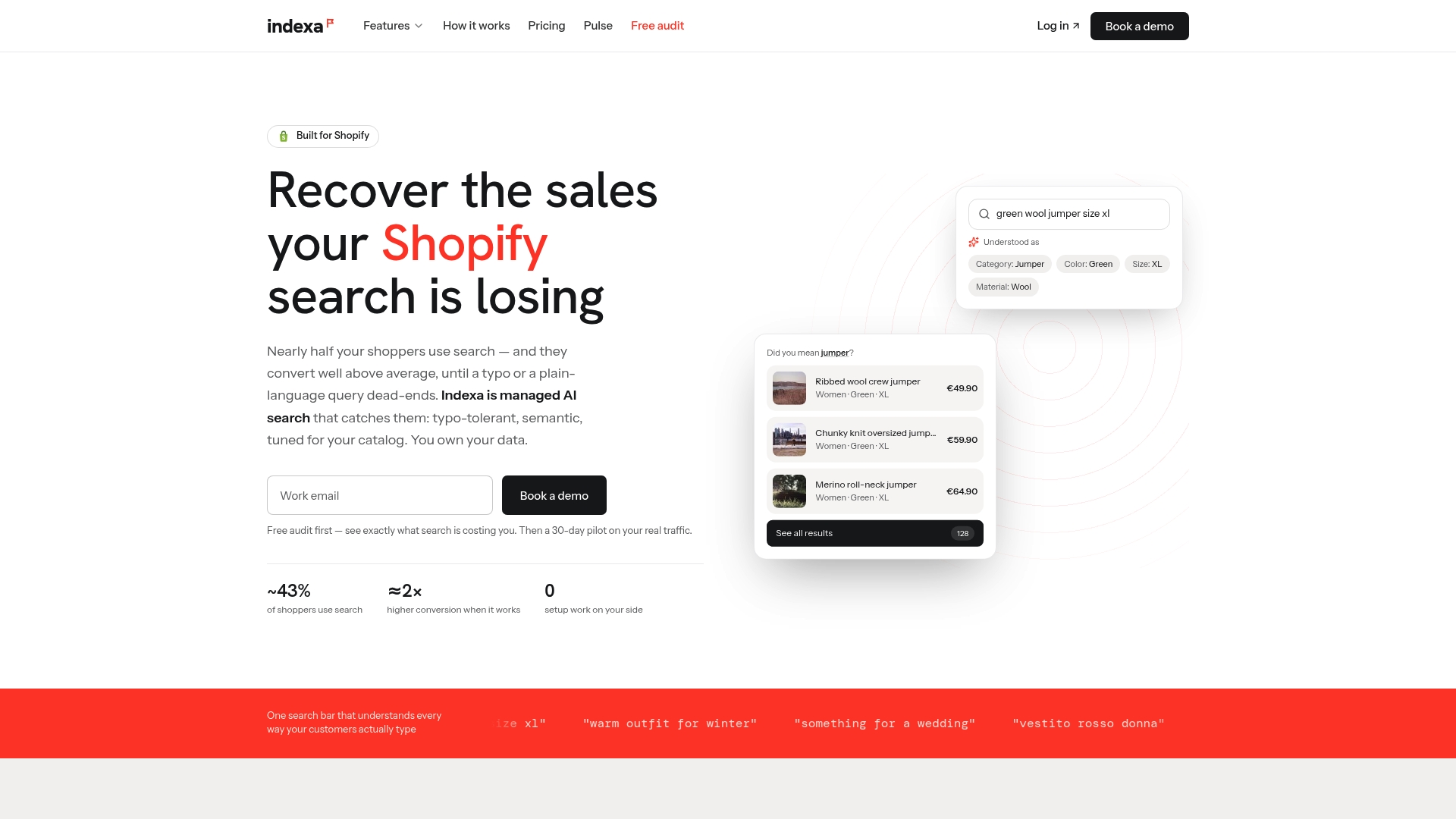
If you’d rather see where your search is losing shoppers before committing to anything, start with our free Shopify search audit, which reviews your query logs and highlights the fixes with the biggest expected impact. From there:
- Our 30-day pilot lets you test managed relevance tuning on live traffic before signing a longer agreement.
- Setup activates in minutes, with a one-time setup fee and a flat monthly retainer billed month to month.
- Ongoing tuning continues automatically as your catalog and query patterns change.
Visit Indexa to start your audit or request pilot access.
FAQ
What is search relevance testing for Shopify stores?
Search relevance testing is the process of measuring whether shoppers find what they’re searching for on your Shopify storefront, usually through offline metrics like Precision@N and live metrics like conversion after search. It combines a one-time audit of query logs with an ongoing test cycle to confirm fixes actually improve outcomes.
How do I calculate Precision@10 for my Shopify search?
Precision@10 is the share of relevant products among the top 10 results for a given query, scored against a labeled dataset of query-product pairs. Shopify Engineering recommends labeling a focused sample, often 1,000 to 3,000 pairs, then averaging the score across your top queries.
What causes “no results found” errors on Shopify?
Zero-result pages are usually caused by missing synonyms, typos the search engine can’t tolerate, or overly strict filtering rather than an actual lack of inventory. Shopify’s own guidance points to typo tolerance, synonym dictionaries, and query relaxation as the main fixes, and these null queries are often the fastest source of recoverable revenue.
Does Shopify’s native search need third-party help?
Shopify’s built-in search ranks by keyword frequency, field importance, field length, and recent popularity signals, which works reasonably well for small, simple catalogs. Larger or more complex catalogs often need semantic search, synonym mapping, or managed tuning to close the gap between what shoppers type and what’s actually in stock.
How much does a managed search service for Shopify cost?
Pricing for a managed service like ours is structured as a one-time setup fee plus a flat monthly retainer, both available on request through our pricing page. A free audit and a 30-day pilot are also available for merchants who want to see expected impact before committing.
Sources
Your query logs live in a few places: Shopify admin reports, your analytics platform’s site search tracking, and any search app’s own dashboard. Pulling all three into one spreadsheet is the only way to see the full query-to-outcome picture.
A few sources and tool categories cover most of what you need:
- Shopify Help Center | Modifying search with Shopify Search & Discovery
- Building Smarter Search Products: 3 Steps for Evaluating Search Algorithms - Shopify Engineering
- How To Fix ‘No Results Found’ Ecommerce Pages (2026) - Shopify
- Shopify SEO & AI readiness playbook - Search Engine Land
Session and order linkage matters more than most merchants expect: without tying a search session to the eventual order, you can’t calculate conversion after search with any confidence. Pulling a representative sample, not just your top ten queries, catches long-tail failures that otherwise go unnoticed, including the predictive search edge cases covered in our breakdown of Shopify predictive search limits.
Pro Tip: Export at least 90 days of query logs before labeling anything, since seasonal terms can quietly skew a smaller sample.
Recommended
Make discovery work harder.
See what your Shopify search could do better with a free, hands-on audit.
Get your free search audit