Pull Your Top 50 Queries Before Adding Shopify Search Banners
Add Shopify search banners only after fixing synonyms, boosts, and filters. Follow a practical implementation checklist, measure results, and request a...

Pull Your Top 50 Queries Before Adding Shopify Search Banners
A search merchandising banner is a promotional or guidance panel placed inside your Shopify store’s search experience, either in the predictive dropdown or on the results page. Add one when you need to promote a campaign, rescue a zero-results query, or steer a shopper through an ambiguous term; skip it if the real problem is that your synonyms, boosts, or filters are not tuned yet.
TL;DR:
- Search banners are best suited for seasonal promotions or recovery efforts, not to fix underlying vocabulary mismatches or ranking issues.
- Implement banners on both predictive dropdowns and results pages only after confirming theme support and fine-tuning Shopify Search & Discovery controls.
- Use clear, concise copy with visual cues like product thumbnails and ensure accessibility for mobile and screen reader users to increase conversion.
- Measure banner effectiveness by tracking impressions, click-throughs, and search-to-order metrics, tagging each campaign for accurate analysis.
- Prioritize fixing synonyms and boosting relevant queries before deploying banners to avoid masking underlying relevance problems.
Table of Contents
- What search merchandising banners are and how they fit Shopify’s search
- When to use banners vs. synonyms, boosts, or filters
- How to implement banners on Shopify
- Design and copy best practices for search banners that convert
- Measuring banner effectiveness and instrumentation
- Common pitfalls and no-results recovery patterns
- How a managed search service treats banners and relevance together
- The order we’d actually follow on a live store
- Get a managed search layer without rebuilding your theme
- FAQ
- Sources
What search merchandising banners are and how they fit Shopify’s search
Shopify search works in two layers, and confusing them is the most common merchandising mistake. Predictive search, the dropdown that appears as a shopper types, is a distinct surface from the full results page a shopper lands on after hitting enter. Both can carry a banner, but they behave differently and need separate planning.
Underneath both surfaces sits Shopify Search & Discovery, which controls what actually ranks: synonyms map vocabulary, assigned search terms (boosts) push specific products up, filters narrow by option or metafield, and recommendations fill gaps. A banner never replaces these controls. It sits on top of them.
- Predictive search returns query, product, collection, and page suggestions before a shopper submits anything.
- Search & Discovery handles ranking through synonyms, boosts, filters, and recommendations.
- Banners add a creative or promotional layer on either surface, but they work best once ranking is already correct.
Plan banners to reinforce native controls, not patch around broken ones.
When to use banners vs. synonyms, boosts, or filters
Every search merchandising decision starts with diagnosing the problem correctly. A banner solves the wrong problem as often as it solves the right one, so match the symptom to the fix before building anything.
- Vocabulary mismatch (shoppers search “sneakers,” your catalog says “trainers”): fix with synonyms, not a banner.
- Business-driven ranking (you want a specific product line to appear first for a category term): fix with assigned search terms (boosts).
- Campaign or seasonal discovery (you want to highlight a holiday collection or clearance event): a banner is the right tool.
- Zero-results queries: pair a banner with a broader recovery pattern, not a banner alone.
Good banner candidates include a seasonal collection push, a clearance or no-results redirect to in-stock alternatives, and a size or fit guide for apparel queries that tend to return mismatched results.
Pro Tip: Pull your top 50 search queries and your full zero-results list before deciding where a banner goes. A banner built on a guess rarely earns its shelf space.
How to implement banners on Shopify
Before writing any code, confirm three things: your theme supports predictive search rendering, you know the predictive section’s section_id, and your Search & Discovery settings are already tuned for the queries you plan to target. Skipping this step is the fastest way to ship a banner that fights your own filters.
For the predictive dropdown, Shopify’s predictive search documentation describes fetching suggestions from the /search/suggest endpoint using a section_id and rendering the response into your theme’s dropdown markup. A banner here needs to be injected into that rendered HTML, typically as a conditional block that appears for specific query patterns or campaign keywords, never as a blocking overlay that delays suggestion rendering.
For the results page, the more common approach, add a Liquid conditional to your search template that checks the submitted query or the result count. A zero-results condition can swap in a recovery banner with links to top collections; a matched campaign keyword can swap in a promotional banner with a filtered collection link.
- Confirm theme and predictive search compatibility before building.
- Use
section_idto fetch and render predictive markup safely. - Add Liquid conditionals on the results template for query matching or zero-results detection.
- Build a fallback for themes or headless storefronts where predictive rendering is handled outside Liquid.
Watch for the predictive suggestion limit (10 by default) and plan for discontinued or out-of-stock products appearing in banner-linked collections.
Design and copy best practices for search banners that convert
A search banner has seconds to earn attention, so clarity beats cleverness every time. State the destination plainly: “Shop Fall Jackets,” not a vague tagline, and keep the copy to a single clear call to action.
- Name the destination explicitly: collection, filtered view, or sale, never an abstract phrase.
- Include a small product thumbnail when space allows; it gives shoppers a visual anchor before they click.
- Respect mobile constraints: keep banner height compact and tap targets large enough for a thumb, not a cursor.
- Build in keyboard focus states and ARIA labels so screen reader users and keyboard navigators can reach the CTA.
- Provide a non-JavaScript fallback link for any banner that depends on dynamic rendering.
Pro Tip: Test your banner’s tap target and contrast on an actual phone, not a resized browser window. Predictive dropdowns are often the first thing squeezed when screen space runs out.
Measuring banner effectiveness and instrumentation
A banner without instrumentation is a guess you can’t correct, so you can use Shopify SEO on Autopilot to help measure and analyze banner impact accurately. Treat every banner as a hypothesis and tag it so you can prove or kill it within weeks, not quarters.
- Track banner impressions and click-through rate for every placement, predictive and results page separately.
- Measure search-driven add-to-cart rate and conversion rate for sessions that started with a banner click.
- Watch average order value for banner-originated sessions against your store baseline.
- Track zero-result rate, query refinement rate, time-to-first-product-click, and bounce rate from search pages as secondary signals.
- Tag every banner with a campaign ID so analytics can isolate its effect from simultaneous synonym or boost changes.
Nearly half of sites fail to recover shoppers effectively after a zero-results search, according to Baymard’s no-results research, which makes instrumentation around that moment one of the highest-leverage places to measure.
Fire analytics events separately from the predictive dropdown and the results page, since shopper intent differs between the two, and compare cohorts before and after any synonym or boost change to isolate what actually moved the number.

Common pitfalls and no-results recovery patterns
A banner alone rarely fixes a zero-results problem. Baymard’s research outlines five recovery patterns that work together: related categories, alternate searches with visual previews, personalized recommendations, support or contact links, and popular products. A banner can carry one of these, but relying on a single static banner to cover every failed query leaves shoppers stuck.
- Offer related categories instead of a dead end when a query returns nothing.
- Show alternate search suggestions with product previews, not just text links.
- Surface personalized or popular product recommendations as a fallback.
- Include a visible support or contact link for shoppers who can’t find what they need.
- Treat the banner as one layer in a multi-path recovery strategy, not the whole strategy.
| Recovery pattern | Best used for |
|---|---|
| Related categories | Broad or mistyped queries with no exact match |
| Alternate search previews | Queries close to an existing product or collection |
| Personalized recommendations | Returning shoppers with browsing history |
| Support or contact links | Highly specific or out-of-catalog queries |
| Popular products | New or anonymous sessions with no signal |
The fastest remediation roadmap: deploy a recovery banner for your top zero-results queries, add synonyms for the recurring ones, then monitor the analytics in the section above to confirm the fix held.
How a managed search service treats banners and relevance together
We built Indexa to put relevance fixes first and treat banners as a layer on top, not a substitute. Before any merchandising creative goes live, our managed AI search and discovery service applies typo tolerance, semantic matching, and synonym mapping so the underlying query interpretation is already correct, then continuously retunes based on real store search data.
Our free Shopify search audit reviews your current zero-results rate, your highest-volume unmatched queries, and whether your existing filters and boosts are doing their job, before recommending where a banner would actually help. Merchants typically get a prioritized list: which queries need a synonym, which need a boost, and which are genuine campaign or recovery opportunities for a banner. No setup work is required on your end to request such a service.

The order we’d actually follow on a live store
If we were fixing one store’s search this week, we would not start with banners. We would pull the zero-results and top-query reports first, fix synonyms and boosts for the queries that affect the most sessions, then layer in banners only for genuine campaigns or leftover recovery gaps. Banners built before that audit tend to mask a relevance problem instead of solving it, and that gap shows up again the moment the campaign ends.
— Barikreativa
Get a managed search layer without rebuilding your theme
Fixing synonyms, boosts, and banners in-house works, but it takes ongoing attention most merchant teams don’t have time to give every week. We run that tuning continuously as a managed AI search and discovery service, so typo tolerance, semantic matching, and merchandising stay current without you touching Liquid every time a campaign changes.
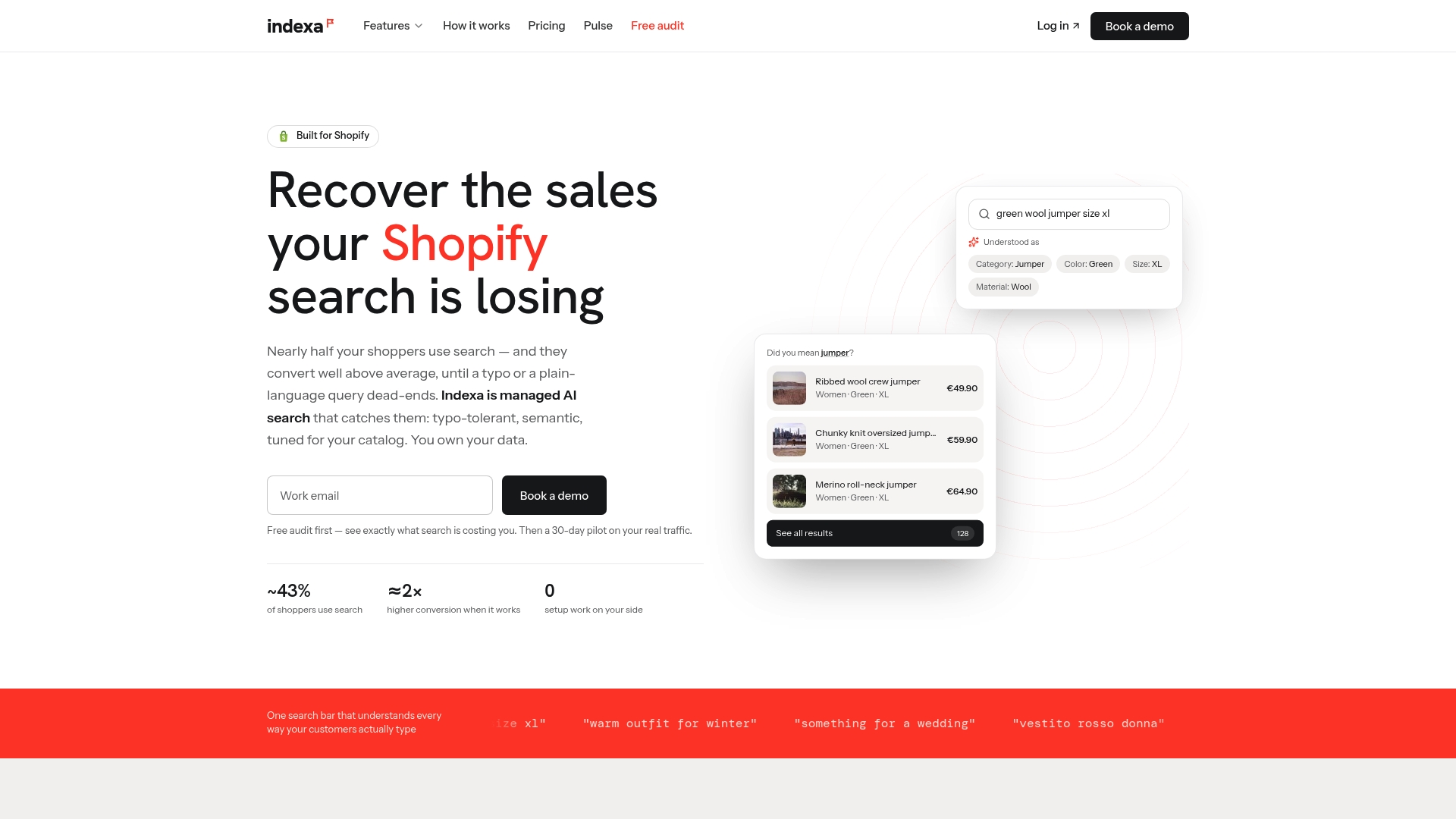
If you want a clear picture of where your search is losing shoppers before you commit to anything, start with our free Shopify search audit. It flags your zero-results queries and relevance gaps directly, the same ones this article walks through fixing.
- Request a free audit to see your current zero-results rate and unmatched queries.
- Start a 30-day pilot if you want the tuning and merchandising running on your store directly.
- These services typically activate quickly with no setup work required on your end, and provide ongoing tuning as your catalog and queries change.
A managed engagement runs on a flat monthly retainer plus a one-time setup fee, both listed on our pricing page, with no per-request charges.
FAQ
What is a search merchandising banner on Shopify?
It’s a promotional or guidance panel placed inside your store’s search experience, either in the predictive dropdown while a shopper types or on the submitted results page. It’s used to promote a campaign, recover a zero-results query, or guide an ambiguous search term toward the right products.
Should I fix synonyms before adding a search banner?
Yes. Shopify’s Search & Discovery guidance treats synonyms and boosts as the foundation for query interpretation and ranking, with banners as a creative layer on top. Adding a banner before fixing a vocabulary mismatch usually masks the problem instead of solving it.
How do I recover from zero-results searches?
Baymard’s research recommends combining related categories, alternate search previews, personalized recommendations, support links, and popular products rather than relying on a single banner. Nearly half of sites fail to do this well, which makes it one of the highest-impact fixes available.
Can I add a banner to Shopify’s predictive search dropdown?
Yes, through the Predictive Search API’s section_id rendering pattern described in Shopify’s predictive search documentation. It requires theme support for predictive rendering and a fallback for storefronts that handle search outside Liquid.
Does Indexa replace Shopify’s native search banners?
Our managed service focuses on relevance first: typo tolerance, semantic search, and synonym tuning, with merchandising and banner-style promotion available as part of the same platform. It’s designed to complement or replace parts of native Search & Discovery depending on what your store needs, as detailed on our comparison page.
Sources
Recommended
Make discovery work harder.
See what your Shopify search could do better with a free, hands-on audit.
Get your free search audit