Search Intent Detection: How Online Stores Read Shoppers
Search intent detection explained for Shopify merchants: the intent types, how stores classify queries, how to measure the gain, and what it means for sales.

Search Intent Detection: How Online Stores Read Shoppers
Search intent detection is the process of working out what a shopper wants from the words they type: a specific product, a category to browse, a comparison, a help page or a brand. For a store, it decides whether a query like “black dres size 12” shows relevant products or an empty page. On Shopify, this is where managed search pays off, because we handle query understanding, typo tolerance and ongoing tuning for you with no setup on your side.
TL;DR
- Search intent detection labels each query with a goal (find a product, browse, compare, get help) so the store can return the right results or page.
- Shoppers type misspellings, short fragments and natural language, so matching keywords alone misses many of them.
- Large retailers run intent models in production. Published studies report measurable gains in click-through and add-to-cart rates.
- You can measure the effect on your own store with a query sample and a controlled test.
- Indexa is a fully managed search service for Shopify that includes typo-tolerant and semantic search, with ongoing tuning based on your store data.
Table of Contents
- What search intent detection means for a store
- The four intent types shoppers express
- Why classification is harder than it looks
- How query intent classification works
- What a store does with detected intent
- How to check whether your search understands intent
- What this means for a small fashion brand
- Our view: intent is a catalog and data problem first
- See it on your own store
- FAQ
- Sources
What search intent detection means for a store
The phrase covers three different jobs, and it helps to keep them apart.
SEO intent analysis asks why people search on Google and what page type should rank. One academic study of the SEO perspective clusters queries by scraping Google results rather than predicting intent from the query alone. If you want background on grouping queries this way, cluster analysis in SEO shows how keyword groups are built.
Conversational AI intent detection classifies chat messages so a bot can route a request.
On-site query classification is the one that matters for your revenue. A survey from IIT Bombay describes it as determining the underlying goal behind a text query, paired with entity extraction. In a fashion store, “nike running shoes” yields the brand “nike” and the product type “shoes”, and those feed the ranking of results.
The rest of this article is about that third job.
The four intent types shoppers express
Shopify’s guide names four main types: informational, navigational, transactional and commercial. Its examples show the pattern.
| Intent | What the shopper wants | Example query | Best result |
|---|---|---|---|
| Informational | To learn something | how to choose running shoes | Guide or help page |
| Navigational | A specific brand or page | nike running shoes | Brand or collection page |
| Commercial | To compare before buying | best moisturizer for dry skin | Category page with filters |
| Transactional | To buy now | buy nike air max 90 | Product page |
The mapping of intent to page type comes from EcomSEO’s guidance. Signals include question words, brand names, buying or discount terms, and review or comparison words.
Store search has extra patterns. Returning buyers often search with brand names, product variations or replacement terms, and queries for refills, accessories or upgrades signal familiarity with the product. In fashion, look for size, color, fit and occasion words (“linen shirt for a beach wedding”). Those mix product attributes with a use case, which keyword matching handles badly.
Why classification is harder than it looks

A classic study of more than five million queries found that over 80% of web queries were informational, with roughly 10% each navigational and transactional. It also found that about a quarter of queries were vague or multi-faceted, which is why modern systems score probabilities instead of forcing one label.
On a store, the difficulty shows up in four ways:
- Ambiguity. “Jordan” could be a sneaker brand or a gift. A query may relate to multiple categories, and the same query can mean different things in different situations, as a CIKM 2019 paper on e-commerce classification notes.
- Tail queries. Rare, long queries are noisy and have little click history to learn from, the same paper explains.
- Misspellings. “Jaket” or “sweter” still carries a clear intent. A system that does not correct it returns nothing.
- Broad versus specific. “Running gear” spans many categories, while “running shoes” is narrow. Research on multi-label query classification points to the subjectivity of labels for broad queries like these.
How query intent classification works
Brave’s glossary outlines a five-step pipeline: define the intents, gather examples, turn the query into embeddings (numeric representations of meaning), classify with a confidence score, and route or act. When confidence is low, the system falls back to a safe default or asks a clarifying question. The same source notes that large language models can now classify from intent descriptions alone, without labeled training examples.

The Home Depot’s published architecture shows a practical shape. The first layer separates product-purchase from informational intent. Purchase queries are then classified as broad or specific, and informational ones by type of information, so users land on the right page.
Model size matters for speed. One 2022 paper describes a model at about 10% of BERT-base’s size so it can serve queries cheaply on CPUs, with gains in both offline tests and the live system. A store search has milliseconds to answer, so intent detection has to be fast as well as accurate.
What a store does with detected intent
Detection is only useful if it changes what the shopper sees. The main levers:
- Retrieval. Extract the brand, product type, color and size from the query and match them to your catalog fields rather than to title text alone.
- Ranking. Put the products that fit the dominant intent first. A specific query should surface exact matches. A broad one should surface a spread of bestsellers and categories.
- Landing pages. Send navigational queries to a brand or collection page, and informational queries to a guide.
- Filters. Pre-apply attributes the shopper already typed so they do not have to select them again.
- Synonyms. Map shopper language (“trainers”, “sneakers”) to your catalog terms.
We cover the mechanics in more depth in how search reads shoppers, and the matching approach in semantic versus keyword search.
How to check whether your search understands intent
You do not need a research lab to find out. A practical routine:
- Pull 100 to 300 real queries from your search analytics, including zero-result and high-exit ones.
- Label each by intent (product, category, brand, informational, vague) and note the result you would want the shopper to see.
- Score the first page of results. Precision@10, the share of the top ten results that are relevant, is a simple measure. Our guide to testing relevance on Shopify walks through it.
- Group the failures. Typos, synonyms, attribute queries and natural-language queries usually fail for different reasons.
- Test fixes against a control. Our piece on search A/B testing explains how.
Research teams use the same logic at scale. Flipkart’s team had experts label a 900-query golden set, then ran an online experiment in which their intent model achieved a 3.03% gain in click-through rate and a 15.45% gain in add-to-cart ratio. Those are one marketplace’s results, not a promise for any store, but they show the effects are measurable in clicks and carts, not only in relevance scores.
If you want a quick read on your own store, the free Shopify search test is a starting point, and the search audit checklist lists what to look at.
What this means for a small fashion brand
Large marketplaces have teams building intent taxonomies with more than 1,000 distinct intents, as one 2025 paper describes for an e-commerce platform. A small Shopify brand will not build that, and does not need to. Your catalog is smaller and your query set is narrower, so the highest-value work is concentrated:
- Fix spelling and plural variations, so intent survives typing errors. See spell correction for Shopify search.
- Map the words your shoppers use to the words in your catalog.
- Handle long-tail queries, which each look rare but add up. See long-tail queries on Shopify.
- Control what appears first for your top queries using a merchandising grid.
This is the work Indexa takes off your hands. Our service is fully managed: installation and ongoing tuning with no required setup or coding, typo-tolerant and semantic search, synonym mapping, a visual merchandising grid editor for search and category pages, and integrated analytics. See the query understanding feature for the details.
Our view: intent is a catalog and data problem first
We approach intent detection from the store’s side of the screen. A shopper never thinks about intent categories. They type three words and expect the right products.
That is why we tune relevance on real store data: your queries, your catalog and your results. Merchants keep ownership of their data, and the service is billed monthly without per-request fees, so improving search does not mean worrying about query volume.
Our approach is to fix the data first, then run a 30-day pilot to see what changes. A managed service means that tuning keeps going as your catalog and your shoppers change, rather than stopping after a one-off configuration.
Barikreativa
See it on your own store
Indexa starts with a free audit of how your search handles real queries. From there you can run a 30-day pilot. Setup fee and flat monthly retainer details are on the pricing page. We also support migration from other search platforms.
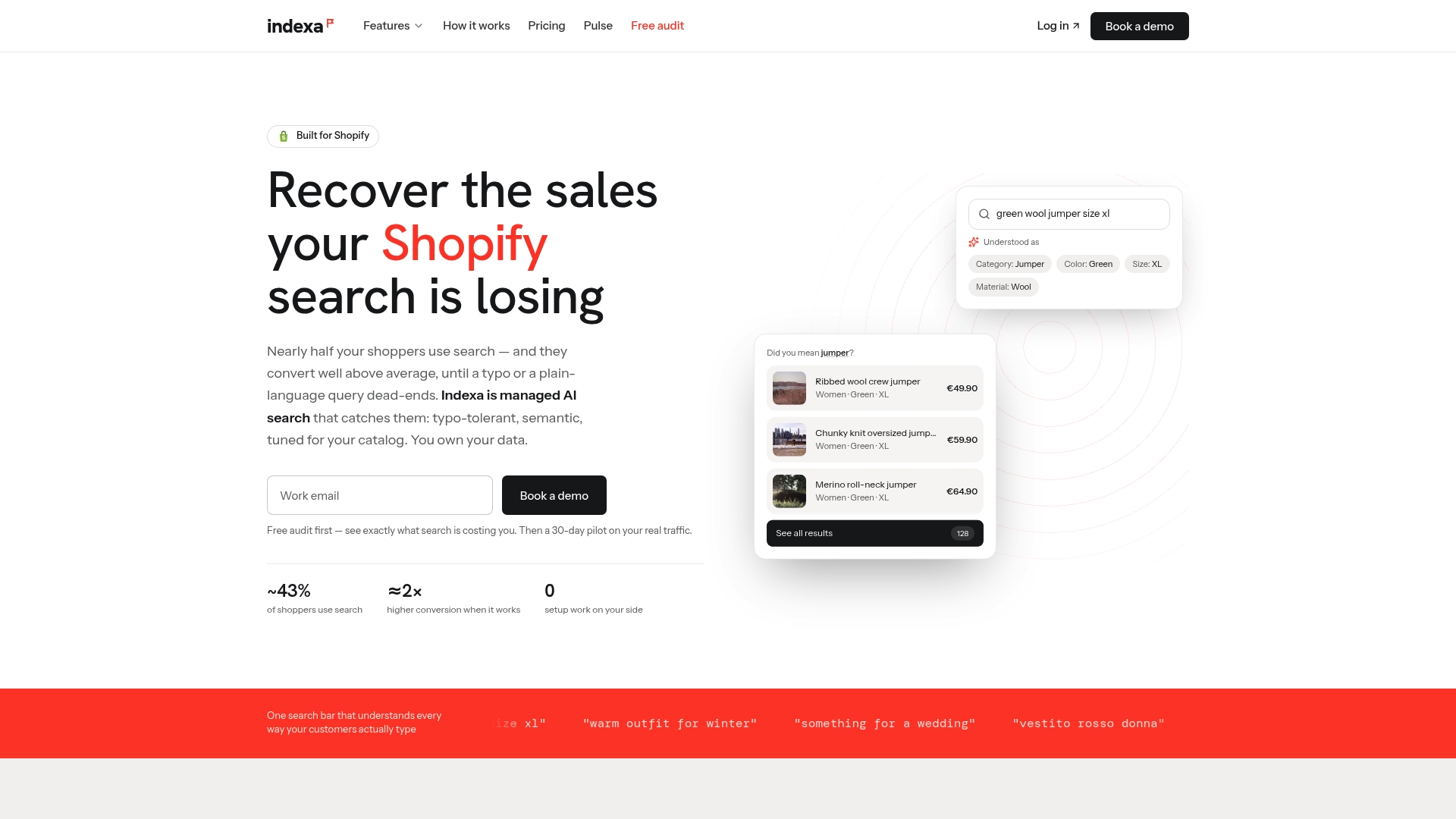
The full service is described on Indexa’s home page.
FAQ
What is the difference between search intent and query intent?
They are used almost interchangeably. Search intent usually describes the goal behind a Google search, as in SEO. Query intent is the same idea applied to what a person types into a specific search box, such as your store’s. In both cases the aim is to match results to the goal.
What are the four types of search intent?
Informational, navigational, commercial and transactional. Informational shoppers want to learn, navigational shoppers want a specific brand or page, commercial shoppers are comparing options and transactional shoppers are ready to buy. Store search also sees product-attribute queries, such as color or size.
Is query intent classification the same as intent detection?
In practice, yes, for e-commerce. Detection is the goal of finding what the shopper wants. Classification is the common method: assign the query to one or more predefined intent categories, often with a confidence score.
Do I need machine learning to detect intent in my store?
Not to start. Cleaning catalog data, mapping synonyms and correcting typos fix many failures. Semantic search then covers natural-language and long-tail queries that rules cannot. A managed service can handle both layers for you.
Sources
- Query Intent Detection from the SEO Perspective (arXiv 2006.09119)
- Survey of Query Intent Detection, IIT Bombay
- Search Intent: What It Is and How to Optimize for It, Shopify
- Search Intent for Ecommerce, EcomSEO Academy
- Keyword Research for Ecommerce, Rediem
- Determining the User Intent of Web Search Engine Queries, Jansen
- A Dynamic Product-aware Learning Model for E-commerce Query Classification
- FABRIC: Fully-Automated Broad Intent Categorization
- Intent classification, Brave
- User Intent Inference for Web Search and Conversational Agents
- Pre-training Tasks for User Intent Detection and Embedding Retrieval
- A Regularised Intent Model for Discovering Multiple Intents
- A Semi-supervised Scalable Unified Framework for E-commerce
- The Role of Cluster Analysis in SEO: 2026 Guide
Recommended
Make discovery work harder.
See what your Shopify search could do better with a free, hands-on audit.
Get your free search audit