post_filter and High Cardinality: When Ecommerce Should Use Facets
Choose filters or facets for ecommerce with concrete engineering rules: post_filter scoping, high-cardinality fixes, and 2026 generative-facet findings.

post_filter and High Cardinality: When Ecommerce Should Use Facets
Filters are static constraints applied before or independent of a query; facets are dynamic attribute breakdowns generated from search results, complete with counts that update as users refine. Use filters when your catalog is small or your constraints are fixed and binary. Use facets when shoppers need to explore a large, attribute-rich catalog and discover options they didn’t know to search for.
TL;DR:
- Facets dynamically update and provide insight into available options as users refine their filters, unlike static filters which are fixed constraints.
- Implement high-cardinality facets with search-as-you-type and limit value counts to optimize performance and user experience.
- Keep facet options to four to seven by default and hide zero-count options to prevent dead-end pages, improving conversion rates.
- Use post_filter rather than base query filtering to ensure accurate counts when users select multiple facet values.
- Prioritize metadata quality and baseline metrics before expanding to ML-assisted faceting for larger catalogs.
Table of Contents
- Search Filters vs Facets: What Each Term Actually Means
- When to Use Filters vs Facets in Your Product Catalog
- Building Facets and Filters: Query Scope, Post_filter, and High-Cardinality Traps
- UX Rules for Facets That Actually Convert
- What the Research Says About Facets in 2026
- What to Prioritize First
- A Managed Route to Better Product Discovery
- Sources
- FAQ
Search Filters vs Facets: What Each Term Actually Means
The terms get used interchangeably in product meetings, and that’s where confusion starts. A static filter is a pre-defined, often binary constraint that narrows results regardless of what’s actually in them. A facet is computed from the attributes of items already returned by a query, and it updates as the result set changes.
Oracle’s APEX documentation draws this line clearly: filters are applied before or independently of the search, while facets are generated from the attributes present in the current result set. That’s why a facet panel showing “Blue (12)” changes to “Blue (3)” the moment you select a brand. A static filter checkbox never does that.
Static filters typically come in four flavors:
- Boolean filters (in stock, on sale) that toggle a condition on or off
- Range filters (price, ratings) that need clear inclusive or exclusive boundaries
- Hierarchical filters (category trees) that narrow through nested levels
- Input or search filters (SKU lookup, text match) for direct attribute matching
Here’s the twist most teams miss: the same attribute can act as both. Color might appear as a facet with live counts when browsing a category page, then behave exactly like a static filter once selected and locked into the query context. The attribute doesn’t change. Its role in the interaction does.
When to Use Filters vs Facets in Your Product Catalog
The decision usually comes down to catalog size, task type, and how much metadata work you’re willing to fund. Here’s a simple sequence for deciding:
- Count your SKUs and attributes. Under a few hundred products with two or three stable constraints (size, availability), static filters do the job with almost no engineering overhead.
- Identify the task. If shoppers arrive knowing exactly what they want (a specific model number), filters suffice. If they’re browsing to discover options (“show me what’s out there under $100 in blue”), facets win because they reveal what’s actually available in the current set.
- Weigh the metadata investment. Facets only work when the underlying attributes are clean and complete. Nielsen Norman Group notes that faceted navigation is more flexible for large content sets but demands considerably more metadata and ongoing maintenance than simple filters.
- Go hybrid. Most mature ecommerce sites start with a handful of core filters (price, availability) and layer in facets for discovery attributes (brand, material, style) as the catalog grows. ML-assisted faceting, covered later, becomes worth considering only after this foundation is solid.
Building Facets and Filters: Query Scope, Post_filter, and High-Cardinality Traps
Getting facets right is a scoping problem before it’s a design problem. A search query defines the hit set; aggregations compute buckets over that set to produce facet counts. If you filter the query itself when a user selects a facet value, every other facet’s counts recalculate against the narrowed set, which is usually what you want for cross-facet counts but not always for the facet the user just clicked.
That’s where post_filter matters. Guidance on faceted navigation and filtering explains that applying a selected value as a post_filter, rather than folding it into the base query, lets you preserve accurate counts for that same facet’s other values, so a shopper who picked “Nike” still sees how many Adidas items exist elsewhere in the set. Get the scoping wrong and facets start lying to users.
A few implementation notes worth building into your architecture from day one:
- Use AND-within-facet, OR-across-values semantics for multi-select: selecting “Red” and “Blue” within color should return items matching either, while selecting a color and a brand should narrow with AND logic.
- Cap high-cardinality facets (thousands of unique values) with a term size limit, and swap exhaustive lists for search-as-you-type once a facet exceeds a few dozen values.
- Debounce facet recalculation so every keystroke doesn’t trigger a full aggregation pass. Per-facet filtered aggregations are accurate, but they multiply compute cost fast.
- Cache frequently requested facet combinations rather than recomputing them per session.
Pro Tip: If a facet regularly shows more than 50 values, that’s a UX signal to convert it into a searchable text field or grouped list, not a longer scrollable checkbox stack.
UX Rules for Facets That Actually Convert
Good facet design is mostly restraint. Show four to seven options per facet by default, with a “show more” link for the rest. Cramming twenty checkboxes into view does the opposite of helping a shopper decide.
Counts matter more than most teams assume. Displaying “(0)” next to an option, or better yet hiding it entirely, prevents the dead-end click that sends someone straight to a zero-results page. Pair every facet panel with an obvious clear or undo control. Shoppers who get stuck three filters deep with no way back tend to abandon rather than backtrack.
Don’t let missing metadata erase inventory. An “Other” or “Unknown” bucket for items lacking a clean attribute value keeps them visible instead of silently dropping them from every facet that relies on that field. On mobile, collapsible facet panels with proper focus management and keyboard navigation aren’t optional accessibility add ons. They’re the difference between a usable filter drawer and one nobody touches.
Ranking facet values by specificity rather than alphabetically also pays off. Research on dynamic facet ordering found that promoting more selective properties first shortens the number of clicks shoppers need to drill down to a target product. If you’re only going to measure one thing, track your zero-result rate after facet selection. It’s the clearest signal that your metadata or your facet logic has a gap.

What the Research Says About Facets in 2026
Faceted search isn’t static territory. The gap between rule-based faceting and what generative approaches can now do has widened enough that it changes the ROI math for larger catalogs.
GenFacet’s 2026 industrial benchmarks report generative faceting lifted facet click-through rates by roughly 42.0% and raised conversion rates by about 2.0%, driven by contextual facet generation and intent-driven query rewriting rather than treating facet clicks as a passive post-filter step.
That’s a meaningful signal, but it comes with a prerequisite most teams skip: NN/g’s usability research is blunt that faceted navigation only pays off when metadata coverage is high and the interface avoids overwhelming users with choices. Elastic’s engineering guidance on ML-assisted faceting makes a similar point: rule-based faceting is predictable and cheap, while ML can surface useful new attributes automatically, but only after calibration work to filter out noise. Skip that step and generative facets just produce more convincing wrong answers.
What to Prioritize First
Audit your metadata and your search failure logs before touching facet design. Build a small set of high-value facets, A/B test interactive versus batch-apply modes, and track zero-result recovery. Save ML-generated faceting for after your taxonomy is clean and your baseline metrics exist to measure against.
— Barikreativa
A Managed Route to Better Product Discovery
Indexa is a fully managed way to fix product discovery without rebuilding your facet and filter logic from scratch. It layers typo-tolerant, semantic search on top of your Shopify catalog so shoppers who misspell a brand name or type “warm jacket for hiking” instead of exact attribute terms still land on relevant products, alongside recommendations and a visual merchandising grid editor for tuning category and search pages.
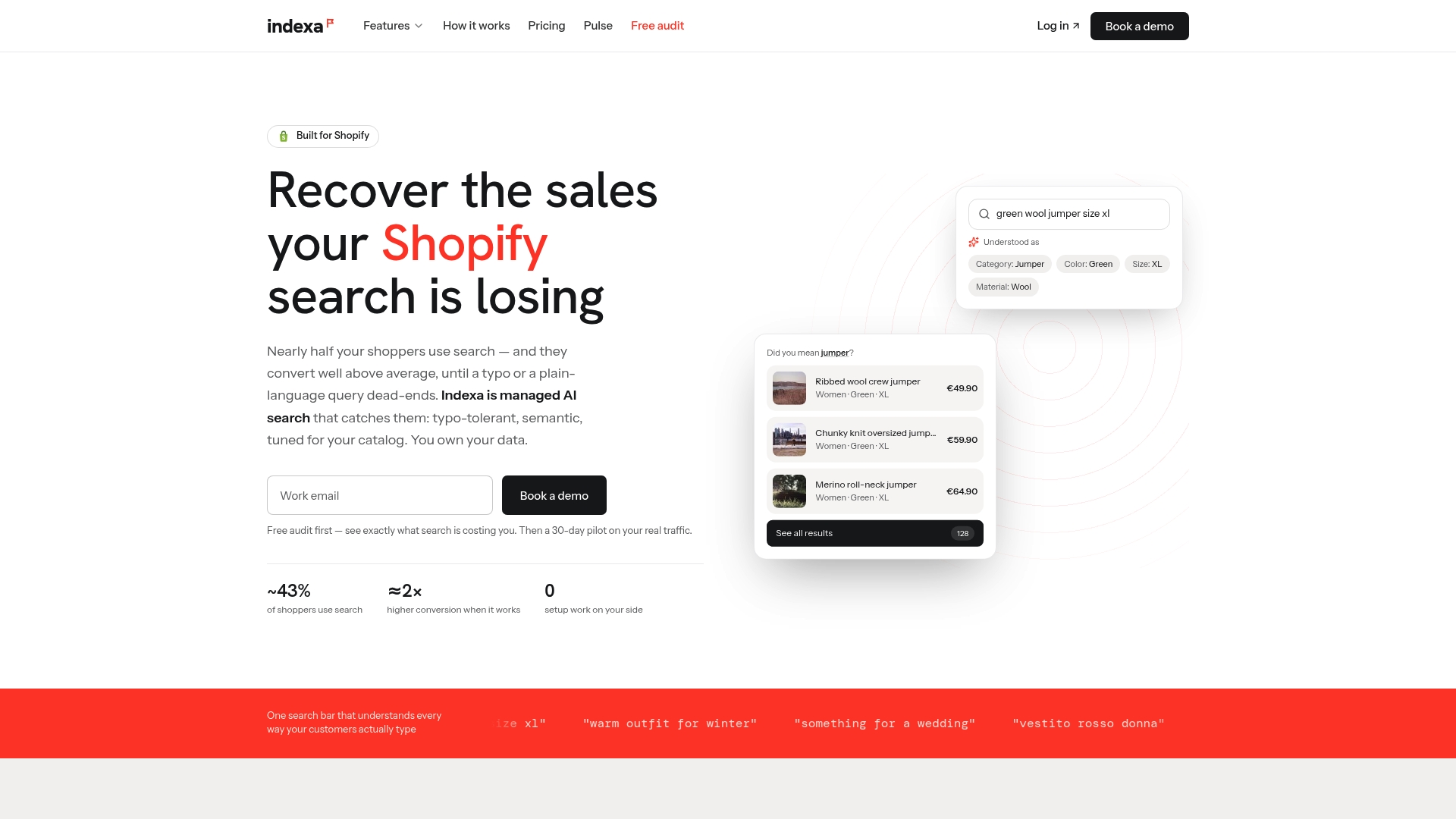
Most metadata gaps that break facets, like inconsistent attribute tagging or missing “Other” buckets, only surface once someone actually audits your search logs. Indexa’s free audit does that diagnostic work directly, and the 30-day pilot lets you see the conversion impact before committing to anything. There’s no setup required on your end, and the query understanding layer keeps tuning itself against real shopper behavior rather than a fixed rule set you have to maintain manually. Start with the audit and see what your current search is actually costing you in lost sales.
Sources
- Filters vs. Facets: Definitions (Nielsen Norman Group)
- Faceted navigation & filtering (Full-Stack Search)
- Dynamic facet ordering and property ranking (IEEE TKDE)
FAQ
What Is the Difference Between Facets and Filters in Search?
Filters are static constraints applied before or independent of a search query, while facets are generated dynamically from the attributes of items already in the result set and update their counts as users refine further. The same attribute, like color, can function as either depending on when and how it’s applied, according to Oracle’s APEX documentation.
What Are the Four Types of Filters?
The common categories are boolean (checkboxes or toggles), range (numeric bands or sliders), hierarchical (category trees), and input or search filters (text fields for direct attribute matching). Each type handles edge cases differently, particularly range filters, which need clear inclusive or exclusive boundaries defined upfront.
What Is the Difference Between Search and Filter?
Search retrieves results matching a query, typically through keywords or natural language, while a filter narrows an existing result set by excluding items that don’t meet a fixed criterion. Search finds the initial set; filters and facets both refine it, just through different mechanisms.
What Are Facets in Search?
Facets are attribute-based groupings, like brand, price range, or material, computed from the items currently returned by a search or browse action, each shown with a live count. They let shoppers narrow a large catalog by exploring what’s actually available rather than guessing at exact search terms, and NN/g’s research confirms they’re most valuable on large, attribute-rich catalogs with solid metadata.
Does Indexa Handle Facets and Filters for Shopify Stores?
Indexa focuses on the search and query understanding layer, typo tolerance and semantic matching, rather than replacing your facet architecture outright, and it works alongside your existing filter and facet setup. Pricing for the managed service, including the one-time setup fee and monthly retainer, is available on Indexa’s pricing page.
Recommended
Make discovery work harder.
See what your Shopify search could do better with a free, hands-on audit.
Get your free search audit