Measure and Fix Shopify Search Conversion Rate in 30–90 Days
Measure Shopify search with behavior reports and ShopifyQL. Reduce zero results and ranking issues in 30 to 90 days, or run a free managed audit.

Measure and Fix Shopify Search Conversion Rate in 30–90 Days
Search conversion rate measures the share of shoppers who use your on-site search box and then buy: purchases from search-using sessions divided by total sessions with a search. Shoppers who search convert at meaningfully higher rates than average browsers because they already know what they want, so a small lift in this metric often produces outsized revenue. Baymard’s research shows most stores still get search wrong, Shopify’s own analytics can prove it on your store, and a free audit can tell you exactly where the money is leaking.
TL;DR:
- Most stores have a zero-results search rate between 3% and 9%, which indicates metadata gaps and can significantly impact conversions.
- High refinement rates coupled with low search-to-PDP rates suggest ranking or relevance issues rather than discovery problems.
- Improving UX, fixing synonym gaps, and enabling typo tolerance can increase search conversion rates by 20% to 80% above the site average.
- Regularly auditing top search queries and addressing zero-results before customer frustration occurs is key to maintaining healthy search performance.
- Managed AI search services like Indexa can reduce engineering effort and deliver consistent tuning, especially for large or fast-changing catalogs.
Table of Contents
- How to Calculate Your Search Conversion Rate in Shopify
- The Five KPIs That Explain Why Search Converts or Fails
- What a Healthy Search Conversion Rate Actually Looks Like
- Diagnosing Why Your Search Isn’t Converting
- Your 30 to 90 Day Search Conversion Fix Plan
- When to Fix This Yourself and When to Hand It Off
- Get a Second Set of Eyes on Your Search Box
- Sources
- FAQ
How to Calculate Your Search Conversion Rate in Shopify
The formula is simple: divide orders placed within sessions that included a search by the total number of sessions where a search occurred. If a shopper searches three times in one visit before buying, that still counts as one converting session, not three, because attribution runs at the session level, not the query level.
Shopify gives you two ways to pull this. The Search conversions over time report in your behavior reports shows sessions with searches alongside downstream clicks, add-to-carts, and purchases. For more control, ShopifyQL exposes a dedicated searches schema with fields built for this exact job:
search_queryandsearch_query_intentto see what shoppers actually typed and how Shopify classifies the intent behind itsearch_results_were_returnedto flag zero-result queries before they get lost in aggregate numberssearch_conversionsto tie a specific search session directly to a completed purchase
One attribution detail trips up a lot of merchants: predictive search clicks (the dropdown suggestions that appear as someone types) behave differently from full search-results-page visits. Many stores conflate their overall site conversion rate with search conversion rate, when accurate measurement means filtering specifically for sessions where a search happened. Treat both paths as valid search entries, but keep them tagged separately so you can tell whether shoppers are converting from the dropdown or from the full results page.
The Five KPIs That Explain Why Search Converts or Fails
Your overall search conversion rate tells you the score. These five numbers tell you why you’re winning or losing:
- Zero-results rate. The percentage of searches returning no products, pulled from
search_results_were_returnedin ShopifyQL. Every zero-result search is a shopper actively telling you what they want and getting nothing back. - Refinement rate. How often shoppers modify or repeat a search in the same session. High refinement usually means your ranking isn’t surfacing the right products on the first try, not that shoppers can’t find what they want at all.
- Search-to-PDP rate. The share of search sessions that reach a product detail page. This isolates whether your results are even clickable, separate from whether they eventually convert.
- Search exit rate. Sessions that end right after a search with no further clicks. A spike here usually points to a UX problem: confusing layout, slow load, or results that look broken on mobile.
- Revenue per search session. Total revenue from search sessions divided by search session count. This catches cases where conversion rate looks fine but average order value from search traffic is quietly low.
Statistic Callout: Search-led sessions on Shopify stores commonly convert well above the site average once search is properly tuned, and industry benchmarks show AI-driven search delivering roughly 2 to 4 times the conversion rate of basic keyword matching, with typical AI search conversion rates landing between 4% and 12% depending on the vertical.
When refinement rate is high but search-to-PDP rate is low, that combination almost always means a ranking or relevance problem, not a discovery problem. Shoppers are searching, just not finding anything worth clicking.
What a Healthy Search Conversion Rate Actually Looks Like
There’s no single universal number here, and any guide that hands you one flat target is oversimplifying. What you can use are operating bands, adjusted for your catalog size and vertical.
- Search usage rate (share of sessions that use search at all): roughly 12% to 28% is typical, with catalog-heavy stores trending higher.
- Zero-results rate: a healthy store keeps this in the 3% to 9% range; anything higher signals a synonym or metadata problem.
- Refinement rate: 18% to 35% is common, per analytics benchmarking from EcomToolkit.
- Search-led conversion uplift versus site average: a well-tuned search experience commonly runs 20% to 80% above your store’s baseline conversion rate.
Fashion and specialty retailers with large SKU counts tend to sit at the higher end of the search usage band, since shoppers are more likely to hunt for a specific size, color, or style than to browse category pages. A boutique store with 200 SKUs might see less search traffic overall, but a much sharper drop-off in conversion if even a handful of queries return nothing. Set your internal guardrail at whatever zero-results rate triggers a weekly fix, not an annual one.
Diagnosing Why Your Search Isn’t Converting
Most underperforming search boxes fail in one of four predictable ways. Run through this list before you touch anything.
- Zero-results and metadata gaps. Missing synonyms mean “sneakers” returns nothing when your catalog only tags items “trainers.” This is the single most common and most fixable failure mode.
- Ranking and relevance issues. No typo tolerance, flat attribute weighting, and no manual boosting mean the right product exists but never surfaces near the top of results.
- UX friction. A muted or hard-to-find search field, cluttered mobile results, or a predictive search dropdown that silently breaks on certain browsers all quietly suppress usage before conversion even enters the picture.
- Measurement blind spots. Sessions get misattributed, or predictive search clicks never get tracked at all, which hides the true scope of the problem from whoever is reading the dashboard.
Baymard’s query-type benchmark found that 56% of sites fail to adequately support search UX across common query types, which means the odds are good at least one of these four issues exists on your store right now, even if your top-line numbers look acceptable.
Pro Tip: Run your ten most common search terms through your own storefront search box once a month. It takes fifteen minutes and it’s the fastest way to catch a broken synonym or a zero-results dead end before a customer does.

Your 30 to 90 Day Search Conversion Fix Plan
Work in this order. Each phase builds on the data the previous one gives you.
- Days 1 to 15, quick wins. Add synonym maps for your top zero-results queries, fix out-of-stock display behavior so dead products don’t clutter results, and boost exact-match products to the top of relevant searches.
- Days 16 to 45, mid-term cleanup. Audit product attributes and tags for consistency, redesign search results templates for clearer mobile scanning, and smooth out predictive search UX so suggestions load reliably.
- Days 46 to 75, technical upgrades. Enable typo tolerance and semantic matching so queries like “warm jacket” and natural-language phrases both return relevant products, and start testing lightweight result personalization.
- Days 76 to 90, measurement governance. Set weekly KPI thresholds, assign a named owner for the zero-results dashboard, and run A/B tests on ranking changes before rolling them out storewide. Practical CRO experiment guidance can help you structure those tests properly.
| Phase | Primary goal | Success signal |
|---|---|---|
| Quick wins | Kill obvious zero-results | Zero-results rate drops toward 3-9% band |
| Mid-term cleanup | Clean data and UX friction | Refinement rate falls, search-to-PDP rises |
| Technical upgrade | Handle typos and intent | Search conversion rate climbs toward vertical benchmark |
| Governance | Sustain the gains | Weekly dashboard review with named owner |
When to Fix This Yourself and When to Hand It Off
Handling search conversion in-house works well when your data is already clean, your team has engineering bandwidth to spare, and your catalog is small enough that manual synonym mapping doesn’t become a full-time job. That’s a real option for a lot of stores, and nothing above requires a vendor.
The calculation changes once you run a large or fast-moving catalog, especially in fashion or specialty retail where query variety is high and exact-title matches rarely happen. At that point, typo-tolerant and semantic matching stop being a nice technical upgrade and start being the difference between a shopper finding your product and bouncing. A managed service like Indexa exists for exactly this gap: no engineering lift, continuous tuning based on your actual store data, and a free audit or 30-day pilot to see the recoverable revenue before committing to anything.
— Barikreativa
Get a Second Set of Eyes on Your Search Box
Indexa is the alternative to spending engineering hours chasing synonym gaps and ranking tweaks yourself: a fully managed AI search and discovery service built specifically for Shopify, with typo tolerance, semantic matching, and no code required on your end.
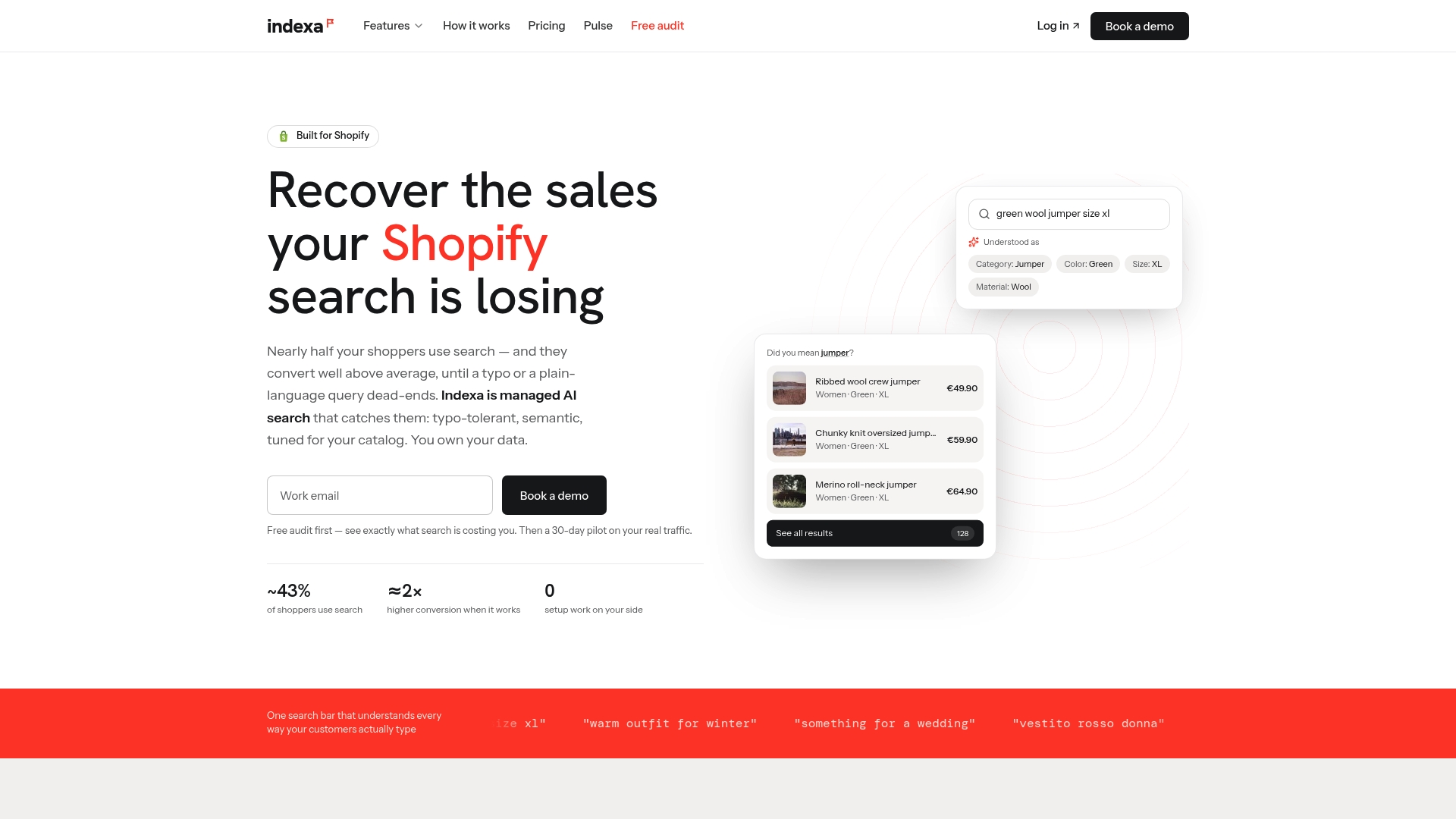
Activation can be done quickly and tuning continues in the background as your catalog and query patterns change. If you want to see where your store is losing search revenue before you commit to anything, the free Shopify search audit walks through your zero-results queries, ranking gaps, and mobile UX in one pass. Merchants who want to test the impact directly can start with the 30-day pilot, which runs alongside your existing setup so you can compare results before deciding on a flat monthly retainer. Start with the audit and see the numbers for your own store.
Sources
- E-Commerce Search Usability Research Studies – Baymard
- Shopify searches schema (ShopifyQL)
- Shopify Site Search Performance Analytics Guide | EcomToolkit
FAQ
How Do You Calculate Search Conversion Rate?
Divide purchases from sessions that included a search by the total number of sessions with a search. Pull the numbers from Shopify’s Search conversions over time report or query the searches schema directly through ShopifyQL for more granular filtering.
What Is a Good Search Conversion Rate for Shopify?
There’s no single universal number, but stores with well-tuned search commonly see a 20% to 80% conversion uplift over their site average, according to industry benchmarking data.
What’s the Fastest Fix for Low Search Conversion?
Start by pulling your top zero-results queries and adding synonym maps for the most common ones, since Baymard’s research shows this single gap accounts for a large share of failed search UX. Fixing out-of-stock display behavior and boosting exact-match products are close behind in terms of speed to impact.
When Does It Make Sense to Use a Managed Search Service?
It makes sense once your catalog is large or fast-changing enough that manual synonym mapping and ranking tuning become a recurring drain on engineering time. Indexa offers a free audit to show the recoverable revenue on your store before you decide, with pricing for the ongoing service available on the pricing page.
Does Typo Tolerance Actually Move the Conversion Number?
Yes. AI-driven search with typo tolerance and semantic matching typically delivers 2 to 4 times the conversion rate of basic keyword search, since it recovers shoppers whose queries would otherwise return nothing.
Recommended
Make discovery work harder.
See what your Shopify search could do better with a free, hands-on audit.
Get your free search audit