Personalization and Privacy: How Shopify Stores Can Do Both
Personalized search lifts sales, but shoppers worry about their data. See what the research says and how a Shopify store can personalize while keeping trust.

Personalization and Privacy: How Shopify Stores Can Do Both
Shoppers want a store that understands them, and they worry about what it takes to get there. The way through is to personalize from the least personal data that still works: what people type, click and buy in your store, with clear choices and a clear reason for each data point. For a Shopify merchant, that starts with search, where relevance is built from your own catalog and on-site behavior rather than from a profile of the person. Indexa runs this as a fully managed search service, and merchants keep ownership of their data.
TL;DR
- The personalization–privacy paradox is real: shoppers value tailored experiences and also worry about data use, often at the same time.
- In a global study of 23,730 consumers, 64% preferred companies that tailor experiences, while 53% were very or extremely concerned about data privacy.
- Shoppers are most comfortable with purchase history and site visits, and least comfortable with financial data and social media posts.
- Relevance work that fixes typos, synonyms and catalog data needs no personal profile at all, so it is the safest place to start.
- In the US, the main legal duty for most stores is honoring opt-outs of data sales and sharing, and Shopify provides a consent API to record choices.
Table of Contents
- What the personalization–privacy paradox means for a store
- What shoppers actually say
- How personalized search works, and what data it needs
- Where the privacy risks sit
- A privacy-first approach to search personalization
- What the law asks of a US store
- Does personalization pay off?
- Where Indexa fits
- Our perspective
- FAQ
- Sources
What the personalization–privacy paradox means for a store
The idea comes from a well-known MIS Quarterly study of more than 400 online consumers. A firm has to collect information to personalize. But the consumers who care most about transparency are the least willing to be profiled. The same shopper can love a store that remembers their size and bristle at a store that seems to know too much.
For a merchant, this is a practical problem, not a philosophical one. Personalization that feels helpful raises the odds of a sale. Personalization that feels like surveillance can cost you the shopper. A 2017 study of e-commerce privacy calculus notes that personalization can drive customers away, and that many consumers will rationally share data when the benefits outweigh the perceived risks.
That last point is the opening for small and mid-size stores. You do not have to choose between a generic experience and a creepy one. You have to make the exchange obvious and worth it.
What shoppers actually say
The numbers point the same way across several surveys.
- The Qualtrics XM Institute surveyed 23,730 consumers in 23 countries. 64% preferred buying from companies that tailor experiences to their wants and needs. At the same time, 53% were extremely or very concerned about data privacy, and 33% trusted companies to use their data responsibly.
- Trust moves the needle. In the same study, consumers who trust companies were on average 8 percentage points more comfortable with each personal-data type being used for personalization.
- A 2025 survey of 3,300 consumers in the US, UK and Australia found 64% take active steps to protect their privacy, yet 71% still want brands to learn from their shopping habits over time.
Shoppers are not asking you to stop personalizing. They are asking you to be careful and to give them something back.
Which data feels acceptable
Not all data is equal in shoppers’ eyes. In the Qualtrics findings, consumers were most comfortable with purchase history (45%) and website visits (42%) being used for personalization. They were least comfortable with financial information (12%) and social media posts (17%).

That ranking is a design guide. First-party signals from inside your own store, such as searches, clicks and past orders, sit at the comfortable end. Data pulled from outside your store, or from sensitive categories, sits at the other.
How personalized search works, and what data it needs
Personalized search reorders results for each shopper. Etsy’s engineers describe training their system on per-user signals: clicks, favorites, add-to-cart actions and purchases. Clicks are the most frequent signal, and purchases are the rarest but the strongest sign of relevance.
A marketplace with millions of listings and shoppers can build that. Most Shopify stores have a smaller catalog and far less traffic per shopper, so heavy individual profiling gives thin returns for the privacy cost. Search quality usually breaks down earlier and in simpler ways:
- A shopper misspells a brand or product and gets zero results.
- A shopper types a natural phrase like “something for a beach wedding” and the search only matches exact words.
- The shopper’s word for a product is not the word in your catalog.
- The best sellers are buried under irrelevant matches.
None of these need a profile of the person. They need typo tolerance, semantic understanding, synonym mapping and well-ordered results, all built from your catalog and anonymous query patterns. We cover the personalization side in more detail in our guide to search personalization on Shopify.
Where the privacy risks sit
Risk comes from three places: collecting more than you need, keeping it badly, and surprising the shopper.
Over-collection and unavoidable personalization
The European Commission’s 2025 Consumer Conditions Scoreboard, based on an IPSOS survey, reports that 93% of EU online shoppers worried about targeted advertising. The specific worries included personal data collected without consent (71%), excessive advertising (67%) and personalization that cannot be avoided (63%). That survey covers the EU, but the third item is a useful warning for any store: shoppers want to be able to turn personalization off.
Breaches and lost trust
A study of the Morele.net breach in Poland, covering 826 affected consumers, found that trust in the store dropped sharply. One in three affected consumers said they would stop shopping there. The lesson is simple: the less personal data you hold, the less there is to lose.
Backlash from surprise
Personalization that shoppers did not expect tends to backfire. A 2026 study of 300 consumers found that AI-driven recommendations improved interest and decision-making, but that extensive data collection threatened trust and disclosure intentions.
A privacy-first approach to search personalization
Here is a practical order of operations for a Shopify store.
1. Fix relevance before you personalize
Relevance is the part of personalization that carries no privacy cost. Typo correction, synonyms, semantic matching and sensible ranking help every shopper, signed in or not. A 30-day audit of spell correction is a quick way to see how many queries return nothing today. Testing relevance with Precision@10, a measure of how many of the top 10 results are relevant, shows whether your results deserve to be personalized yet.
2. Use first-party, in-session signals
What a shopper clicked a minute ago in your store is both the most useful and the most comfortable signal. It matches the data types shoppers accept most readily, as the survey above shows. Session-level adjustments, such as boosting categories someone is browsing, deliver much of the benefit without building a long-term profile.
3. Make the value exchange visible
The Attentive report found that 99.6% of consumers are willing to share some zero-party data in exchange for an incentive. Zero-party data is information a shopper volunteers on purpose, like a size, a style preference or a gift occasion. Ask for it when it clearly improves what they see next: “Tell us your size and we will show what is in stock for you.”
4. Give shoppers control
A systematic review of 82 marketing papers found that perceived benefits and perceived privacy control are the main drivers of self-disclosure, while privacy concern is the main barrier, and trust in the organization shapes how much shoppers disclose. In plain terms: a visible way to reset or switch off personalization makes people more willing to leave it on.
5. Keep ownership and retention simple
Know what you store, where, and for how long. Prefer a search service where you keep ownership of your data. Collect less, keep less, and delete on a schedule.
What the law asks of a US store
This section is general information, not legal advice. Rules differ by state and change, so confirm your own obligations with a privacy attorney.
There is no single federal privacy law covering all online stores, so state laws set the rules. In California, the CCPA as amended by the CPRA sets no general opt-in before cookies are set. Instead, a business that sells or shares personal information must offer an opt-out and honor it, including a Global Privacy Control signal from the browser. Sharing the data of consumers under 16 needs opt-in consent. Other states have passed their own laws, and your obligations depend on where your customers live and how many you serve.
If you sell to the EU or UK, stricter consent rules apply, and the Commission’s survey shows how sensitive shoppers there are about unavoidable personalization.
On the Shopify side, the Customer Privacy API lets you check what data processing a visitor has allowed and build a cookie banner. Shopify’s guidance is to record consent only when a visitor actively accepts or declines, never automatically on their behalf. Any personalization you build should read those consent settings first.

Does personalization pay off?
It does, and the evidence includes cases where privacy limits cost sellers money. A Wharton paper using randomized experiments at Wayfair found that personalization raised revenue, cut returns by 10% and raised repeat purchase probability by 2.3%. It also found that browser privacy restrictions that degrade personalization data hit small and niche sellers hardest. The authors propose a probabilistic approach to recognizing returning devices that recovers much of the loss without using exact user identity.
Two takeaways for a small brand. First, personalization is worth doing. Second, it should not depend on third-party tracking that browsers keep restricting. Signals you collect yourself, with consent, are more durable. For the broader business case, see why personalized content matters for engagement and results.
Where Indexa fits
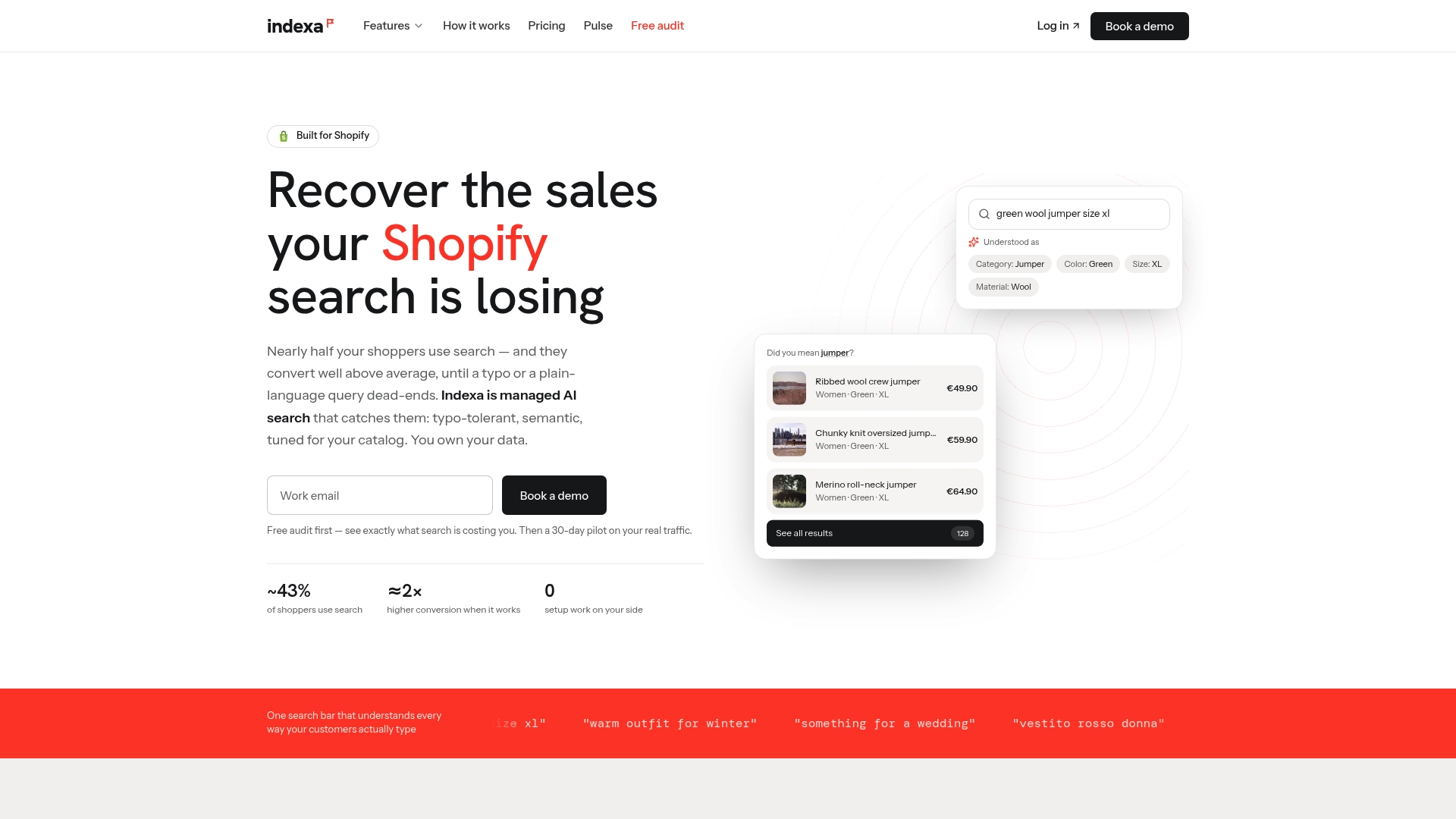
Indexa is a fully managed AI search and discovery service for Shopify stores. It includes typo-tolerant and semantic search, synonym mapping, multilingual support, a visual merchandising grid editor, product recommendations and integrated analytics, tuned on real store data. There is no setup or coding on your side, and merchants keep ownership of their data, with month-to-month billing and no per-request fees.
A good first step is the free audit, which shows where search is losing shoppers today. If you want to see the effect on your own store, the 30-day pilot is the next step, and the pricing page explains the setup fee and flat monthly retainer.
For how we handle cookies on our own site, see our cookie policy.
Our perspective
We think the paradox is mostly a design problem. Shoppers do not object to a store that finds the right jacket when they type “blzer”. They object to a store that seems to follow them around.
That is why we start where no one’s privacy is at stake: relevance. Typo tolerance, semantic matching, synonym mapping and well-merchandised results work on your catalog and on how people search, and they help every visitor. Most stores have a long list of queries that return nothing or the wrong thing, and that is lost revenue you can recover before you profile anyone.
We also believe a merchant should own their data and never pay per request for using it. Our service is fully managed and tuned continuously on real store data, so a small team does not need to build and police a personalization stack alone.
Personalization that earns trust is specific, explained and optional. Build that, and the paradox works in your favor.
Barikreativa
FAQ
What is the personalization–privacy paradox?
It is the tension between a business needing customer data to personalize and customers worrying about how that data is used. Research shows the shoppers who value transparency most are the least willing to be profiled. Clear choices and a visible benefit narrow the gap.
Can a store personalize search without tracking individuals?
Yes. Typo tolerance, semantic matching, synonyms and merchandising rules all improve results using your catalog and aggregate query patterns. Session-level signals, such as what someone clicked during the visit, add more without a long-term profile.
What data are shoppers most comfortable sharing?
In the Qualtrics study, purchase history (45%) and website visits (42%) ranked highest. Financial information (12%) and social media posts (17%) ranked lowest. Using first-party store data stays on the comfortable end of that scale.
Do I need a cookie banner on my Shopify store?
That depends on where your shoppers live and what tracking you run. California’s law centers on opt-outs and honoring browser opt-out signals, while EU and UK rules lean on prior consent. Shopify’s Customer Privacy API records those choices, and a privacy attorney can confirm what applies to you.
Sources
- The Personalization Privacy Paradox (MIS Quarterly)
- Privacy calculus and its utility for personalization
- Qualtrics XM Institute: Consumer Preferences for Privacy and Personalization
- Attentive: The State of Personalized Marketing in 2025
- Marketing Charts: Consumers Are Concerned About Their Data
- Etsy Engineering: Bringing Personalized Search to Etsy
- European Commission: Key consumer data
- Consumers’ Change in Trust and Security after a Personal Data Breach
- The Impact of AI-Driven Recommendation Systems on Consumer Behaviour
- Personalisation-Privacy Paradox from Marketing Perspectives
- Balancing User Privacy and Personalization (Wharton)
- Which Cookies Need Consent Under the CCPA
- Shopify Customer Privacy API
- Why personalized content matters
Recommended
Make discovery work harder.
See what your Shopify search could do better with a free, hands-on audit.
Get your free search audit