When Shopify Multilingual Synonyms Break for Merchants
A Shopify-first playbook for merchants: set up and test multilingual synonym groups, avoid native caps (20 per group, 1,000 total), and know when to add...

When Shopify Multilingual Synonyms Break for Merchants
For a small catalog in two or three languages, build synonym groups by hand inside Shopify’s Search & Discovery app, one language at a time. Once your catalog grows past a few hundred SKUs, adds more languages, or keeps generating no-results searches across locales, manual synonym lists become a maintenance job nobody wants, and a semantic search layer that maps meaning across languages starts to pay for itself.
TL;DR:
- Building multilingual synonym groups manually in Shopify requires creating and testing separate lists for each language, with a maximum of 20 synonyms per group.
- Shopify’s native features limit query suggestions to English, while interface languages support multiple options, causing a disconnect in non-English search experiences.
- Maintaining synonyms becomes inefficient as catalogs grow, especially with frequent product additions or high SKU churn, making automated or semantic solutions more advantageous.
- Moving filterable attributes to translatable metafields and focusing on concept-based synonyms improve search relevance across different markets.
- A managed semantic search layer can reduce ongoing maintenance, address language limitations, and improve results at scale, especially for stores with broad international offerings.
Table of Contents
- How Shopify handles languages, translated fields, and where synonym rules live
- Concrete Shopify native limitations that impact multilingual synonyms
- Step-by-step: creating and managing multilingual synonym groups
- Multilingual synonym strategy and product-data architecture best practices
- When to adopt semantic or AI search: signals, benefits, and integration notes
- Implementation checklist and timeline: who does what and when
- Troubleshooting and measuring impact: tests and KPIs
- Why a managed semantic layer is worth considering
- Ready to see what your own search is missing?
- Key Shopify docs and industry reads to consult next
- Sources
- FAQ
How Shopify handles languages, translated fields, and where synonym rules live
Shopify lets you add languages through the admin, either with the built in Translate & Adapt app or a third-party translation tool. Each published language gets its own URL path (a subfolder like /fr/ or /de/), which search engines treat as separate content, so translating your top pages helps both shoppers and your international SEO.
Translated fields, titles, descriptions, and some metafields become searchable once published in that locale, but the store’s primary locale still shapes collection and query suggestions behind the scenes. That distinction matters when a French shopper types a search term and gets English-influenced results.
Synonym groups themselves live inside the Search & Discovery app, reachable from the Shopify admin. The synonyms screen has a language selector at the top, and whatever group you build applies only to the language you have selected when you save it. Switch the dropdown to Spanish and you are looking at, and editing, a completely separate list from the English one. Nothing carries over automatically between languages, which is the root of most of the maintenance work described later in this guide.
Concrete Shopify native limitations that impact multilingual synonyms
Before you invest hours building synonym lists, it helps to know exactly where the platform draws its lines.
- Predictive search query suggestions are English-first. According to Shopify’s own predictive search documentation, collection suggestions follow the store’s primary language, while query suggestions remain English-only, with other languages rolling out over time.
- Filter translation is incomplete. Tag and vendor based filters stay in the store’s default language regardless of what locale a shopper is browsing in.
- Synonym groups have hard caps. Each group allows up to 20 synonyms, each synonym can be up to five words, and a store can hold up to 1,000 synonyms in total.
- Some fields ignore synonyms entirely. SKU and barcode fields, along with certain search syntax patterns, do not get synonym matching applied.
Shopify’s predictive search interface and content display cover 45 languages, including less common ones like Icelandic, Macedonian, and Vietnamese, but query suggestions inside that same feature are still restricted to English. That gap between interface language and suggestion language is easy to miss during setup and obvious the moment a non-English shopper starts typing.
The practical result: a merchant selling in five languages needs five separate synonym builds, five separate reviews, and five separate sets of edge cases to track, because nothing in the native tool shares logic across languages.

Step-by-step: creating and managing multilingual synonym groups
Building synonym groups in Shopify admin follows the same sequence regardless of language, but skipping steps is where most merchants lose accuracy.
- Open Search & Discovery from your Shopify admin, then select Synonyms.
- Use the language dropdown at the top of the screen to choose the locale you are editing.
- Create a new synonym group and add terms that shoppers in that language actually use, up to 20 per group.
- Save the group, then repeat steps two through four for every published language, since groups are language neutral in structure and never copy themselves across locales.
- Test each group by searching in that locale’s storefront view, not just the admin preview.
Each synonym term can run up to five words, every group caps at 20 synonyms, and a store’s total synonym count tops out at 1,000. Phrase handling has its own quirks too: compound terms and multi-word phrases do not always match the way single-word synonyms do, so test phrase-based entries directly on the storefront rather than trusting the admin preview alone.
Pro Tip: Pull your store’s no-results search report before writing a single synonym, then build groups for the highest-volume failed queries first instead of guessing what shoppers might type.
Treat this as an ongoing workflow, not a one-time setup. Run the no-results report monthly, prioritize the terms costing you the most traffic, test each new synonym group in the actual buyer locale (not just your admin session), and put a recurring review on the calendar so seasonal terms and new product names get added before they start failing silently.

Multilingual synonym strategy and product-data architecture best practices
The synonyms themselves are only half the job. How your product data is structured determines whether those synonyms have anything solid to match against.
- Move filterable attributes to translatable metafields. Shopify’s own filter documentation recommends metafields over tags and vendor fields specifically because metafields can be translated, while tag and vendor filters cannot.
- Group synonyms by concept, not just by word. A “sneakers” group in English needs its US and UK spelling variants, its regional product names, and any brand-specific slang your shoppers actually use in search.
- Let real search data drive priority. Building synonyms from guesses wastes time; building them from your no-results report and query logs targets the terms actually costing you sales.
- Loop in merchandising and buying teams before big changes. A synonym rule that groups two products a buyer considers distinct can misfire at scale, so cross-check with the people who know the catalog.
Relying on translation alone will not fix search intent differences between markets. A term that means one thing in American English can carry a different connotation in British or Australian English, and translation without a matching data structure tends to paper over the problem rather than solve it. Metafields plus a clear synonym taxonomy is the more durable fix, even though it takes longer to set up.
When to adopt semantic or AI search: signals, benefits, and integration notes
Manual synonym lists work fine at a small scale, but a few signals tell you it is time to look at something more automated.
- Repeated no-results across multiple locales, especially when the same concept fails in different languages for different reasons.
- A catalog spanning many languages where duplicating and maintaining synonym groups by hand has become a part-time job.
- Heavy SKU churn, where new products outpace the team’s ability to update synonym lists.
- Limited internal resources to own an ongoing synonym maintenance cadence.
Semantic search addresses these gaps by mapping concepts rather than exact words, so a shopper searching “jumper” in the UK and one searching “sweater” in the US land on the same products without a manually built synonym pair for every regional variant. Industry analysis of Shopify search tools points to semantic matching as a way to reduce the no-results pages that manual dictionaries struggle to eliminate at scale, since it can pick up conceptual equivalence that a fixed word list will always miss until someone notices the gap and adds it by hand.
One fashion retailer, SikSilk, reported 25% e-commerce growth after moving to AI-powered on-site search paired with synonym configuration, a result tied to eliminating no-results pages and improving product discovery rather than any single feature in isolation.
For headless or Hydrogen storefronts, Shopify’s Storefront API can carry predictive search, typo tolerance, and synonym groups into a custom front end, but that still means building and maintaining the logic yourself. A managed service that plugs directly into Shopify, handling the semantic mapping and ongoing tuning without engineering time on your side, is the other route, and it is the specific gap Indexa is built to fill.
Implementation checklist and timeline: who does what and when
A rollout works best broken into phases with clear owners, rather than one open-ended project.
- Weeks 0 to 2: Enable your target languages in Shopify admin, translate your top-selling SKUs first, and build synonym groups for your highest-volume no-results queries in each locale.
- Weeks 2 to 8: Convert tag and vendor filters to translatable metafields, set up analytics tracking for search behavior, and test every synonym group by browsing the storefront in the actual buyer locale rather than the admin preview.
- Ongoing, quarterly: Review synonym performance against updated no-results reports, refresh terms ahead of seasonal launches, and set a clear threshold (a fixed number of persistent no-results terms, a specific language count, or a resourcing shortfall) that triggers a move to semantic search.
Assign the first phase to whoever owns storefront content, the metafield conversion to a developer or app-based tool, and the quarterly review to whoever owns merchandising. Splitting ownership this way keeps the project from stalling once the initial setup enthusiasm fades.
Troubleshooting and measuring impact: tests and KPIs
Validating a synonym change means checking it the way an actual shopper would encounter it, not just confirming it saved in the admin.
- Reproduce the buyer’s exact conditions: switch your storefront view to the target locale, run the search, and confirm the translated metafields and synonym matches actually appear.
- Check predictive suggestions separately, since query suggestions stay English-only regardless of what locale you are testing.
- Track no-results rate by locale as your primary health metric, since a drop there is the clearest sign a synonym fix worked.
- Watch search conversion rate and revenue from search sessions to confirm the fix is translating into sales, not just fewer empty result pages.
Review these numbers monthly at minimum, and consider a simple holdout test, applying a new synonym group to half your traffic first, when you want to confirm a specific change actually moved conversion rather than coinciding with a seasonal traffic shift.
Why a managed semantic layer is worth considering
Manual synonym lists are a reasonable starting point, but they scale linearly with your language and catalog size, and most merchants underestimate how quickly that becomes unsustainable. The real cost is not the initial setup, it is the ongoing review cycle nobody has time for once the catalog hits a few thousand SKUs across four or five languages.
A managed AI-driven search and discovery service can layer typo tolerance and semantic mapping on top of a store’s existing catalog, with continuous tuning rather than a one-time configuration. For teams without a dedicated search engineer, or catalogs spanning more languages than a synonym spreadsheet can reasonably track, that managed layer can shorten the time between noticing a search problem and fixing it.
— Barikreativa
Ready to see what your own search is missing?
Building synonym lists by hand across five languages is doable. Doing it well, every quarter, forever, is a different question, and it is usually the point where merchants start looking for a managed alternative instead of another admin screen to maintain.
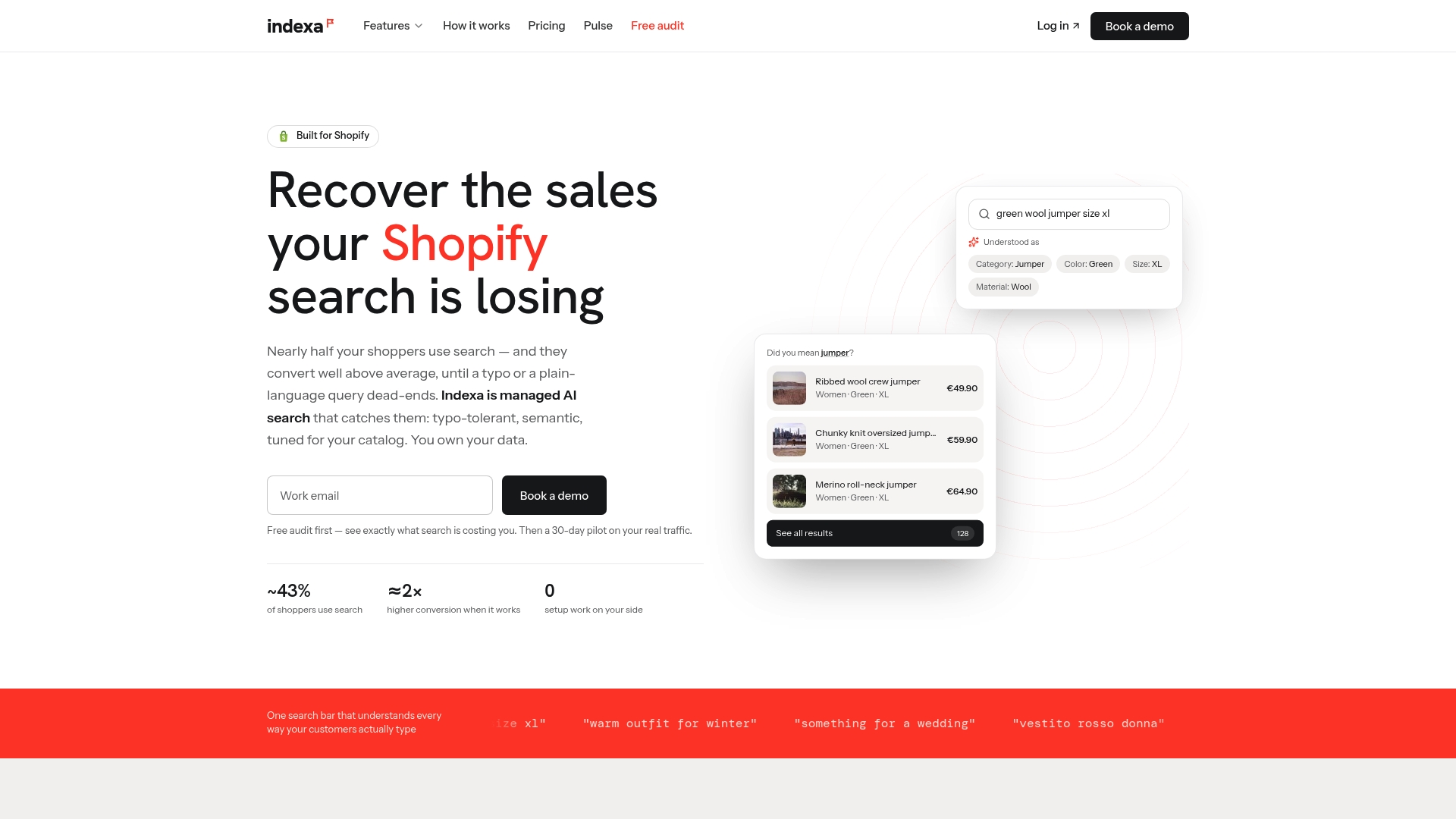
Indexa’s free audit reviews your store’s no-results queries, existing synonym coverage, and where shoppers are quietly failing to find products, no setup required to see the results. Stores dealing with recurring no-results across locales, a catalog spread across many languages, or simply no one on staff with time to own synonym maintenance are the best fit for this next step.
- The free audit surfaces your top no-results queries and quick wins across your current language setup.
- The 30-day pilot shows managed semantic tuning running against your real catalog and real search traffic.
- Both start from Indexa, with no code changes required on your end.
Book the audit or start the pilot to see what a managed semantic layer would recover from your current search traffic.
Key Shopify docs and industry reads to consult next
For the technical details behind everything above, keep these bookmarked:
- Shopify’s Predictive Search API reference for the current supported languages list.
- The Search & Discovery synonym rules for group limits and phrase handling.
- A practical breakdown of Shopify SEO automation for multilingual URL and metadata considerations.
Sources
- Predictive Search API reference
- Modifying search with Shopify Search & Discovery
- Shopify search and discovery (Pagefly blog)
FAQ
How can I use Shopify with multiple languages?
Enable additional languages from your Shopify admin using the built-in Translate & Adapt app or a third-party translation tool, then publish translated content for each locale. Each language gets its own URL path, and you will need to build separate synonym groups per language inside Search & Discovery since they do not share automatically.
What are some catchy names for a Shopify store?
There is no universal formula since a strong store name depends on your niche, audience, and brand tone rather than a fixed template. Focus on something short, easy to spell, and available as a domain and social handle, then test how it reads alongside your product category.
Does Kim Kardashian use Shopify?
This is not something the platform or the business itself confirms publicly, and no verifiable source ties that specific claim to a current storefront. Rather than repeat an unverified claim, it is more useful to look at what fashion and beauty brands actually need from Shopify’s search and localization tools, which is the focus of this guide.
Can you make $10,000 a month on Shopify?
Revenue on Shopify depends entirely on product, pricing, traffic, and conversion rate, so there is no fixed answer that applies across stores. Improving search relevance and reducing no-results pages, whether through synonym groups or a managed semantic search layer, is one lever known to lift search conversion, but it works alongside pricing, marketing, and product-market fit rather than in place of them.
Recommended
Make discovery work harder.
See what your Shopify search could do better with a free, hands-on audit.
Get your free search audit