Stop Revenue Loss When Migrating From InstantSearch+ on Shopify
Protect revenue when migrating from InstantSearch+ on Shopify. Start with an audit, run a 30 day pilot, and expect relevance gains in weeks.

Stop Revenue Loss When Migrating From InstantSearch+ on Shopify
Migrating from InstantSearch+ to a fully managed AI search service like Indexa typically improves relevance and recovers lost sales from failed searches, with activation taking minutes and measurable gains appearing within a few weeks of tuning. The process runs through an audit, data mapping, a staged pilot, and ongoing tuning, each step designed to protect revenue while the new system learns your catalog.
TL;DR:
- Migrating to a managed AI search service like Indexa requires a thorough audit, data mapping, staged testing, and careful rollout to avoid losing relevance or revenue.
- Properly handling search query types, no-results pages, filters, and autocomplete quality during the audit ensures the new system addresses core search issues with minimal disruption.
- Data preparation involves marking product fields as retrievable and enabling real-time event tracking, with a 24-hour window needed for new tiers to fully train.
- Incremental testing through A/A and A/B tests helps confirm measurement accuracy, with close monitoring of null search rates and other key metrics during rollout.
- Post-launch, continuous tuning using performance dashboards, manual adjustments for short-term merchandising, and consistent data tracking sustain search quality over time.
Table of Contents
- Your step-by-step checklist for migrating off InstantSearch+
- What a professional search audit covers and what it costs
- Preparing your catalog and event data for AI search
- Testing and rollout: how to validate the migration safely
- Keeping search tuned after launch
- How typo tolerance and semantic search close the gaps InstantSearch+ leaves open
- Mapping your data from InstantSearch+ to a new search system
- Integration challenges with your existing tech stack
- Communicating the change to your team and customers
- Fallback plans if the migration doesn’t go as expected
- SEO considerations during and after the migration
- Why a managed migration is the pragmatic choice for most merchants
- Getting started: audit, pilot, and activation with Indexa
- Sources
- FAQ
Your step-by-step checklist for migrating off InstantSearch+
A migration succeeds or fails based on the order of operations. Skipping the audit or rushing the pilot phase is how merchants end up with a system that looks fine in a demo but underperforms in production.
- Run a focused search UX audit to catch no-results pages, broken filters, and gaps in autocomplete before you touch any code.
- Map your catalog attributes, marking Title, Description, Brand, and Specs as retrievable, and confirm the UI fields (like SkuID) your storefront needs to render results.
- Export historical search events and turn on real-time event tracking for impressions, clicks, add-to-cart actions, and purchases.
- Set your query-expansion policy and canonical_filter so broader matches trigger only when the original query returns too few results, as described in Google Cloud’s retail search documentation.
- Hold off on aggressive manual boosts at launch. Let the system build a ranking baseline from real behavior first.
- Run an A/A test to confirm your measurement setup is clean, then move to A/B tests that split traffic by visitor ID.
- Track your baseline metrics (search click-through rate, null search rate, and revenue per visitor) before widening the rollout.
Pro Tip: Keep one variable changed per test. If you adjust ranking and query expansion in the same window, you will not know which change moved the numbers.
This order matters because each step feeds the next. The audit tells you what to fix, the data mapping gives the AI something to learn from, and the staged tests confirm the fixes actually worked before you commit the whole store. Merchants who jump straight to a full cutover often lose the ability to tell whether a dip in conversions came from the new system or from an unrelated seasonal shift. A managed AI upgrade sidesteps much of the manual configuration, but the sequence of audit, data readiness, and staged testing still applies no matter who runs the technical work.
What a professional search audit covers and what it costs
Before moving a single setting, you need a clear picture of what is actually broken. A proper audit looks at query types, how the site handles zero-result searches, facet behavior, autocomplete quality, and any merchandising rules that were patched together over time.
- Query types: whether the current search handles category terms, long-tail phrases, and misspellings equally well.
- No-results handling: whether a failed search dead-ends or offers alternatives, autosuggestions, or related categories.
- Facets and filters: whether filters narrow results correctly or occasionally return nothing when combined.
- Autocomplete quality: whether suggestions appear fast enough and match intent, not just literal text.
- Merchandising gaps: whether certain products or collections are invisible in search despite being in stock.
Professional UX audits commonly produce a 40 to 50 page report with 15 prioritized recommendations, often costing around $7,000, according to Baymard’s research on e-commerce search. That price point reflects the depth of manual review involved. Once you have the findings, convert each one into a workstream: critical fixes (dead no-results pages, broken facets) go into phase one of the migration, while lower-priority items like autocomplete tuning can wait until after launch. Indexa offers a free audit that applies the same logic without the upfront cost, using its own search audit checklist as a starting point for merchants who want to scope the work themselves first.
Preparing your catalog and event data for AI search
An AI search system is only as good as the data it can see. Before cutover, confirm which product fields are retrievable and which events are actually flowing into the system.
- Mark Title, Description, Brand, and Specs as retrievable so the AI can match natural-language queries to the right products.
- Expose UI-facing identifiers like SkuID so your storefront can render the exact variant a shopper clicked.
- Turn on real-time tracking for impressions, clicks, add-to-cart events, and purchases, since these signals are what the AI uses to learn which results actually convert, as detailed in examples of AI in eCommerce to boost sales and SEO.
- Import historical events where possible so the system has a baseline instead of starting cold.
Performance tiers on managed retail search platforms unlock only after data-quality checks pass, and training a newly unlocked tier typically takes about 24 hours, according to Google Cloud’s data quality documentation. That 24-hour window is why rushing the data migration backfires: if your event tracking is incomplete when you flip the switch, you are not just missing data, you are potentially stuck in a lower performance tier until the gap gets fixed and the system retrains. Use whatever data-quality console your platform provides to catch missing fields or broken event streams before launch rather than discovering them after traffic is already flowing through the new system.
Testing and rollout: how to validate the migration safely
A staged test protects you from that.
- Start with an A/A test, splitting traffic by visitor ID with no actual changes, to confirm your analytics setup is measuring consistently.
- Move to a single-variable A/B test, comparing the new system against InstantSearch+ on one clear axis, such as ranking relevance.
- Track search click-through rate, null search rate, searches-to-convert, and revenue per visitor throughout the test window.
- Expect a 24 to 72 hour warm-up period after any data or configuration change before metrics stabilize, since the system needs time to retrain on fresh signals.
- Widen the rollout gradually: pilot audience first, then a partial rollout, then a full launch once the metrics hold steady.
Null search rate is worth watching closely. A search platform that returns zero results for queries it should handle is actively pushing shoppers away, and Baymard’s usability research found that 68% of e-commerce sites have insufficient no-results handling. If your new system’s null rate looks similar to the old one, the migration hasn’t actually fixed the core problem yet.
Keeping search tuned after launch
Migration is not a one-time event. The weeks after launch determine whether the gains you saw in the pilot hold up at full volume.
- Build a dashboard that tracks performance-tier status, null-search rate, and conversion rate from search traffic.
- Use visual merchandising controls to pin seasonal items or promotions without overriding the AI’s learned ranking for everything else.
- Reserve manual boosts for specific, short-term situations (a clearance event, a limited drop) rather than as a default setting.
- Review event data monthly to confirm tracking hasn’t broken after a theme update or app change.
Pro Tip: If a product keeps underperforming in search despite good stock and reviews, check its retrievable fields first. A missing attribute is a more common culprit than a ranking problem.
Letting the automated tuning handle the bulk of ranking decisions, while reserving manual intervention for merchandising moments that matter to the business, tends to produce steadier results than constantly hand-adjusting rankings.
How typo tolerance and semantic search close the gaps InstantSearch+ leaves open
A large share of search failures trace back to a shopper typing something close to, but not exactly, a product name. Shopify’s own Storefront API documentation describes typo tolerance and predictive search as core features that require search tracking setup to work properly, which means the groundwork you laid in the data migration step directly determines how well these features perform.
Synonym handling solves a related but different problem: shoppers using different words for the same product (“sneakers” versus “trainers,” “jumper” versus “sweater”). Without synonym mapping, a search engine treats these as unrelated queries and returns nothing useful for one of them.
Semantic query support goes a step further, matching intent rather than exact keywords. A shopper searching “something warm for winter hikes” should see jackets and thermal layers, not just products with “warm” in the title. Baymard’s research on query types found that the biggest risk in a search migration is losing support for the query types shoppers actually use, and recommends prioritizing typo tolerance and synonym handling over chasing exact feature parity with the old system. That framing matters: the goal of migrating off InstantSearch+ is not matching every setting one-for-one, it’s making sure shoppers can still find what they want when they phrase it imperfectly.
Mapping your data from InstantSearch+ to a new search system
Data migration is where most of the actual risk lives. InstantSearch+ stores your catalog in its own index structure, and that structure rarely maps one-to-one to a new system’s schema.
Start by exporting your current index configuration: the fields you’re searching, the facets you’re filtering by, and any custom ranking rules you’ve built up over time. Then build a field-by-field map: Title maps to Title, but custom attributes (a “Fit Type” facet, a “Season” tag) need explicit decisions about whether they carry over, get renamed, or get dropped.
Avoid rendering raw search API responses directly into your storefront components. A safer approach is building a thin enrichment layer that merges the new system’s search output with your existing store data, so differences in attribute naming or structure between the two systems don’t break your product cards mid-migration. This also gives you a buffer: if the new system returns a field slightly differently than InstantSearch+ did, the enrichment layer absorbs that difference instead of surfacing a rendering bug to shoppers.

Historical event data deserves its own migration path. Where your platform allows it, import past impressions, clicks, and purchase events rather than starting the new system with zero history, since that history is what shortens the initial learning curve.
Integration challenges with your existing tech stack
Search rarely lives in isolation. It touches your theme, your analytics setup, any personalization apps, and sometimes custom checkout logic, so a migration that only replaces the search backend without checking these connections tends to surface problems later rather than sooner.
The most common friction point is the frontend rendering layer. If your theme was built around InstantSearch+'s specific response format, swapping the backend without adjusting the frontend will break facets, pagination, or sort order even if the underlying search quality improved. This is another reason an enrichment layer pays off: it isolates your theme from the raw differences between the old and new systems.
Analytics integration is the second common snag. If your event tracking was wired specifically to InstantSearch+'s event names or structure, you’ll need to remap those events to the new system’s tracking format, or your search click-through rate and conversion numbers will quietly stop updating without any visible error.
Shopify Hydrogen storefronts introduce their own considerations, since headless setups handle rendering differently than theme-based stores. Confirming that your chosen replacement has native support for your specific storefront architecture, rather than assuming generic compatibility, avoids a scramble after launch. A managed search provider that handles native Shopify and Hydrogen integration removes much of this coordination work, but even then, confirming that existing apps (reviews, personalization, loyalty) don’t depend on InstantSearch±specific hooks is worth doing before cutover.

Communicating the change to your team and customers
A search migration is mostly invisible to shoppers when done right, but internal teams need a heads-up. Customer support staff should know the launch date so they can flag unusual search complaints quickly rather than treating them as one-off bugs.
Merchandising teams need earlier notice than support staff. If they’ve been relying on manual boosts or pinned products in InstantSearch+, they need time to understand how the new system’s merchandising controls work before the old rules disappear. A gap here is where a lot of migrations lose internal buy-in: a merchandiser who can’t reproduce a promotion they used to run manually will assume the new system is worse, even if overall relevance improved.
For shoppers, there’s generally nothing to announce, since the people who pay for and manage the search system are the merchant’s team, not the shoppers themselves. The exception is if URL structures or search result pages change in a way that affects bookmarks or shared links, which is worth a brief note in a release log even if it never reaches customer-facing channels.
Internally, keep a shared document tracking what changed, when, and what metrics looked like before and after. This becomes useful not just during the migration but months later when someone asks why a ranking decision was made.
Fallback plans if the migration doesn’t go as expected
Every migration plan needs an exit ramp. Before you touch production traffic, confirm you can revert to InstantSearch+ quickly if the new system underperforms or breaks in a way you didn’t anticipate.
The staged rollout described earlier is itself a safeguard: because you’re testing on a small traffic split before a full launch, a rollback at the pilot stage affects a fraction of shoppers, not your whole store. Keep InstantSearch+ configured and billable in parallel during the pilot and partial rollout phases rather than canceling it the moment you start testing the replacement.
Set clear rollback triggers in advance rather than deciding in the moment. A spike in null search rate, a drop in revenue per visitor beyond an agreed threshold, or a critical bug in facet filtering are the kinds of conditions worth defining before launch, not after you’re staring at a dashboard wondering if the dip is normal noise or a real problem.
Document your rollback procedure the same way you documented the migration steps: what gets reverted, in what order, and who needs to be notified. A rollback that happens cleanly because it was planned looks very different from one that happens in a panic because nobody wrote down how InstantSearch+ was configured before you started.
SEO considerations during and after the migration
Search migrations usually touch internal site search rather than the pages Google indexes, but there are a few places where the two overlap. If your search result pages are indexable (some stores allow this for high-volume query terms), changing the URL structure or parameters during migration can create crawl or redirect issues worth planning for.
Check whether your current InstantSearch+ setup generates any indexed search landing pages, and if so, map those URLs to equivalent pages in the new system with proper redirects rather than letting them 404. Losing indexed pages that were quietly driving organic traffic is an avoidable cost of a careless migration.
Site speed is the other overlap point. Search widgets that load slowly or block rendering can affect Core Web Vitals, which Google factors into ranking. A managed search service that loads efficiently on the storefront side is a minor but real SEO consideration, separate from the relevance improvements that are the main point of the migration.
Finally, if your no-results pages were previously thin or empty, improving them as part of the migration (adding related categories, popular searches, or a search bar prompt) can reduce bounce rate on those pages, which is a secondary signal worth monitoring even though it’s not a direct ranking factor.
Why a managed migration is the pragmatic choice for most merchants
The appeal of a managed AI migration isn’t that it’s technically superior to a self-configured setup, it’s that it removes the ongoing engineering burden of tuning relevance by hand. Most merchants don’t have a dedicated search engineer, and InstantSearch+ setups often drift into a tangle of manual boosts nobody remembers the reasoning for.
The honest trade-off is that you give up some granular control in exchange for speed and lower maintenance. For a merchant watching revenue per visitor instead of index configuration, that trade usually pays off within weeks rather than months.
— Barikreativa
Getting started: audit, pilot, and activation with Indexa
The lowest-risk way to see whether a managed migration pays off is to start with proof, not commitment. Indexa’s free audit looks at the same query types, no-results pages, and facet issues covered earlier in this guide, scoped to your actual store rather than a generic checklist.
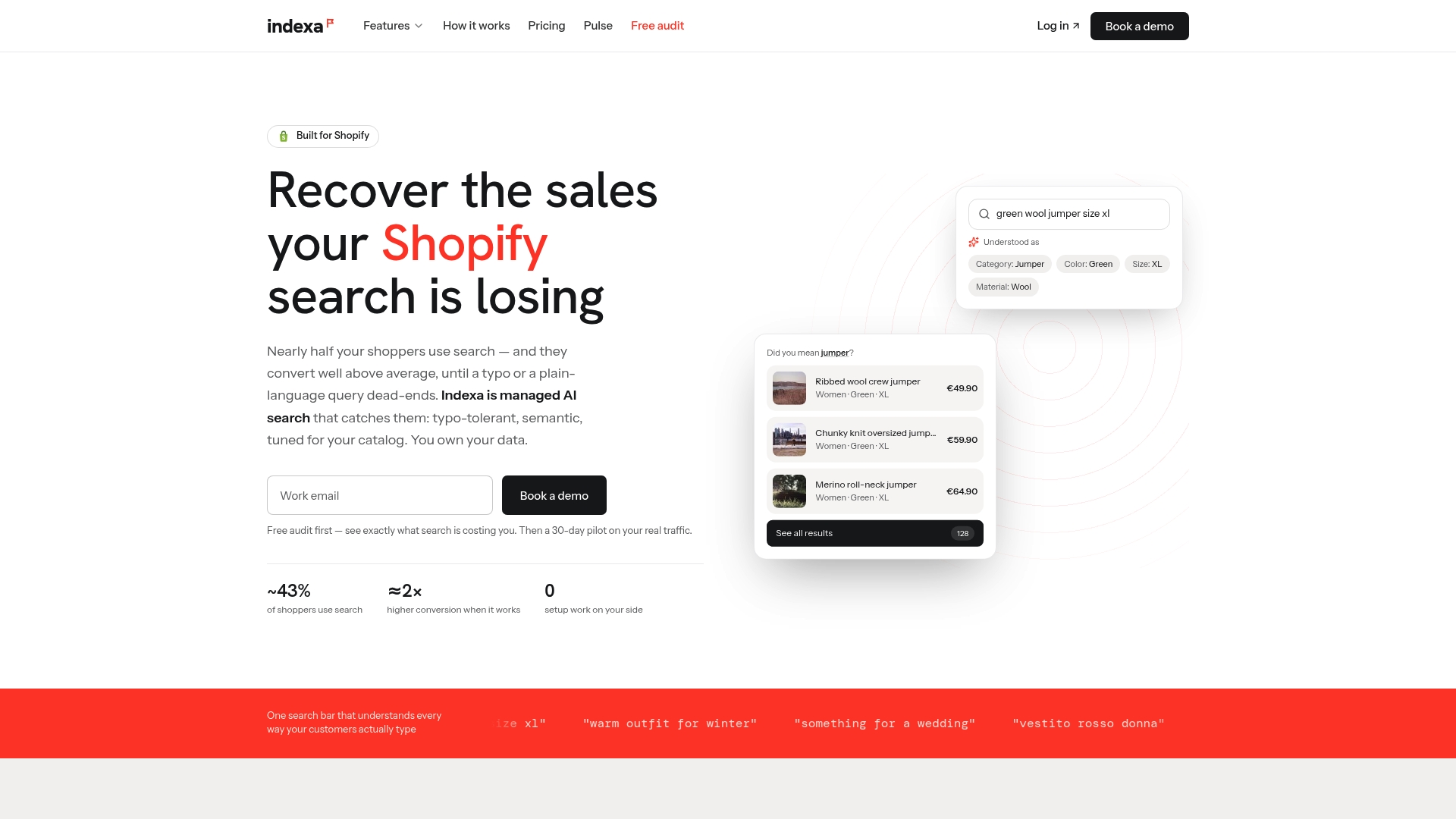
From there, the 30-day pilot lets you run a real A/B test against InstantSearch+ on a portion of traffic before committing to a full switch. Activation itself takes minutes since there’s no setup required on your end, though the tuning period that follows is where the real relevance gains show up over the following weeks.
- Start with an audit to see what’s actually costing you sales in search today.
- Run a pilot to measure uplift against your current setup before switching fully.
- Review the features and pricing pages to see what’s included in the flat monthly retainer and one-time setup fee.
If you’re ready to see what a managed migration looks like for your store, get started with Indexa and scope your first audit this week.
Sources
- Ecommerce Search UX Best Practices 2026 – Baymard
- Query expansion | AI Commerce Search in Gemini Enterprise for Customer Experience
FAQ
How long does migrating from InstantSearch+ take?
Activation on a managed service can happen in minutes, but meaningful relevance improvements typically take a few weeks as the system tunes on your event data. The audit and staged pilot phases, covered earlier, usually account for most of the calendar time rather than the technical switch itself.
What data do I need to prepare before migrating?
You need your catalog fields (Title, Description, Brand, and Specs marked as retrievable) and real-time event tracking for impressions, clicks, add-to-cart actions, and purchases. Importing historical events alongside this data helps the new system build a baseline faster instead of starting with no history.
Will I lose search rankings or SEO value during the migration?
Internal site search rarely affects organic rankings directly, but if your store has indexed search result pages, you should map old URLs to new ones with redirects to avoid losing indexed traffic. Page speed on the storefront is a secondary factor worth checking after the switch.
What happens if the new search system underperforms after launch?
A staged rollout (pilot, then partial rollout, then full launch) limits exposure if something goes wrong, and keeping InstantSearch+ configured in parallel during testing lets you revert quickly. Defining rollback triggers, like a spike in null search rate, before launch makes that decision faster if it’s needed.
Does Indexa require development work to set up?
No, Indexa activates without setup required on the merchant’s end and is billed as a flat monthly retainer plus a one-time setup fee, with pricing details available on its pricing page. Catalog syncing and typo-tolerant, semantic search are handled as part of the managed service once activated.
Recommended
Make discovery work harder.
See what your Shopify search could do better with a free, hands-on audit.
Get your free search audit