Switch Off Expertrec on Shopify in 2–4 Weeks Without Extra Engineers
Move search off Expertrec to Shopify in 2–4 weeks with a phased shadow index. Pick a managed Shopify native route or run the DIY migration playbook.

Switch Off Expertrec on Shopify in 2–4 Weeks Without Extra Engineers
The fastest safe way to stop using Expertrec is a phased migration that keeps Shopify as the source of truth and runs a shadow index until cutover. For a medium-complexity catalog, plan on 2 to 4 weeks, with success measured by working queries, a lower zero-results rate, and search-driven revenue that recovers or improves after the new engine goes live.
TL;DR:
- Using a phased migration with a shadow index typically takes 2 to 4 weeks for medium-complexity stores, with success measured by query accuracy and revenue recovery.
- Shopify’s Catalog API allows direct, no-scrape data integration, reducing risk and maintaining real-time pricing and availability during migration.
- A shadow index should run for at least a week before cutover to capture typical traffic patterns and prevent performance issues.
- Most migration failures stem from missing attributes, stale inventory, or CORS/configuration errors, which should be verified through testing before live launch.
- Managed Shopify-native services like Indexa often deliver faster revenue recovery and simpler setup for merchant teams without developer resources.
Table of Contents
- Which replacement category fits your store?
- Step-by-step migration playbook you can run
- Shopify-specific migration considerations
- Timeline, resource estimate, and cost signals
- Common pitfalls and how to verify a clean cutover
- Why a managed Shopify-native route often wins on speed
- Getting a managed migration off the ground with Indexa
- Where to verify these technical details
- Sources
- FAQ
Which replacement category fits your store?
Before picking a tool, sort your options into categories. Each one trades engineering effort for control in a different way.
- Managed Shopify-native: A vendor handles setup, indexing, and tuning for you, which suits merchant-led teams with no dedicated developer.
- Hosted API-first: You get a powerful search API and dashboard, but your team writes the integration, ranking rules, and merchandising logic.
- Self-hosted or open-source: You run the search infrastructure yourself, which gives full control over ranking and data residency at the cost of ongoing maintenance.
- Hybrid: A hosted engine paired with custom middleware, often chosen by teams that want API flexibility without building indexing pipelines from scratch.
Dev effort rises as you move from managed to self-hosted, while control over ranking and merchandising rises in the same direction. Multilingual support varies widely: some hosted platforms handle it natively, while others need custom synonym and language configuration. Cost predictability also differs. A flat retainer is easier to budget than usage-based pricing that scales with query volume or index size.
A merchant-facing team with no developer on staff usually does best with managed Shopify-native tools. A dev-led team that wants to fine-tune ranking logic often prefers hosted API-first platforms. Enterprises with strict data governance requirements sometimes justify self-hosted infrastructure, and cost-sensitive stores with simple catalogs can often get by with a lighter hybrid setup.
Step-by-step migration playbook you can run
This sequence works whether you build it yourself or hand it to a managed provider. Each phase produces something you can verify before moving to the next.
- Audit first. Pull query logs, top searches, zero-results queries, existing synonyms, and any merchandising rules currently tied to Expertrec.
- Export and map your data. Capture product IDs, variants, images, attributes, price, availability, and canonical URLs so nothing gets dropped in translation.
- Build a sync pipeline. Subscribe to webhook or event feeds, index incrementally, and add a retryable queue with a reconciliation job that catches drift.
- Index and tune. Map your schema, load synonyms, configure typo tolerance and ranking rules, and set up merchandising with real test data.
- Test and verify. Run a shadow index alongside Expertrec, A/B test a sample of traffic, and check a query set that includes plurals, misspellings, and long-tail phrases.
- Cut over with a rollback plan. Swap the search widget, watch your monitoring dashboard closely, and define the exact triggers that would send you back to Expertrec.
Developer notes matter here. Store API keys server-side, never in client-visible scripts. Configure CORS and CSP headers before you inject any new storefront script, and rotate credentials once the old integration is fully retired.
Pro Tip: Run the shadow index for at least a full week before cutover so it captures a normal traffic cycle, not just a quiet weekday.

Shopify-specific migration considerations
Shopify stores have a structural advantage during migration: the platform itself can serve as the single source of truth for catalog data, so you never need to scrape product pages to rebuild your index.
- Build against the Catalog API rather than scraping storefront pages, since Shopify’s Catalog API explainer describes a native surface with
search_catalog,lookup_catalog, andget_producttools that keep pricing and availability current. - Migrate topic by topic. Shopify’s own guidance on how to migrate from webhooks confirms that Events and classic webhooks can run side by side while you test, since Events payloads are GraphQL-shaped and some topics are not yet supported.
- Use the lookup flow in the Catalog API to resolve product URLs so pricing and availability stay live instead of relying on a cached snapshot.
- If you build on Hydrogen, account for Sign in with Shop and rate-limit behavior on your credentials before you scale traffic to the new index.
Building on Shopify’s own catalog surface instead of scraping product pages is the more reliable path, according to the Catalog API explainer, which reports higher conversion for Catalog-powered search compared to scraped approaches. This is also where a managed Shopify-native service reduces risk: there is no client-side setup to maintain, and tuning continues in the background instead of falling on your team.
Timeline, resource estimate, and cost signals
Scope depends on catalog size and how customized your current Expertrec setup is.
- Simple catalogs (a few hundred SKUs, minimal merchandising) typically take 1 to 2 weeks.
- Medium complexity (multiple collections, synonyms, and merchandising rules) runs 2 to 4 weeks.
- Complex catalogs (large SKU counts, multilingual search, heavy customization) can take 4 to 8 weeks or more.
You will need a developer for the sync pipeline, an integrator to handle the storefront widget swap, a merchandiser to rebuild ranking and pinning rules, and someone on QA or analytics to validate results before and after cutover. Pricing models change the math too: a flat retainer is easier to forecast than a per-query or per-index fee that scales with traffic, making Shopify SEO automation an important consideration for stores tracking analytics and conversion metrics after search migration. Factor in the opportunity cost of the tuning period itself, since a search engine that has not yet learned your catalog will convert worse than a mature one. As a decision rule, teams without spare developer bandwidth usually come out ahead hiring a managed provider rather than building and maintaining the pipeline in-house.
Common pitfalls and how to verify a clean cutover
Most migration failures trace back to a handful of repeatable mistakes.
- Missing facets or attributes that existed in Expertrec but were not mapped during export.
- Stale inventory caused by a sync pipeline with no reconciliation job to catch missed events.
- Broken CORS or CSP rules that silently block the new search widget from loading.
- Analytics gaps where search events stop firing because tracking code was swapped along with the widget.
Before you fully cut over, run a verification pass: fire a sample query set, check that merchandising rules pin the right products, smoke-test your top three landing funnels, and confirm zero-results queries actually return something useful. After launch, watch query success rate, zero-results rate, search-driven revenue, and the conversion delta against your Expertrec baseline. Set rollback triggers ahead of time, such as a zero-results spike or a conversion drop past a defined threshold, so you can revert the widget without a panicked mid-incident decision.
Pro Tip: Keep your old Expertrec integration dormant but ready for 48 hours after cutover so rollback is a config change, not a redeployment.
Why a managed Shopify-native route often wins on speed
Most merchants care less about which engine wins a feature comparison and more about how fast lost revenue comes back. A managed Shopify-native route tends to win there, because it skips the weeks a DIY team spends learning the catalog before ranking quality catches up. That said, teams that need granular control over ranking algorithms or custom relevance logic are usually better served building or hosting it themselves. Judge any option by the problem it fixes, not by its feature list.
— Barikreativa
Getting a managed migration off the ground with Indexa
A managed Shopify-native service can handle the entire migration: setup, typo-tolerant and semantic search, and ongoing tuning, all native to Shopify with minimal client configuration required.
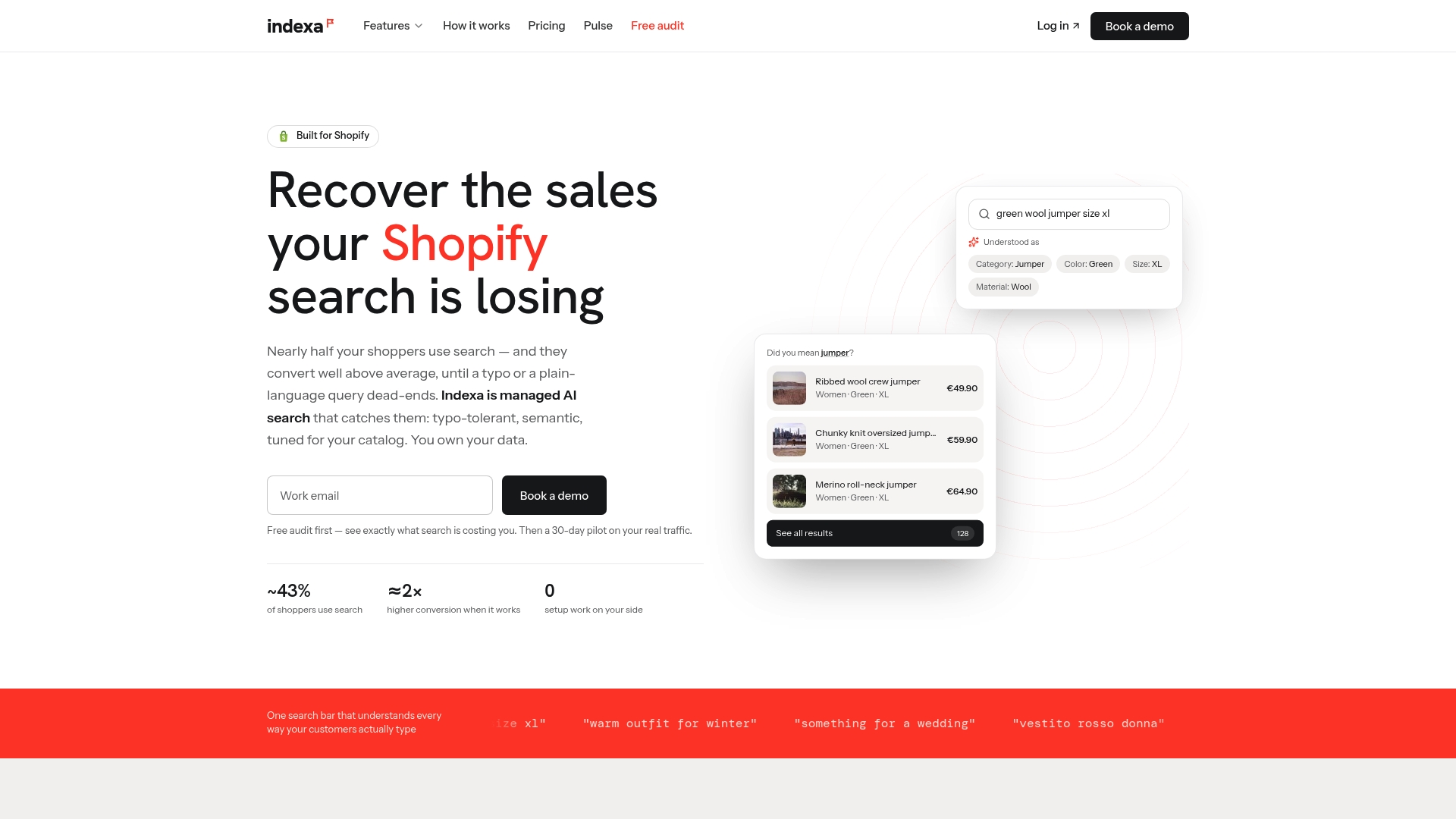
The typical path starts with a free audit of your current search performance, followed by a 30-day pilot where you can measure search-driven revenue and zero-results rate against your Expertrec baseline before committing. If you want a hands-off comparison to a self-serve tool, see how Indexa’s managed Shopify-native approach differs before you decide. Ask for those two metrics specifically during the pilot: they tell you in 30 days whether the switch is worth making permanent.
Where to verify these technical details

Confirm the specifics against Shopify’s own webhook migration guide, the Catalog API explainer, and vendor comparisons on G2.
Sources
FAQ
How long does a typical Expertrec migration take?
Most medium-complexity Shopify catalogs take 2 to 4 weeks using a phased, shadow-index approach. Simple catalogs can finish in 1 to 2 weeks, while large or multilingual catalogs can run 4 to 8 weeks or longer.
Should I migrate to a hosted API platform or a managed service?
It depends on whether your team can maintain a sync pipeline and tuning process long term. Teams without spare developer bandwidth usually get faster, steadier results from a managed Shopify-native service, while dev-led teams that want fine-grained ranking control often prefer a hosted API-first platform.
Do I need to scrape my Shopify store to rebuild search data?
No. Shopify’s Catalog API exposes product, lookup, and search tools directly, which keeps pricing and availability accurate without scraping storefront pages.
What should I test before fully cutting over from Expertrec?
Run a shadow index alongside your current setup, test a query set that includes misspellings and long-tail phrases, and check that merchandising rules and analytics events fire correctly. Confirm your rollback trigger and process are ready before the widget swap goes live.
How does Indexa’s migration differ from a DIY approach?
Indexa handles setup, indexing, and ongoing tuning for you with no client-side configuration, starting with a free audit and a 30-day pilot to measure results against your Expertrec baseline. A DIY migration gives you more control over ranking logic but requires your own developer time to build and maintain the sync pipeline.
Recommended
Make discovery work harder.
See what your Shopify search could do better with a free, hands-on audit.
Get your free search audit