Recover Lost Sales on Shopify: Fix Long Tail Queries in 30 Days
Audit your Shopify no results, fix autocomplete, synonyms, and facets, then run a 30 day pilot to recover lost sales from long tail queries.

Recover Lost Sales on Shopify: Fix Long Tail Queries in 30 Days
Long-tail onsite queries on Shopify, the rare, specific, and often misspelled searches shoppers type into your store’s search bar, are a common and measurable cause of lost sales. Fix autocomplete so it never points to a dead end, add automatic query rewriting for zero-hit searches, tighten facets, and instrument your no-results logs. A managed, fully tuned search upgrade is available when you need faster results than an in-house fix can deliver.
TL;DR:
- Fix autocomplete to ensure suggestions lead to relevant results and avoid recommending queries that return zero matches.
- Implement automatic query rewriting strategies such as term dropping, replacement, or typo correction to recover most zero-hit search instances.
- Build synonym groups and attribute-based filters to better match use-case phrases and product attributes in long-tail searches.
- Regularly review no-results search logs and conduct short pilots to identify the most common recoverable queries for targeted fixes.
- Consider a managed, AI-driven search service for ongoing relevance improvements, especially if high no-results volume or recurring misspellings persist.
Table of Contents
- Why rare onsite queries matter for your revenue
- Common failure modes that break long-tail search
- Prioritized fixes for autocomplete, rewriting, and facets
- Shopify checklist and quick tests for query recovery
- When a managed, AI-driven search makes sense
- Examples of effective long-tail query optimization
- Impact of long-tail queries on SEO and traffic
- Tools and apps for managing long-tail queries
- Best practices for content and metadata
- Case studies and success stories in query recovery
- Author perspective and practical prioritization
- Get a free audit and a 30-day pilot
- FAQ
- Sources
Why rare onsite queries matter for your revenue
A long-tail onsite query, in this context, is not an SEO keyword you target for Google rankings. It is what a real shopper types into your Shopify search box: a misspelling, a use-case phrase like “gift for someone who hates jewelry,” an abbreviation, or a product-specific request your catalog does not literally contain. These queries are individually rare but collectively make up a large share of search traffic, and most store search engines handle them poorly.
Baymard Institute’s 2026 research found that ecommerce sites fail non-product queries 66% of the time, abbreviation and symbol queries 54% of the time, and use-case queries 43% of the time. These are exactly the query types that make up the long tail on a typical Shopify store.
When a shopper’s query returns nothing relevant, the usual outcome is not a refined second search. It is abandonment, a retreat to browsing categories, or an exit entirely. Every one of those zero-hit moments is a shopper who had intent and purchasing power and left with neither satisfied.
Common failure modes that break long-tail search
Most Shopify stores lose long-tail traffic to the same handful of problems, and they are usually easy to spot once you know where to look.
- Autocomplete suggests queries that themselves return zero results, which Baymard’s research on misspelling suggestions found is worse for users than offering no suggestion at all.
- Search matches only literal catalog text, missing use-case or symptom-style phrasing like “waterproof for rain” or “quiet for apartments.”
- There is no automatic rewriter for zero-hit searches, so a single typo or extra word kills the entire query instead of triggering a term drop or replacement.
- Filters and facets are built around categories, not the attributes shoppers actually search by, such as size, material, or occasion.
- Nobody is reviewing search logs, so the store has no idea which queries return nothing and how often it happens.
Any one of these gaps is enough to sink a meaningful share of long-tail traffic. Most Shopify stores running default or lightly configured search have several at once.
Prioritized fixes for autocomplete, rewriting, and facets
Not every fix carries equal weight, and tackling them in the right order matters more than tackling all of them at once.
- Fix autocomplete first. Confirm predictive search has typo tolerance and that every suggested completion actually resolves to results. Nielsen Norman Group is blunt about this: a suggestion that leads nowhere is worse than no suggestion.
- Add zero-hit query rewriting. Research into how shoppers revise failed searches found that automatic rewriting strategies recover the large majority of zero-hit queries, split roughly between term replacement (29%), term dropping (27%), typo correction (26%), and rephrasing (17%). Build or configure a pipeline that tries these before showing an empty page.
- Build synonym groups and assign search terms. Map the phrases shoppers actually use to the products you actually sell, and use targeted boosts to push high-intent queries to the right result.
- Tighten facets for attribute-driven queries. When someone searches “waterproof jacket men’s large,” the filters for waterproof, men’s, and large should preapply rather than forcing a manual click-through.
- Layer in personalization and progressive matching. Tiered matchers that fall back from exact to fuzzy to semantic help cover queries too rare to have reliable frequency data on their own.
- Measure continuously. Set up a top no-results report, track search conversion rate separately from browse conversion rate, and watch bounce rate from the search results page.
Pro Tip: Pull your current top 50 no-results queries before changing anything. That list alone usually reveals which fix matters most for your specific catalog.
Shopify checklist and quick tests for query recovery
Turning the priorities above into concrete Shopify work does not require a full platform migration. Most of it can be checked and adjusted inside the admin or through the Search & Discovery app.
- Confirm predictive search is enabled and test typo tolerance directly: search a common product name with one letter swapped and see what comes back.
- In the Search & Discovery app, add synonym groups, assign specific search terms to key products, and set boosts for your highest-value queries, following Shopify’s own guidance on built-in search behavior.
- Add or refine faceted filters so product type, feature, and use-case attributes are available to narrow long, ambiguous result sets.
- Export your search analytics and build a running list of top no-results terms alongside search click-through-to-conversion rates.
- Run four live tests: a common misspelling, a use-case phrase, an abbreviation, and a deliberately broken query to confirm your zero-hit recovery actually works.
A large share of sites do not offer relevant autocomplete suggestions for closely misspelled queries, according to Baymard’s benchmark research, which makes this one of the highest-leverage single checks you can run this week.
Use our free Shopify search checklist as a working document while you run these tests, since checking boxes against a real list catches gaps a quick glance misses.
When a managed, AI-driven search makes sense
Fixing autocomplete, synonyms, and facets in-house works, but it takes sustained attention: someone has to review logs weekly, update synonym groups as inventory changes, and retune boosts as new products launch. A managed solution makes sense when no-results volume is high, the same misspellings keep recurring, your team has limited bandwidth for ongoing tuning, or you need recoverable revenue fast rather than over a multi-quarter project.
A fully managed AI search and discovery service built specifically for Shopify stores is available, featuring typo-tolerant and semantic matching that understands natural shopper language rather than only literal catalog text. Setup requires no work on your end, and relevance is tuned continuously using real search data from your own store rather than a one-time configuration. The service includes a visual merchandising grid editor, product recommendations, and integrated analytics, and it installs natively on Shopify storefronts, including headless builds on Hydrogen. Data ownership remains with the store owner throughout.
A typical pilot starts with an audit that surfaces actual top no-results queries, then runs for 30 days to measure conversion lift against a clear baseline. You can read more about how this compares to running Shopify’s native Search & Discovery app alone if you are weighing a managed upgrade against further in-house tuning.
Examples of effective long-tail query optimization
The clearest wins come from treating long-tail failures as a catalog mapping problem rather than a pure engineering one. A fashion retailer whose shoppers search “dress for wedding guest” instead of any literal product name benefits from synonym groups that tie occasion language to product attributes already tagged in the catalog, so the search engine matches intent rather than exact text.
Abbreviation handling is another recurring pattern. Shoppers searching “XL” or “M” alongside a product name need that token matched against size attributes, not treated as unrecognized noise that drops the whole query to zero results. Stores that map these consistently see fewer dead-end searches on exactly the queries Baymard’s research flags as frequent failure points.
Typo recovery matters just as much for specialty catalogs with hard-to-spell brand or ingredient names. A beauty retailer selling a product with an unusual name benefits disproportionately from typo-tolerant matching, since a single transposed letter in an uncommon word is far more likely than in a common one.
Progressive matching, falling back from exact match to fuzzy to semantic, handles the queries too rare to fit any synonym list you build manually. This tiered approach, described in engineering research on personalized autocomplete, lets common queries stay fast while rare ones still resolve to something relevant instead of nothing at all.

Impact of long-tail queries on SEO and traffic
Long-tail onsite search behavior and long-tail SEO keyword targeting are different disciplines, but they intersect in one practical way worth noting: the queries shoppers type into your onsite search bar are a direct record of the language your actual buyers use, independent of what external search engines report. That data is a gift for product page copy and metadata, because it reflects intent you did not have to guess at.
When onsite search routes a long-tail query to a relevant product or collection page instead of a dead end, that page gets an internal click and a longer session, both of which are stronger engagement signals than a bounce from a failed search. A shopper who finds what they searched for converts; one who hits zero results and leaves contributes to a higher site-wide bounce rate, which drags on every page’s performance metrics, not just the search results page.
Site search also acts as free, ongoing market research. Shopify’s developer documentation recommends tracking search analytics specifically to feed relevance improvements, and that same data set doubles as a list of phrases worth testing in product titles, descriptions, and collection pages. If “waterproof for rain” shows up repeatedly in your no-results log, that is a phrase your product copy is probably missing, both for onsite search and for how shoppers describe their need before they ever reach your store.
Tools and apps for managing long-tail queries
Shopify merchants have a layered set of options depending on how much control and customization they need. Shopify’s built-in Search & Discovery app covers the basics: predictive search, typo tolerance, synonym configuration, product boosts, and analytics reporting, all without a third-party integration. For many smaller catalogs, configuring this well solves most long-tail problems outright.
Larger or more complex catalogs often outgrow the native app’s customization limits and move to dedicated search platforms, several of which merchants evaluate as direct swaps into the same role the default app plays. If you are comparing options in that category, our notes on positioning against Algolia, Klevu, Searchanise, and Doofinder lay out where a fully managed service differs from a self-configured platform.
Search speed also affects how well predictive and progressive matching feel to a shopper, since a slow first keystroke response undercuts even well-tuned autocomplete. A roundup of caching plugins for Shopify is worth a look if your store’s overall page speed is dragging down the responsiveness of search-adjacent features alongside everything else.
Whichever layer you choose, the deciding factor is usually ongoing maintenance capacity: a native app configuration needs someone to revisit it as inventory shifts, while a managed service handles that tuning as part of the service itself.
Best practices for content and metadata
Search relevance improves fastest when your catalog’s metadata already speaks the language your shoppers search in, rather than relying entirely on the search engine to bridge the gap at query time.
Tag products with the attributes shoppers actually filter and search by: size, material, color, occasion, and use case, not just the taxonomy your supplier feed happens to provide. Baymard’s research recommends applying these attributes dynamically as filters and redirecting clear category matches straight to the relevant collection page rather than a generic result list.
Product titles and descriptions should include the natural-language phrases that show up in your no-results logs, since those are confirmed real shopper language rather than guesses. If “quiet for apartments” keeps appearing as a failed search for a product you sell for exactly that reason, work that phrase into the description.
Collection pages benefit from the same treatment: a collection titled only with a product-type name misses the use-case and occasion searches that a slightly longer, more descriptive title and metadata set would catch. Consistency matters too. If your metadata uses one term and your synonym groups use another, you are maintaining two sources of truth that can drift apart over time.
Case studies and success stories in query recovery
The pattern across stores that fix long-tail search tends to follow the same sequence: audit the no-results log, find a concentrated cluster of recoverable queries, apply targeted fixes, and measure the lift against a clear baseline rather than a vague sense of improvement.

A specialty retailer dealing with a catalog full of technical or hard-to-spell product names typically finds that a large share of its zero-hit queries trace back to a small number of recurring misspellings and abbreviations rather than a broad, unsolvable spread. Once those specific terms are mapped with synonyms and typo correction, the no-results rate for that segment drops sharply because the fix was narrow and targeted rather than a full platform rebuild.
This is also the structure behind a 30-day pilot: identify the top recoverable queries first, apply fixes, then measure conversion rate on search sessions before and after. That window is usually enough to show whether the fix is working, since search behavior does not require a long observation period the way broader traffic trends sometimes do.
The common thread in every version of this story is that the fix followed the data. Teams that start by fixing whatever seems intuitively broken, rather than what the no-results log actually shows, tend to spend effort on queries that were never costing them much in the first place.
Author perspective and practical prioritization
Start with measurement, not intuition: pull your no-results log before touching autocomplete or synonyms, because it tells you which fix actually matters for your catalog. Run small experiments and a short pilot before committing to a larger platform change. Most stores overestimate how much customization they need and underestimate how much a clean audit alone reveals.
— Barikreativa
Get a free audit and a 30-day pilot
A free Shopify search audit is available that surfaces actual top no-results queries and flags conversion opportunities, with no setup required on your end.
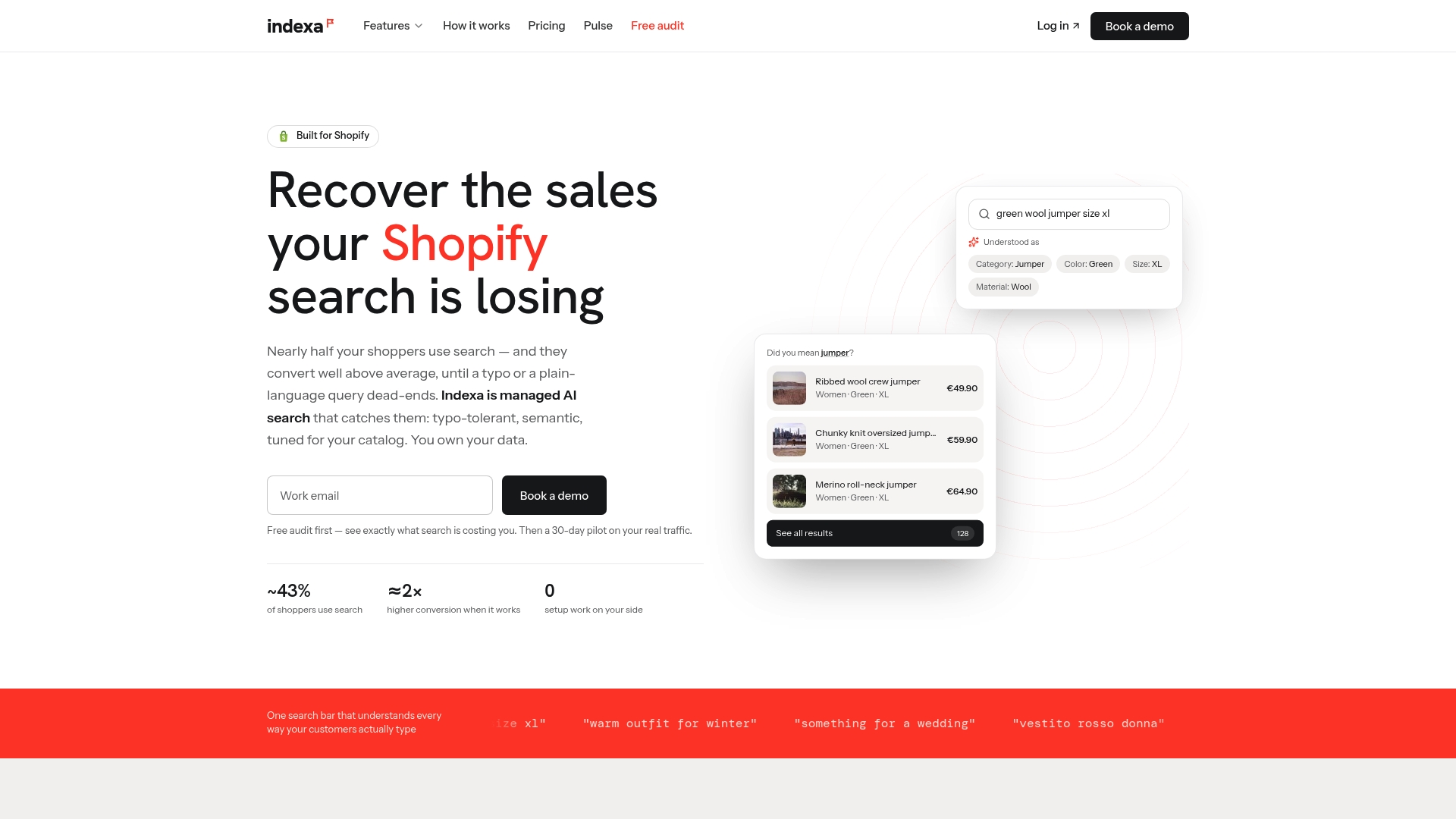
From there, a 30-day pilot measures recoverable revenue against your current baseline before you commit to anything ongoing, and a flat monthly retainer covers continued tuning after that.
- Request the free Shopify search audit to see your own no-results data.
- Review pricing and pilot details for the 30-day pilot and monthly retainer.
- Explore the full feature set, including typo tolerance, synonyms, and merchandising tools.
FAQ
What causes zero results for long-tail searches on Shopify?
Zero results usually come from a search engine matching only literal catalog text against a shopper’s exact words, with no handling for misspellings, synonyms, or use-case phrasing. Baymard’s research found this failure is common across non-product, abbreviation, and use-case query types specifically.
How does query rewriting fix zero-hit searches?
Query rewriting automatically retries a failed search using term dropping, term replacement, rephrasing, or typo correction before showing the shopper an empty page. Research on zero-hit query revision found these strategies recover the large majority of zero-hit queries when applied automatically.
Does Shopify’s built-in search handle typo tolerance?
Yes, Shopify’s Search & Discovery app includes built-in predictive search with typo tolerance and synonym configuration, though larger catalogs sometimes need additional tuning beyond the defaults.
What does Indexa’s managed search service cost?
Indexa prices a one-time setup fee and a flat monthly retainer, with current details available on the pricing page; a free audit and 30-day pilot are available before committing to the retainer.
How quickly can a store see results from fixing long-tail search?
A focused 30-day pilot is generally enough to measure conversion lift on search sessions, since fixes to autocomplete, synonyms, and zero-hit handling tend to show up in search conversion data quickly once they are live.
Sources
- Baymard Institute — ecommerce search query types
- Site search suggestions – Nielsen Norman Group
- How do users revise zero-hit product search queries? — research analysis
Recommended
Make discovery work harder.
See what your Shopify search could do better with a free, hands-on audit.
Get your free search audit