30–40% Energy Loss: When Liquid Hydrogen Wins for Engineers
Practitioner-first comparison of liquid and compressed hydrogen for storage and transport. Learn when LH2's 30–40% liquefaction loss pays off for project...
30–40% Energy Loss: When Liquid Hydrogen Wins for Engineers
For bulk, long-distance transport and dense storage, liquid hydrogen usually wins; for local distribution and short-term buffering, compressed gas usually wins. Liquid hydrogen packs roughly 848 times more energy per unit volume than gaseous hydrogen at standard pressure, but liquefaction consumes roughly 30% to 40% of the fuel’s own energy content just to get it cold enough to pour. The right answer depends on scale, distance, boil-off tolerance, and how much capital you’re willing to sink into cryogenic infrastructure.
TL;DR:
- Liquefaction consumes roughly 30% to 40% of hydrogen’s energy to reach cryogenic temperatures, making gaseous hydrogen more efficient for short-distance and small-scale transport.
- Boil-off rates in liquid hydrogen storage are minimized with vacuum-insulated tanks, but active boil-off gas recovery is essential for long idle periods to avoid significant product loss.
- Pipelines are only practical for steady, high-demand routes due to enormous fixed infrastructure costs, while cryogenic tankers efficiently support long-distance shipping of liquefied hydrogen.
- Purity requirements are stricter for liquefied hydrogen, as contaminants can freeze and clog equipment, adding costs for upstream cleaning and specialized materials.
- When deciding between liquid and gaseous hydrogen, consider volume, distance, frequency, and upfront capital, with gaseous options often being cheaper and simpler at smaller scales.
Table of Contents
- Hydrogen vs Liquid: The Core Metrics Compared
- Production and Energy Cost Trade-Offs
- Cryogenic Storage Design and Boil-Off Control
- Transport and Logistics: Tankers, Pipelines, and Compressed Gas
- Safety, Materials, and Engineering Constraints
- Lifecycle and Environmental Trade-Offs
- How to Choose Between Liquid and Gaseous Hydrogen
- Comparing Liquid Hydrogen to Metal Hydrides and Chemical Carriers
- Where Hydrogen Liquefaction and Storage Technology Is Headed
- Regulatory and Standards Differences Between Liquid and Gaseous Hydrogen
- Why Hydrogen Purity Matters More for Liquid Hydrogen
- Squeezing More Efficiency Out of Liquefaction and Compression
- Author Perspective: Pragmatic Recommendations for Engineers and Planners
- Sources
- FAQ
Hydrogen vs Liquid: The Core Metrics Compared
The two forms trade density for energy cost, and that trade shows up in nearly every downstream decision. Liquid hydrogen (LH2) sits at around 70.8 kg/m³ at its boiling point, versus a much lower density for hydrogen gas at atmospheric pressure. That volumetric advantage is why LH2 shows up wherever space and payload matter, like rocket propellant tanks or long-haul cryogenic trailers.
Gravimetric energy density, by contrast, barely changes between the two states. Hydrogen holds roughly 120 MJ/kg either way. The container is what changes, not the fuel.
- Volumetric energy density: LH2 stores about 848 times more hydrogen per liter than ambient gas, cutting tank and trailer footprint dramatically.
- Liquefaction energy input: Cooling hydrogen to about 20 Kelvin typically consumes 10 to 13 kWh per kilogram, or roughly 30% to 40% of the fuel’s own lower heating value.
- Compression energy input: Pushing gas to 350 to 700 bar for trailers or vehicle tanks costs an order of magnitude less energy than liquefaction.
- Operational losses: LH2 tanks lose product to boil-off gas continuously; compressed systems lose comparatively little beyond seal leakage and minor line losses.
Liquefaction alone can consume 30% to 40% of hydrogen’s own energy content before a single kilogram reaches a customer. That penalty is the single biggest reason gaseous pathways still dominate short-haul and small-scale distribution, even though LH2 wins on density.
Production and Energy Cost Trade-Offs
Liquefaction runs through several stages: pre-cooling with liquid nitrogen or mechanical refrigeration, expansion cooling (often via Claude or Linde cycles), and final cooling to the 20 Kelvin boiling point. A less obvious energy sink is ortho-para conversion. Hydrogen gas at room temperature is mostly the ortho spin isomer, but liquid hydrogen needs to be mostly para, or it slowly boils itself off as it converts in storage. Plants add catalytic conversion stages to manage this, and skipping that step just shifts the loss downstream into the customer’s tank.
- Pre-cooling and cascade refrigeration dominate early-stage energy use.
- Ortho-para catalytic conversion adds equipment cost but reduces post-liquefaction boil-off.
- Compression avoids both of these steps entirely, which is why its energy cost per kilogram stays so much lower.
Scale changes the math. A large liquefaction plant running continuously can push costs down through economies of scale, while a small compressor skid serving a single fueling station stays cheap regardless of throughput. Distance matters too: past a certain haul length, the extra energy density of LH2 starts paying back its liquefaction penalty, because you’re moving far more hydrogen per truck trip and burning less diesel per kilogram delivered.
Cryogenic Storage Design and Boil-Off Control
Boil-off gas (BOG) is the quiet cost center of every LH2 system. Heat inevitably leaks into the tank, and that heat boils a small fraction of the liquid every day, venting hydrogen unless it’s captured. Large-scale project designs now target boil-off rates below 0.1% per day, a threshold that drives serious insulation engineering.
Vacuum-jacketed tanks with multilayer insulation cut heat leak much more effectively than simpler foam-insulated designs; however, they increase construction cost and require ongoing vacuum-integrity monitoring. Non-vacuum insulation is cheaper upfront and fine for smaller, shorter-duration storage, but it bleeds far more product over weeks of dormant storage.
Operators manage BOG through a few proven methods: reliquefaction using onsite cryocoolers, recirculation loops that recondense vapor before it vents, and, where reliquefaction isn’t practical, capturing the vented gas for lower-value use rather than flaring it.
Pro Tip: If your project involves LH2 storage sitting idle for more than a few days at a time, budget for active boil-off gas (BOG) recovery from the start, as retrofitting cooling equipment later tends to be costly.
Transport and Logistics: Tankers, Pipelines, and Compressed Gas
Pipelines make sense only where gaseous hydrogen demand is steady and geographically concentrated, since the infrastructure cost is fixed and enormous regardless of how much you actually ship. They’re the cheapest option per kilogram once built, but they’re impractical for one-off or emerging routes.
- Compressed gas trailers work best for short hauls and smaller daily volumes, where the compression energy penalty is small relative to total trip cost.
- Cryogenic LH2 tankers, built with vacuum-jacketed tanks and specialized transfer equipment, carry far more hydrogen per trip, which is what makes them the practical choice for long-distance or intermodal shipments by truck and ship.
- Cryo-compressed and hybrid tanks, still mostly in the research and pilot stage, aim to combine some of LH2’s density advantage with reduced boil-off risk, though material durability at cryogenic temperatures remains an active engineering challenge.
Boil-off during transit is the wild card for LH2 logistics. A tanker sitting in port for days can lose a meaningful fraction of its cargo before it ever reaches the customer, which is why route planning for LH2 factors in dwell time almost as heavily as distance.
Safety, Materials, and Engineering Constraints
Cryogenic hydrogen and high-pressure gas fail in different ways, and each demands its own engineering discipline. LH2 systems face embrittlement of standard steels at 20 Kelvin, thermal contraction that stresses seals and welds, and a frostbite risk from any contact with exposed cryogenic surfaces or liquid splashes. Materials selection typically shifts to austenitic stainless steels and specialized composites rated for cryogenic service.
Compressed gaseous systems carry a different risk profile: catastrophic failure under high pressure rather than cold-related material failure. Mitigation leans on pressure relief devices, continuous leak sensors, and siting distances that keep high-pressure vessels away from occupied structures. Both pathways require trained personnel and adherence to hydrogen-specific codes, and neither is a system you retrofit casually onto general industrial infrastructure without dedicated cryogenic or high-pressure expertise.
Lifecycle and Environmental Trade-Offs
A truck-based lifecycle assessment found the liquid hydrogen delivery pathway produced about 35% higher CO2 equivalent emissions and about 40% higher acidification potential than the gaseous pathway for the intrastate routes studied, and liquefaction energy was the primary driver in both figures.
That gap narrows or widens depending on where the electricity for liquefaction comes from. Run the liquefaction plant on grid power heavy with fossil generation, and the emissions penalty compounds on top of the energy penalty. Run it on renewable electrolysis power, and the relative climate impact shrinks, though the logistics trade-offs around boil-off and CAPEX don’t disappear just because the electrons are cleaner. The IEA frames this as fundamentally a supply-chain optimization question: liquid wins on density-constrained routes, gas wins where infrastructure and distance don’t justify the energy penalty.
How to Choose Between Liquid and Gaseous Hydrogen
Start with four questions: How much hydrogen do you need to move or store, how far, how often, and how much CAPEX can you absorb upfront? A small refueling station serving a local fleet rarely justifies a liquefaction plant. A bulk industrial user shipping hundreds of tons across state lines rarely gets there efficiently on compressed trailers alone.
- Model delivered cost per megajoule for both pathways, including boil-off and compression losses, before committing capital.
- Pilot the chosen pathway at smaller scale before building full liquefaction or high-pressure infrastructure.
- Build BOG recovery or compression efficiency measures into the initial design, not as a later retrofit.
Common mistakes: ignoring boil-off in early cost models, underestimating liquefaction plant CAPEX because vendor quotes often exclude site prep and utilities, and assuming pipeline access exists when it doesn’t.
Pro Tip: Run your delivered-cost model at three different distances, not just your current route. Pathways that look cheaper today can flip once you add a second, farther customer to the network.
Comparing Liquid Hydrogen to Metal Hydrides and Chemical Carriers
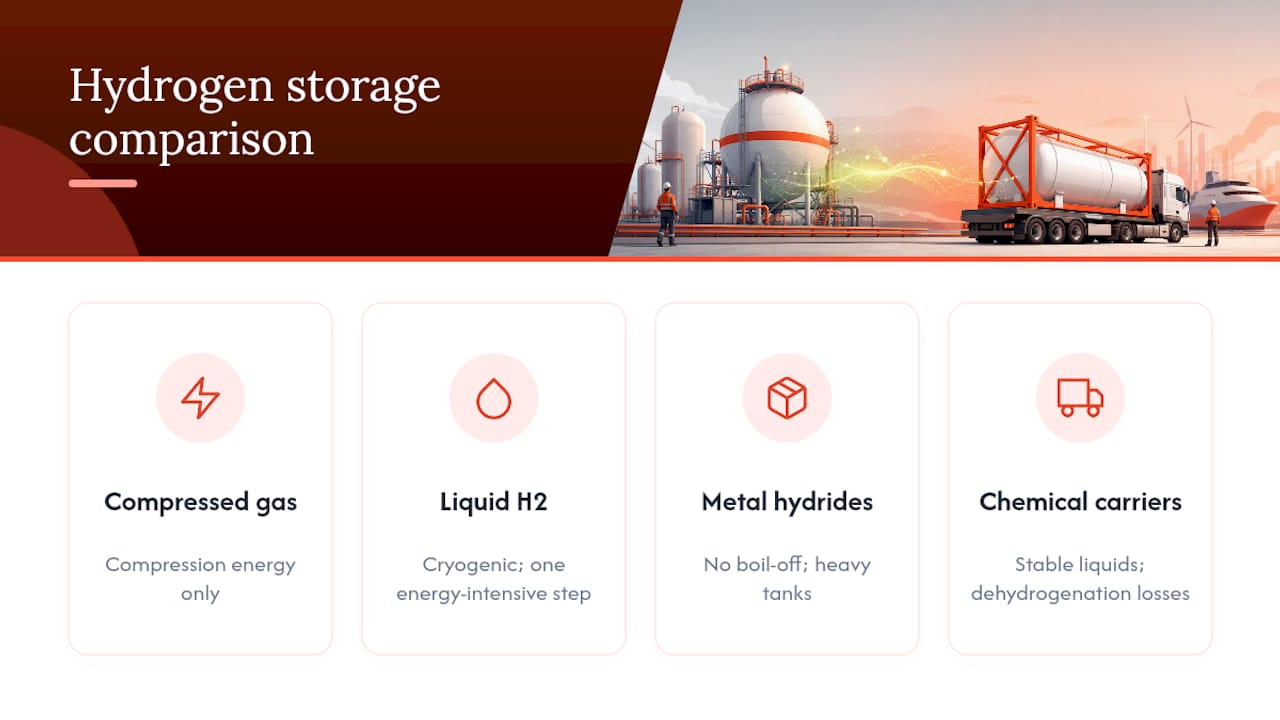
Liquid hydrogen isn’t the only way to pack more hydrogen into less space. Metal hydrides absorb hydrogen into a solid lattice, releasing it on heating, and they sidestep boil-off entirely since there’s no cryogenic liquid to lose. The trade-off is weight: hydride tanks are heavy relative to the hydrogen they hold, which rules them out for most transport applications but keeps them viable for stationary storage where weight doesn’t matter.
Chemical carriers like ammonia or liquid organic hydrogen carriers (LOHCs) go a step further, binding hydrogen into a stable compound that behaves like a conventional liquid fuel at ambient temperature. That stability solves the boil-off problem completely and simplifies transport using existing tanker infrastructure. The catch is a different energy penalty: converting hydrogen into the carrier and then releasing it again (dehydrogenation) both cost energy, and that round-trip loss can rival or exceed liquefaction’s penalty depending on the carrier chemistry.
Compressed gas remains the simplest and cheapest option at small scale, with no conversion or cryogenic losses at all, just the compression energy itself. Where liquid hydrogen still wins against hydrides and carriers is round-trip efficiency for bulk transport, since it involves one energy-intensive step rather than two. The practical takeaway: hydrides suit stationary buffering, carriers suit ultra-long-distance shipping using conventional vessels, and LH2 sits in between, best for corridors where speed and density both matter.
Where Hydrogen Liquefaction and Storage Technology Is Headed
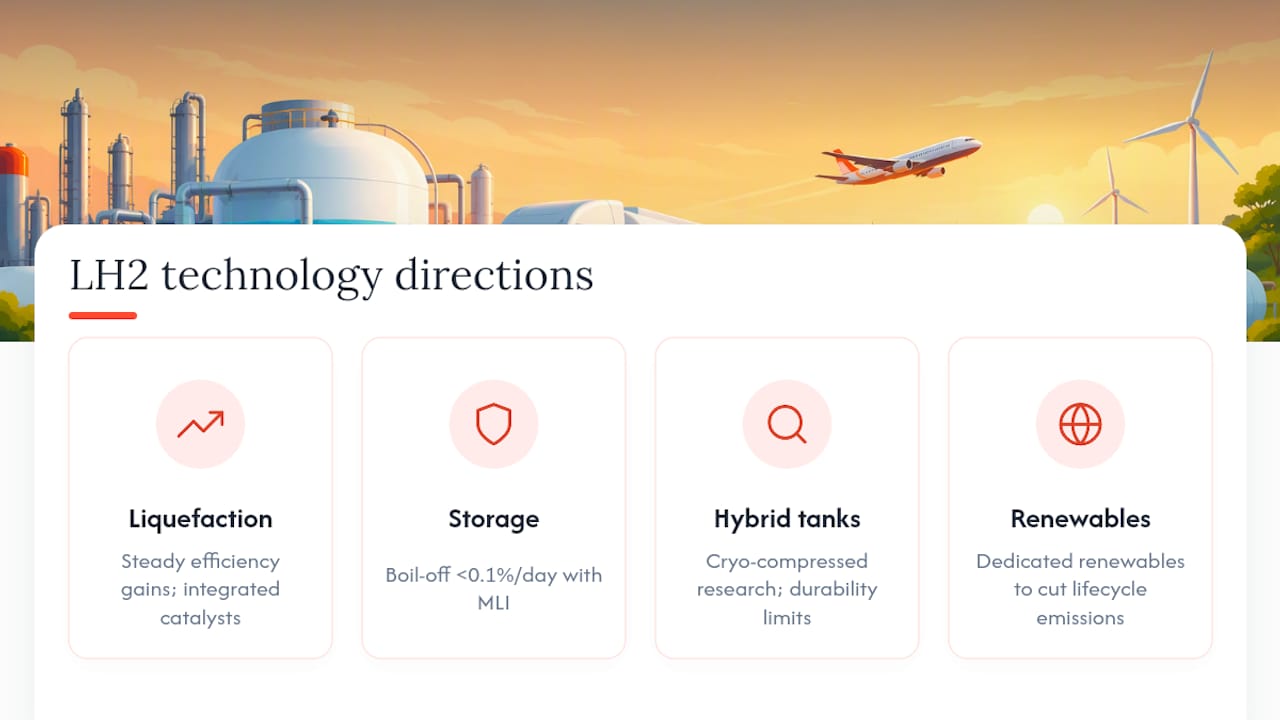
Liquefaction plant efficiency has been the target of steady incremental improvement rather than any single breakthrough. Larger plants benefit from economies of scale in refrigeration cycles, and newer designs increasingly integrate ortho-para conversion catalysts more efficiently into the cooling train instead of treating it as a bolt-on stage.
Storage-side, insulation technology keeps pushing boil-off rates down. The sub 0.1% per day targets that large LH2 projects now aim for weren’t achievable with older foam-insulated designs; they depend on advances in multilayer vacuum insulation and better vacuum-integrity monitoring that catches degradation before it becomes a costly leak.
Cryo-compressed hybrid tanks remain the most active research frontier, chasing a middle ground between LH2’s density and gaseous hydrogen’s simplicity. Progress has been steady but slow, gated mainly by material durability at cryogenic temperatures under repeated thermal cycling, a problem that doesn’t have a quick fix.
On the production side, expect liquefaction plants to increasingly pair with dedicated renewable generation rather than pulling from mixed grids, since that pairing directly attacks the lifecycle emissions penalty tied to liquefaction’s energy intensity. None of this eliminates the fundamental liquefaction energy cost. It chips away at the margins: a few percentage points of efficiency here, a fraction of a percent less boil-off there. Over a decade of deployment at scale, those margins add up to meaningfully cheaper delivered hydrogen.
Regulatory and Standards Differences Between Liquid and Gaseous Hydrogen
Codes governing gaseous hydrogen storage and dispensing are relatively mature, built on decades of experience with compressed industrial gases and, more recently, hydrogen fueling stations for vehicles. Siting distances, pressure relief requirements, and material specifications for high-pressure vessels are well established in most jurisdictions.
Liquid hydrogen standards are less uniform globally, partly because large-scale civilian LH2 infrastructure is newer outside of aerospace applications. Requirements around vacuum-jacketed tank certification, cryogenic transfer equipment, and boil-off venting vary more between regions than gaseous hydrogen codes do. That inconsistency matters for any project spanning multiple jurisdictions, since a tanker design certified in one region may need modification to meet another’s cryogenic vessel standards.
Both forms require specialized training and certification for personnel, but the training content diverges sharply: gaseous hydrogen safety programs emphasize pressure hazards and leak detection, while cryogenic programs cover frostbite risk, material embrittlement, and vacuum system integrity. Anyone running a mixed fleet, some compressed gas assets and some LH2, ends up managing two distinct compliance tracks rather than one unified standard, and that operational overhead is worth pricing into any project comparison before committing to either pathway.
Why Hydrogen Purity Matters More for Liquid Hydrogen
Purity requirements hit liquefaction harder than compression, and the reason comes down to what happens to contaminants at 20 Kelvin. Trace impurities like nitrogen, oxygen, or water vapor that stay harmlessly mixed in gaseous hydrogen can freeze solid inside a liquefaction plant’s cold sections, clogging valves and heat exchangers over time. That’s why liquefaction feedstock typically needs tighter purity specifications than gas destined for compression and direct use.
Fuel cell applications add another layer: both liquid and gaseous hydrogen feeding proton exchange membrane fuel cells need very high purity to avoid catalyst poisoning, regardless of which storage form delivers it. The difference is where the purification happens. Gaseous systems can sometimes purify closer to the point of use, while LH2 systems generally need purification upstream, before liquefaction, since removing frozen contaminants from a cryogenic system after the fact is far harder than filtering a warm gas stream.
This purity burden adds a cost layer that’s easy to overlook in early-stage project comparisons. A liquefaction plant needs feed-gas purification equipment that a simple compression skid doesn’t, and that equipment adds both CAPEX and an ongoing maintenance obligation. For projects sourcing hydrogen from less-refined production methods, that purification gap can shift the economics further toward the gaseous pathway than the raw liquefaction energy numbers alone would suggest.
Squeezing More Efficiency Out of Liquefaction and Compression
On the liquefaction side, the biggest efficiency gains come from cascade refrigeration cycle design, using multiple refrigerant stages tuned to different temperature ranges rather than one blunt cooling process. Better integration of the ortho-para conversion catalyst into the cooling train, instead of running it as a separate downstream step, also trims energy losses that older plant designs left on the table.
Compression efficiency improvements tend to focus on multistage compression with intercooling, which reduces the work needed per kilogram compared to single-stage compression to the same final pressure. Heat recovery from compression stages, redirecting waste heat into other plant processes, adds a modest but real efficiency gain that’s increasingly standard in newer compressor station designs.
Both pathways benefit from better process control and monitoring. Real-time tracking of compressor efficiency or liquefaction plant cold-box performance lets operators catch drift toward inefficient operation before it compounds into meaningfully higher energy costs. Neither optimization path changes the fundamental physics: liquefaction will always cost more energy per kilogram than compression, because phase-change cooling to 20 Kelvin is inherently more energy-intensive than isothermal compression. What these techniques do is narrow the gap incrementally, and at industrial scale, even a few percentage points of efficiency translate into real operating cost differences over a plant’s lifetime.
Author Perspective: Pragmatic Recommendations for Engineers and Planners
Pick the pathway that matches your actual scale and distance, not the one that sounds more advanced on paper. Liquid hydrogen looks impressive in a technical brief, but if your project moves modest volumes over short distances, compressed gas will beat it on delivered cost almost every time. Pilot before you scale. If liquefaction wins your delivered-cost model, invest in BOG recovery from the start rather than treating it as an optional upgrade. The physics won’t change in your favor. Your engineering discipline around it can.
— Barikreativa
Sources
- Global Hydrogen Review 2026 – IEA
- Liquid Hydrogen Delivery (U.S. DOE)
- Life cycle analysis comparing liquid and gaseous hydrogen transportation pathways (IJHE, 2026)
FAQ
Why don’t we use liquid hydrogen as a fuel more widely?
Liquefaction consumes roughly 30% to 40% of hydrogen’s own energy content, and boil-off keeps losing product during storage and transport. For most vehicle and local-distribution use cases, that penalty outweighs the density advantage, so compressed gaseous hydrogen remains the more practical choice.
Is hydrogen fuel cheaper than gasoline?
Hydrogen fuel costs vary widely by production method, region, and delivery pathway, and there’s no single settled figure that applies universally. Liquefaction and compression each add distinct energy costs on top of production, which is a major reason delivered hydrogen often costs more than gasoline per equivalent unit of energy today.
Why does Elon Musk not like hydrogen?
Musk has publicly criticized hydrogen fuel cells largely over efficiency losses, including the energy cost of production, compression or liquefaction, and conversion back to usable power. Those compounding losses are a real technical concern, though the debate over hydrogen’s role alongside batteries remains active across the energy industry.
Can you purchase liquid hydrogen?
Yes, liquid hydrogen is commercially available and delivered using liquefaction plants, vacuum-jacketed tankers, and specialized cryogenic transfer equipment. Access typically requires industrial or aerospace-scale demand, since the infrastructure for LH2 handling isn’t as widespread as compressed gas cylinders or trailers.
Make discovery work harder.
See what your Shopify search could do better with a free, hands-on audit.
Get your free search audit