Generative AI Search: How It Works and What It Means for Shopify Stores
What generative AI search is, how it differs from classic and machine-learning search, and how Shopify merchants can use it to fix on-site product discovery.

Generative AI Search: How It Works and What It Means for Shopify Stores
Generative AI search retrieves information and then writes a synthesized, conversational answer, instead of handing you a ranked list of links. For an online store, the idea matters in two places: on external engines where shoppers start their research, and on your own search bar, where they decide whether to buy. The second one is the one you control, and it is where most stores lose sales quietly.
TL;DR
- Generative search retrieves web information and synthesizes it into one natural-language response rather than returning separate pages.
- Two different things get called “AI search”: answer engines outside your store, and semantic, typo-tolerant search inside it. Only the second one is yours to fix.
- Shoppers are moving fast. Shopping-related generative-AI searches grew 4,700% from July 2024 to July 2025, according to BoF Insights and McKinsey.
- Good AI search depends on clean catalog data and ongoing tuning, not just a model. Start with a small pilot and measure it.
Table of Contents
- What generative AI search actually is
- Two kinds of AI search your shoppers use
- How AI site search understands a shopper’s query
- What it changes for fashion and specialty retail
- What you need before AI search can work
- Risks and how to measure results
- How small brands can adopt AI search on Shopify
- Our perspective
- See what your search is missing
- FAQ
- Sources
What generative AI search actually is
A traditional search engine matches a query to an index and returns a ranked list. You click, read, compare, and decide. Generative search adds a step: a language model reads what was retrieved and writes a response for you.
The 2026 ACL Findings paper “Characterizing Web Search in the Age of Generative AI” names three core differences:
- Generative systems may draw on internal model knowledge, external sources, or both.
- They can aggregate information from many sources.
- They generate new, synthesized text instead of reproducing separate snippets.
A TechTarget comparison of generative and traditional search adds the user-facing side: conversational answers, understanding of natural-language intent, memory of earlier turns in a conversation, and the ability to bring in current information when the system is connected to search.
If you want the same shift seen from the SEO side, this piece on the role of AI search engines in SEO is a good companion read.
Where machine learning fits
“Machine learning for search” is older and narrower than generative search. It covers the models that understand a query, represent it numerically, and rank results. It does not necessarily write anything. Most of what shoppers experience as a “smart” store search is this layer, not a chatbot.
| Traditional keyword search | Machine-learning / semantic search | Generative AI search | |
|---|---|---|---|
| Output | Ranked list of matches | Ranked list, reordered by meaning and behavior | A written answer, often with sources |
| Handles typos and synonyms | Poorly, unless rules are added | Yes | Yes |
| Handles “something warm for a March wedding” | Rarely | Often | Designed for it |
| Main risk | Zero-result pages | Weak catalog data limits relevance | Answers can vary between runs |
| Where shoppers meet it | Basic store search bars | Store search, recommendations | AI answer engines, chat assistants |
Two kinds of AI search your shoppers use
The phrase “AI search ecommerce” mixes two very different surfaces.
AI answer engines outside your store
External AI answer engines use what Shopify’s own guide calls query fan-out: they expand one prompt into related questions, gather information, and combine it with language-model training data into a conversational answer. That can end in a zero-click search, where the shopper never visits a site.
What you can do here is publish clear product data and useful content so your catalog can be understood and cited. What you cannot do is control the answer.
AI-powered search inside your store
Once a shopper lands on your site, the search bar is a different game. The 2025 State of Fashion report from BoF Insights and McKinsey found that 69% of customers go straight to a retailer’s search bar, yet 80% are dissatisfied with the experience and leave the site. 41% name irrelevant results as a main shopping barrier.

That is the gap. Shoppers who arrive with intent, from an ad, an email, or an AI answer, hit a search box that misreads them. Fixing it is usually the highest-leverage AI project a small store can run, because you own the whole experience.
How AI site search understands a shopper’s query
Under the hood, modern site search does a handful of things well.
1. It works out intent
A query like “black dress under 100 for a funeral” has a category, a color, a price ceiling and an occasion. The 2024 ACL paper on explicit attribute extraction found that production search benefits from pulling explicit attribute values out of queries and normalizing them to product attributes. The same authors name nonstandard spelling and strict real-time latency as the hard parts.
2. It matches meaning, not only words
Instacart has described how its system uses machine-learning models to embed queries and products in a shared vector space, retrieve relevant products, and rank them by relevance, popularity and personal preference. Product embeddings can be precomputed, so retrieval stays fast at runtime.
Earley’s industry guide makes the practical point: vector search can surface conceptually related products even when the shopper’s words differ from your product titles, and behavior such as clicks, purchases and cart additions can improve those representations.
For a deeper explanation of how to introduce meaning-based matching without throwing out what already works, see semantic versus keyword search on Shopify.
3. It combines old and new methods
The best systems rarely go all-in on one technique. Exact matching is still right for SKUs and model numbers, while semantic matching handles vague, descriptive queries. This write-up on hybrid search and pilot metrics covers why blending the two is the safer path.
The underlying retrieval idea is explained clearly in this overview of how semantic retrieval works.
What it changes for fashion and specialty retail
Fashion is the hardest test for search, because shoppers describe feelings and occasions rather than product types. Earley notes that fashion discovery has to account for relationships among style, fit, material and occasion, and that retrieval-augmented generation can add comparisons, review summaries and accessory suggestions.
Connective3 describes how generative search lets shoppers describe intent conversationally, ask for comparisons, and discover products through text, images, video and voice. It can also reduce decision fatigue by curating choices instead of making people filter manually.
The demand side backs this up. In the State of Fashion 2026 findings, 53% of US consumers who used generative AI for search in Q2 2025 also used it to shop, and 85% of US generative-AI shopping users said the experience beat traditional methods.
What that means for your store: shoppers are being trained elsewhere to type full sentences and expect sensible results. A search bar that only matches exact title words will feel broken by comparison.

What you need before AI search can work
A model is not a magic layer. Earley’s view is that generative search alone is not enough: merchants also need reliable product data, sound information architecture, and systems that can ground generated responses in retrieved catalog information.
A practical checklist:
- Consistent attributes. Color, material, fit, occasion and season filled in the same way across products.
- Descriptive titles and copy. Words shoppers actually use, not internal codes.
- A list of your real search queries. Especially the ones that return nothing or the wrong thing.
- A synonym plan. “Joggers” and “sweatpants,” “sneakers” and “trainers.”
- Language coverage. If you sell in more than one language, search must follow the shopper’s language.
If tagging is the bottleneck, read about product tagging for search to decide between APIs and custom models. For fixing the fundamentals first, Shopify search relevance: data first, then a pilot lays out the order of work.
Risks and how to measure results
Generative outputs are not perfectly repeatable. The 2026 ACL paper reports that outputs can vary across time and repeated runs, which creates evaluation challenges that classic ranked-result metrics do not fully capture. The researchers argue for evaluation beyond factual accuracy: retrieval footprint, synthesis behavior, source diversity and output stability.
For a store, translate that into habits you can run every month:
- Build a fixed query set. Take 100 to 300 real queries from your search logs, including misspellings and long descriptive ones.
- Score the top results. Judge whether the first ten results are relevant for each query, and keep the scoring consistent.
- Track outcomes, not only relevance. Search-to-cart rate, search conversion rate, exit rate after search, and zero-result rate.
- Repeat after every change. If results swing between runs, you have found a stability problem before shoppers did.
A worked method for this is in Precision@10 to sales, and the practical wins are collected in site search best practices.
How small brands can adopt AI search on Shopify
You do not need to build a retrieval system. The realistic options for a small brand are:
- Use the platform’s built-in tools as a baseline and learn where they stop. The limits of predictive search on Shopify and the 10-result ceiling are worth understanding first.
- Add a search service that plugs into the storefront natively and handles the models, syncing and tuning for you.
- Run a time-boxed pilot against your own query set before committing to anything long-term.
If you are weighing an upgrade over built-in search, this overview of a managed upgrade path explains what changes. To see which long-tail queries are costing you the most, start with fixing long-tail queries in 30 days and the fuzzy search guide.
Our perspective
We built Indexa around one observation: most Shopify merchants do not lose sales because shoppers dislike their products. They lose them because the search bar fails to understand a typo, a synonym, or a plain-language request.
That is why we focus on the layer you control. Typo-tolerant and semantic search, synonym mapping, multilingual support and a merchandising grid for search and category pages all work on your own catalog and your own shoppers’ words. We also tune relevance continuously from real store data, because a search system that is switched on once and left alone drifts.
Our view is that small brands should not need an engineering team to get this. We run the installation and the tuning, there is no coding on your side, and you keep ownership of your data. Billing is month to month with no per-request fees, so the economics do not punish you for having shoppers who search a lot.
Generative answers on external engines will keep growing. The stores that benefit most will be the ones whose own search is ready for the shoppers who arrive.
Barikreativa
See what your search is missing
Indexa is a fully managed AI search and discovery service for Shopify stores. It adds typo-tolerant and semantic search, multilingual support, synonym mapping, product recommendations, analytics and a visual merchandising grid editor, with ongoing relevance tuning based on your store’s data. We can also help migrate you from another search platform.
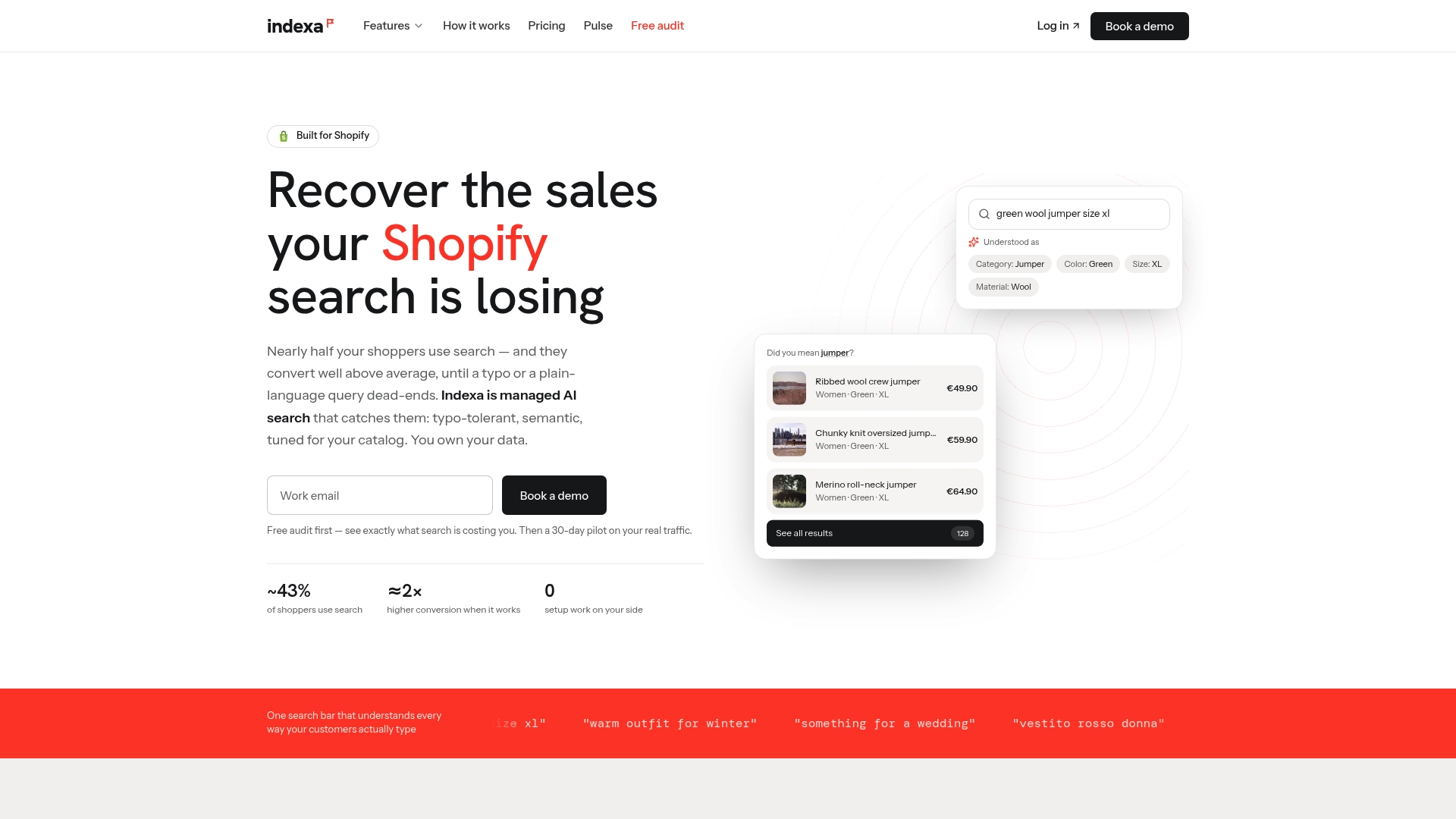
The easiest first step is a free audit of your store’s search. If you would rather test with live traffic, look at the 30-day pilot and pricing details, or explore the full feature set and how query understanding and recommendations work. You can also estimate what weak search may be costing you with the site search revenue calculator.
FAQ
Is generative AI search the same as the AI search in an online store?
No. Generative search writes a synthesized answer from retrieved sources, as described in the 2026 ACL study. Store search usually relies on machine-learning models to understand queries and rank products, and returns a product list instead of a written answer. The two are complementary, and shoppers increasingly expect the store to understand natural language too.
Does my store need a chatbot to benefit from AI search?
Not necessarily. Many gains come from search that tolerates typos, understands synonyms and reads descriptive queries, with no chat interface at all. Start with query understanding and relevance, then add conversational features if your shoppers ask for them.
How do I know whether AI search is improving my sales?
Compare before and after on the same set of real queries, then watch search conversion, search-to-cart rate, zero-result rate and exits after search. Keep the test window consistent so you can attribute changes to search instead of seasonality.
Can a small Shopify brand use AI search without developers?
Yes. A managed service handles installation, catalog syncing and tuning, so you do not write code. With Indexa, activation takes minutes, the console is no-code, and it integrates natively with the storefront, including Shopify Hydrogen.
Will AI search help shoppers who arrive from AI answer engines?
It helps them once they are on your site. External engines may send fewer clicks, as the Shopify guide to answer engine optimization notes about zero-click behavior, so converting the visitors who do arrive matters more.
Sources
- Characterizing Web Search in the Age of Generative AI (ACL Findings 2026)
- GenAI search vs. traditional search engines (TechTarget)
- How Instacart Uses Embeddings to Improve Search Relevance
- Transforming Product Discovery Through AI (Earley)
- The State of Fashion 2026: AI’s transformation of online shopping (BoF)
- The State of Fashion 2025: Fashion’s new era of product discovery (BoF)
- Fashion search in the age of Generative AI (Connective3)
- Explicit Attribute Extraction in E-Commerce Search (ACL 2024)
- AEO for Ecommerce: Drive Traffic From AI Search (Shopify)
- Avoid Hybrid Search Pitfalls: Vector Database Pilot Metrics
- Semantic Search for a Knowledge Base: How It Works
Recommended
Make discovery work harder.
See what your Shopify search could do better with a free, hands-on audit.
Get your free search audit