SEO Safe Faceted Search for Shopify Stores Around the 25 Filter Limit
Implement faceted search on Shopify the SEO safe way with platform aware steps to avoid duplicate URLs, protect crawl budget, and ensure theme and...

SEO Safe Faceted Search for Shopify Stores Around the 25 Filter Limit
Use faceted search on Shopify, but treat it as an engineering project, not a checkbox. Before turning filters on, audit your product data, confirm your theme actually renders the filter objects, and put canonical and indexing rules in place first. Shopify’s own platform limits, including a cap on the number of filters and hidden filters on very large collections, will shape exactly how you build it.
TL;DR:
- Shopify filters are limited to 25 attributes per store, and large collections over 8,000 products often hide available filters, requiring collection splitting.
- Filters can generate thousands of low-value URLs, risking duplicate content, crawl waste, and diluted link equity, necessitating canonicalization and selective blocking.
- Proper data hygiene and consistent metafield modeling are crucial to ensure filters remain reliable and do not break as catalog size grows.
- Native Shopify filters are sufficient for small to medium stores with clean data, but larger catalogs or complex merchandising should consider adding an AI search layer like Indexa.
- Implementing filters effectively involves auditing product data, confirming theme support, and monitoring filter usage and SEO impact regularly.
Table of Contents
- What Faceted Search Is and Why It Matters for Shopify Stores
- Shopify’s Technical Constraints: Search & Discovery, Metafields, and Platform Limits
- SEO Risks and Platform-Appropriate Mitigation Tactics
- Step-by-Step Implementation Checklist for Faceted Search on Shopify
- UX and Merchandising Rules for Conversion-Friendly Facets
- Testing, Monitoring, and Measuring Faceted Search Impact
- When Native Shopify Filters Are Enough, and When to Upgrade
- Indexa: A Managed AI Search Upgrade for Shopify
- Sources
What Faceted Search Is and Why It Matters for Shopify Stores
Faceted search lets shoppers narrow a product list by combining multiple independent attributes at once, like size, color, price, and material, in any order they choose. Simple filtering usually means one dimension at a time, sort by price or view one category. Faceted navigation stacks them: “women’s, size 8, under $75, waterproof” all in a single pass.
The facets themselves come from a handful of predictable sources: standard product attributes (price, availability, product type), variant options (size, color), and metafields you define yourself (fabric, occasion, fit). Shoppers use these to skip straight past irrelevant inventory, which matters more on Shopify than people assume because most storefronts default to sorting by relevance or best-selling, not by the attribute a shopper actually cares about.
The business case is straightforward:
- Fewer clicks between landing on a collection and reaching a product page
- Higher conversion on category and search pages, since shoppers self-select into products that already match their criteria
- Better long-tail discovery, surfacing niche inventory that would otherwise sit buried on page 6
Faceted search is not automatically worth building, though. If your catalog is under a few hundred SKUs, or your product data is inconsistent (missing metafields, mismatched option names, no standardized values), filters will feel broken before they feel useful. Data hygiene has to come before UI work, not after.
Shopify’s Technical Constraints: Search & Discovery, Metafields, and Platform Limits
Shopify exposes filtering through the Search & Discovery app, which merchants configure in admin, and themes render through Liquid filter objects or the Storefront API. Nothing shows up on the storefront automatically. If your theme doesn’t include the filter markup, configuring filters in admin does nothing visible to shoppers, a gap that trips up a lot of merchants moving off older themes.
The platform has hard ceilings you need to design around, not fight.
| Constraint | Limit | Practical implication |
|---|---|---|
| Filters per store | Maximum 25 | Prioritize the attributes that actually drive decisions |
| Collection size for filters | Hidden above 8,000 products | Split large collections into narrower ones |
| Search result size | Filters hidden beyond certain thresholds | Curate search-facing categories deliberately |
| Filter values/groups | Upper display limits apply | Group similar values instead of listing every variant |
Shopify’s Help Center is explicit that filters disappear once a collection or result set gets too large, which means an 8,000-product “All Products” collection with filtering turned on may show shoppers no filters at all.
Product-level filters (brand, product type, tags) and variant-level filters (size, color) behave differently under the hood. For deep-linking to a specific variant, size and color filtering works best on variant metafields rather than product-level tags, as it ties the filter directly to inventory and availability at the variant, not just the parent product.
The practical fix for large catalogs is almost always structural: split oversized collections into focused subsets, consolidate near-duplicate filter values (“Navy” and “Dark Blue” becoming one value), and model your metafields with consistent namespaces and value types from day one. Shopify’s developer documentation treats this data modeling step as foundational, not optional, and it’s the single biggest predictor of whether filters feel reliable six months later.
SEO Risks and Platform-Appropriate Mitigation Tactics
Faceted navigation is one of the most reliable ways to accidentally generate thousands of low-value URLs, and search engines notice. Every combination of filters, “red + size 8 + under $50,” can spin up its own crawlable URL if your theme isn’t careful, and most of those combinations have almost no unique content and zero search demand.
Three problems show up repeatedly:
- Duplicate or near-duplicate pages. A dozen filter combinations can return nearly identical product grids, competing with each other for the same rankings.
- Crawl budget waste. Search bots spend time crawling thin filter permutations instead of your actual product and collection pages.
- Link equity dilution. Internal links spread across thousands of filter URLs instead of concentrating authority on pages that deserve to rank.
Shopify’s own guidance on faceted navigation points to canonicalization as the fastest fix: point low-value filter URLs back to their parent collection with a canonical tag, so search engines consolidate ranking signals there instead of splitting them across variants. Beyond that, apply noindex or robots directives selectively rather than blanket-blocking every parameter, and where your theme supports it, use AJAX or the History API to update the product grid without generating a new indexable URL at all.
Pro Tip: Check what your theme is actually outputting before assuming it’s correct. Load a filtered URL, view source, and search for the canonical tag. If it points to the filtered URL itself instead of the parent collection, your theme is leaking duplicate pages into the index and no amount of content work will fix that upstream.
Not every filter combination deserves to be blocked, though. Shopify’s guidance also flags that high-value, high-search-volume combinations, “women’s black running shoes under $100,” are worth turning into deliberately curated, indexable landing pages rather than treating every filter URL the same way. The decision rule is simple: does real search demand exist for this combination? If yes, curate it. If not, canonicalize or block it. This same crawl-budget dynamic shows up constantly in Shopify’s developer community, where merchants report indexed filter URLs eating crawl budget that should be going to their real inventory pages. For a deeper look at how site structure affects crawlability at scale, this breakdown of site architecture and SEO covers the crawl-budget mechanics in more detail than a Shopify-specific guide usually goes into.
Step-by-Step Implementation Checklist for Faceted Search on Shopify
Building faceted navigation on Shopify follows a predictable sequence, and skipping steps is exactly how merchants end up with filters that technically work but confuse shoppers or leak SEO problems.
- Audit your product data first. Pull a spreadsheet of every product attribute you want filterable and check for inconsistent naming, missing values, and orphaned tags before touching any settings.
- Define your filter taxonomy. Decide which attributes genuinely drive purchase decisions in your catalog, standardize the value names, and cut anything redundant. Remember the 25-filter ceiling; prioritize ruthlessly.
- Configure filters in Search & Discovery. Turn on standard attribute filters in admin, then add custom metafield filters for anything specific to your catalog (fit, occasion, material).
- Confirm theme support. Check that your collection and search templates actually render the filter objects, or add Storefront API support if you’re on a custom build. Shopify’s Help Center notes this is theme-dependent, not automatic.
- Set sensible UI defaults. Show your top three to five filters expanded by default, collapse the rest, and group long value lists (twenty color options collapsing into a manageable set) rather than dumping everything on the shopper at once.
- Verify URL and canonical behavior. Apply a filter, check the resulting URL structure, and confirm the canonical tag points where you intend it to.
- Test on mobile. Filter panels that work fine on desktop often need a completely different interaction pattern on a phone screen.
- Run a crawl test. Use a crawler tool to simulate how search engines encounter your filtered URLs, and confirm you’re not accidentally exposing thousands of thin pages to indexing.
If you’d rather work from a pre-built version of this sequence, Indexa’s free Shopify search audit checklist walks through the same steps with space to document what you find at each stage.
UX and Merchandising Rules for Conversion-Friendly Facets
Filters only earn their keep if shoppers actually use them, and that comes down to a handful of rules that get ignored constantly. Show the filters that influence buying decisions first, price, size, and category almost always outperform filters like “release year” or internal SKU codes that shoppers never touch.
Label things the way customers talk, not the way your inventory system talks. “Waterproof” beats “moisture resistance rating: IPX4” for almost every shopper outside a technical niche. Long value lists need grouping. Nobody wants to scroll through forty individual size options when “XS to XL” plus a “see all sizes” expander gets them there faster.
Empty results kill momentum fast. If a shopper filters into a dead end, “size 6 + waterproof + under $30,” and gets nothing, show adjacent options or a message suggesting they loosen one filter rather than a blank page. That single fix recovers sessions that would otherwise bounce.
- Prioritize purchase-driving filters over administrative or internal ones
- Group and rename values in plain language
- Always give shoppers a path forward from zero results
- Build filter panels mobile-first: collapsible, fast, no full-page reloads
Pro Tip: Pin your best-selling variant or a promoted product to the top of filtered results only when you have data showing it converts there. Merchandising a filtered grid without evidence is just guessing with extra steps, and shoppers notice when the “featured” item doesn’t match what they filtered for.
Testing, Monitoring, and Measuring Faceted Search Impact
Filters need the same measurement discipline as any other conversion lever. Track filter usage by attribute, filtered-session conversion rate against unfiltered sessions, average clicks before purchase, and bounce rate specifically on filtered pages.
Set up analytics events on filter clicks and applied-filter combinations, then compare cohorts: shoppers who filter versus those who browse unfiltered. If filtered sessions convert lower than unfiltered ones, that’s a signal something in the filter logic or empty-result handling is broken, not a signal to remove filters.
- Filter usage by attribute and value
- Filtered vs. unfiltered conversion rate
- Bounce rate on filtered pages specifically
- Crawl reports showing growth in indexable filter URLs over time
Community reports on Shopify’s developer forums describe merchants discovering, months after launch, that filter URLs had multiplied into the thousands, quietly eating crawl budget the whole time. Regular log file review catches this before it becomes a ranking problem.
Certain signals point toward outgrowing native tools entirely: conversion on filtered pages stays flat despite UX fixes, merchandising needs get more complex than pinning a few products, or catalog size keeps bumping against Shopify’s filter and collection limits. That’s the point where a managed search layer usually enters the conversation.
When Native Shopify Filters Are Enough, and When to Upgrade
Native filters handle most stores fine, as long as product data is clean and the catalog stays modest. Where things break down is scale and nuance: typo tolerance, natural-language queries, or merchandising that needs to react to real shopper behavior rather than static rules. Shopify’s own guidance acknowledges this ceiling, noting that native synonyms and predictive results are useful but limited. That’s usually the point where merchants start looking at a managed AI search layer instead of stretching admin settings further.
— Barikreativa
Indexa: A Managed AI Search Upgrade for Shopify
If you’ve hit the point where clean metafields and canonical tags aren’t enough, that’s exactly the gap Indexa was built to close. Indexa replaces the guesswork in native filtering with typo-tolerant, semantic search that understands what a shopper meant even when they misspell a product name or search in plain language instead of exact keywords.
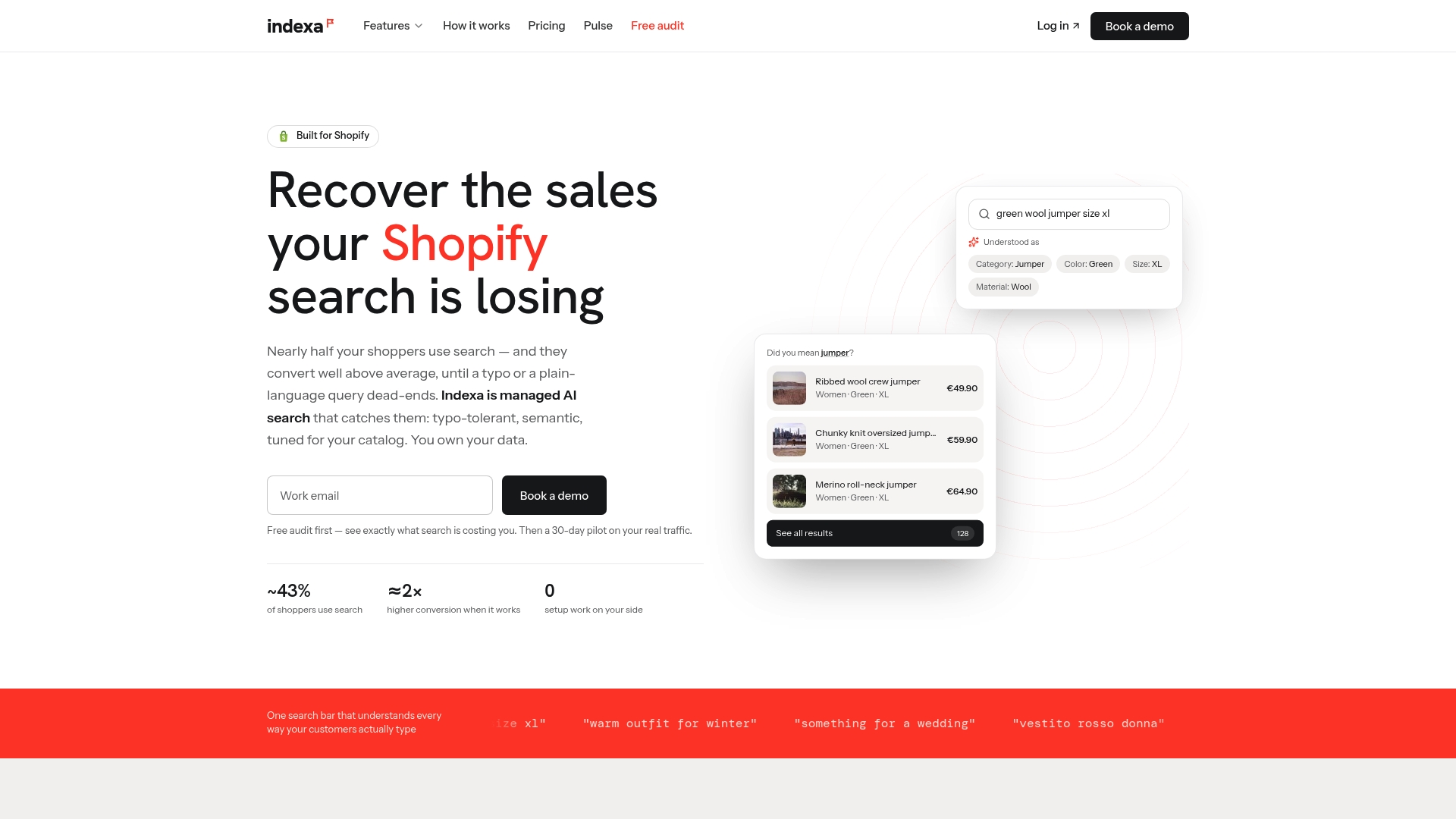
Setup requires no development work on your end. The service activates quickly and keeps tuning itself against real shopper behavior on your store, rather than sitting static after a one-time configuration. For merchants comparing it directly against native Search & Discovery, this breakdown of the managed AI upgrade lays out where the two diverge on merchandising control and query understanding. If you want a clearer picture of where your current setup is losing shoppers before you commit to anything, start with a free Shopify search audit.
Sources
- Support storefront filtering — Shopify developer docs
- Adding filters with Shopify Search & Discovery — Shopify Help Center
- Faceted navigation: SEO and UX best practices — Shopify Blog
Recommended
Make discovery work harder.
See what your Shopify search could do better with a free, hands-on audit.
Get your free search audit