Boost New Arrivals Search on Shopify in Under an Hour, When to Scale
Combine four native Shopify moves—product boosts, predictive suggestions, recommendations, and a Newest sort—to surface new arrivals fast and learn when...

Boost New Arrivals Search on Shopify in Under an Hour, When to Scale
The fastest way to boost new arrivals in Shopify search is to combine four native moves: set a product boost on your top new SKUs in Search & Discovery, add those items to predictive search suggestions, update product recommendations to surface them, and use a Newest sort or dedicated collection. Use manual boosts for small, time-limited drops. Once new arrivals land weekly or your catalog is large, automation or a managed AI search upgrade holds up better than manual tuning.
TL;DR:
- Shopify boosts apply only after a product is indexed and in stock, with a limit of 10 search terms per item.
- Move beyond manual tuning when arrivals come weekly or the catalog exceeds a few hundred active products, especially if search click rates are falling.
- Boosts and predictive suggestions affect only your storefront, so they cannot improve Google or Bing rankings or visibility on other external search engines.
- Record a baseline week, then track search click rates, add to cart activity, conversions, and abandonment for 7 to 14 days after changes.
- A controlled pilot can test 20 to 50 recent products for 14 days; reduce boosts to one or two terms if relevance falls.
Table of Contents
- Quick wins checklist to implement this week
- How Shopify’s native search tools actually work
- Scaling discovery: when manual boosts stop working
- Measure impact: metrics and a short experiment
- A 5-step weekend plan for new-arrival launches
- Indexa: managed search for frequent new-arrival drops
- FAQ
- Sources
Quick wins checklist to implement this week
Start small. Pick your three most important new arrivals, not thirty, and work through these steps in order.
- Open the Search & Discovery app in your Shopify admin, select a product, and assign up to 10 search terms to boost its ranking for those queries.
- Confirm the product is marked in stock. Shopify only applies the boost when the item is available for sale, so a boosted but sold-out SKU gets pushed to the bottom instead.
- Check that the new item appears in predictive search by typing a few letters of its name into your storefront search bar.
- Add the new product as a complementary or related recommendation on pages for items shoppers already browse often.
- Tag the product with new-arrival language and build a small synonym group (for example, “new,” “latest,” “just dropped”) without boosting common misspellings, which can crowd out relevant results.
- Create or update a “New Arrivals” collection and make sure it is one of the suggestions that shows up in predictive search.
Pro Tip: Set boosts the same day you publish the product, not a week later. Search & Discovery boosts only help once the product is indexed and in stock, so delays mean lost visibility during the highest-interest window.
This checklist takes under an hour for a handful of SKUs. The work scales badly past that, which matters once you get into how Shopify’s native tools actually behave.
How Shopify’s native search tools actually work
Shopify’s search stack has real mechanics worth understanding before you lean on it for every new drop.
- Product boosts live in the Search & Discovery app and let you assign specific terms to a product so it ranks higher when a shopper searches those exact words. Shopify caps this at 10 terms per product, and the boost only fires when the product is in stock.
- Predictive search runs on the
predictive_searchobject and endpoints like/search/suggest, returning matching products, collections, pages, and query suggestions as a shopper types, before they even hit enter. Shopify’s predictive search documentation covers parameters likeunavailable_products,prefixmatching, and resulttypes, which control what shows up in that typeahead list. - Product recommendations split into two types: manually curated complementary or related products, capped at 10 per product, and Shopify’s auto-generated suggestions based on purchase and browsing patterns. Pairing both lets a new item piggyback on your bestsellers’ traffic.
- Boosts and predictive search only affect your storefront’s internal search. They have no effect on Google, Bing, or any external search engine, a distinction worth remembering if your plan depends on new items ranking outside your own store.
Partial-word matching and typo handling in Shopify’s native search are limited compared to dedicated search tools, which is part of why boosts alone cannot fully compensate for a shopper who misspells a product name or searches in natural language rather than exact keywords.
Scaling discovery: when manual boosts stop working
Manual boosts work for a seasonal drop or a single hero product. They start breaking down once you are boosting dozens of SKUs across competing categories, because each boost competes with every other boost for the same query terms, and relevance drifts. Shopify’s own guidance on modifying search behavior notes that sold-out items get pushed to the end of results, so a catalog with frequent restocks needs constant manual upkeep just to keep boosts valid.
A few signals tell you it is time to move past manual tuning:
- New arrivals land weekly or faster, and your team cannot keep boosts, tags, and synonyms current.
- Your catalog passes a few hundred active SKUs, making the 10-term boost cap feel more like a constraint than a tool.
- Search click-through rate is flat or falling even as you add new inventory, a sign shoppers cannot find what just arrived.
This is the gap automation and managed services fill: continuous relevance tuning, typo-tolerant and semantic matching, catalog sync so boosts never point to sold-out items, and visual merchandising controls instead of a 10-term list. A practical way to test the difference is a staged pilot: run a free audit of your current search setup, then a 30-day pilot comparing baseline search metrics against the tuned version before committing further.
Pro Tip: Before you automate anything, export your top 50 search queries. Half the “relevance problem” is usually a handful of queries nobody has looked at in months.

Measure impact: metrics and a short experiment
Boosting new arrivals only matters if it changes shopper behavior, so track it directly rather than assuming it worked.
- Search click-through rate: the share of searches that result in a product click, pulled from Search & Discovery analytics or a storefront query export.
- Add-to-cart rate for search sessions: whether people who find a new item through search actually add it to the cart.
- Search-to-conversion rate: the percentage of search-driven sessions that end in a purchase.
- Search abandonment: searches with no click at all, often a sign the new item is not surfacing where expected.
Run a baseline week before making changes, apply your boosts and predictive tweaks, then measure again for 7 to 14 days. One Baymard pilot approach samples 20 to 50 recent SKUs with controlled boosts and predictive tweaks for a single segment, then measures search-driven conversions over 14 days to estimate recoverable revenue before committing to full automation. Watch for pogo-sticking, where shoppers click a boosted result and bounce straight back to search, since that usually means the boost outranked a more relevant match. If overall relevance drops, pull the boost back to one or two terms rather than the full 10.
A 5-step weekend plan for new-arrival launches

Here is the plan we would run for a client with a Friday product drop. Saturday morning, pull your actual search query data and see what shoppers already type, don’t guess. Pick three SKUs, not ten. Tag them and build a tight synonym group. Set boosts and predictive search tweaks that afternoon, while the product is fresh in stock. Sunday, check your numbers against the prior week’s baseline.
The mistakes we see most often: boosting fifteen SKUs at once instead of three, forgetting that a boost does nothing once an item sells out, and never circling back to check whether any of it moved the needle. Search tuning without measurement is just guessing with extra steps.
— Barikreativa
Indexa: managed search for frequent new-arrival drops
When new arrivals outpace what manual boosts can handle, we built Indexa to take that work off your plate entirely. A managed AI search and discovery service runs typo-tolerant, semantic search natively on Shopify, so a shopper who misspells a product name or searches in plain language still finds what just landed. There is no setup required on your end: the service can be activated quickly and keeps tuning relevance against your store’s real search data, including catalog sync so a boosted item never points to something sold out.
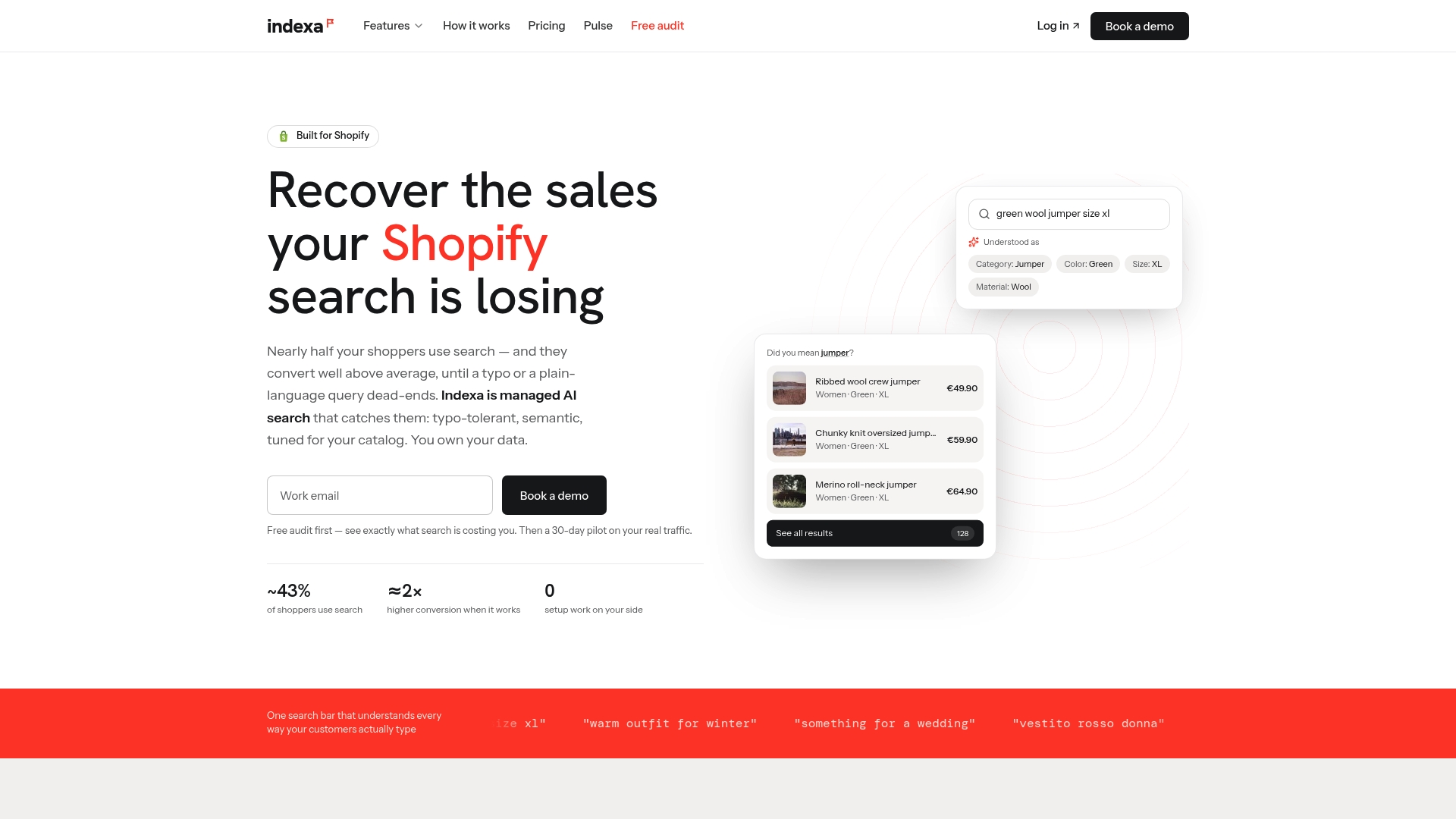
Indexa fits best once new arrivals are frequent, your catalog has grown past what a 10-term boost can cover, or your search KPIs are sliding despite fresh inventory.
| What you get | How it works |
|---|---|
| Typo-tolerant, semantic search | Matches natural-language and misspelled queries to the right products |
| Continuous relevance tuning | Adjusts rankings based on real shopper search behavior |
| Visual merchandising controls | Lets you pin or arrange new arrivals without a term cap |
| Catalog sync | Keeps boosted items from pointing to sold-out stock |
We offer a free audit of your current search setup and a 30-day pilot so you can compare your baseline numbers against the tuned version before deciding to move forward.
FAQ
How many terms can I boost per product in Shopify?
Shopify’s Search & Discovery app lets you assign up to 10 search terms per product to boost its ranking. The boost only applies when the product is in stock, and it affects your storefront search only, not external search engines.
Does boosting a product affect its ranking on Google?
No. Product boosts and predictive search tweaks in Shopify only change results inside your own store’s search and discovery experience. They have no effect on how a product ranks on Google, Bing, or any other external search engine.
What is predictive search and how does it help new arrivals?
Predictive search is the typeahead suggestion list that appears as a shopper types, built on Shopify’s predictive_search object and endpoints like /search/suggest. Adding new arrivals to these suggestions surfaces them before a shopper even finishes typing or submits a search.
When should I switch from manual boosts to a managed search service?
Manual boosts work well for a handful of SKUs or a short promotion, but they get harder to maintain once new arrivals land weekly or your catalog grows past a few hundred active products. At that point, a managed AI search service like Indexa can keep tuning relevance and syncing stock status automatically, which manual boosts are not built to do at scale.
Does product imagery or video affect search-driven clicks on new arrivals?
Strong product photography and video make a new item’s listing more compelling once it shows up in search or recommendation widgets, though they do not change where Shopify ranks it. Pairing a visible boost with clear product imagery tends to convert better than a boost alone.
Sources
- Shopify Help Center | Modifying search with Shopify Search & Discovery
- Shopify Predictive Search: setup, customization, and limits
- Ecommerce Search UX: Query types and best practices (Baymard)
Recommended
Make discovery work harder.
See what your Shopify search could do better with a free, hands-on audit.
Get your free search audit