Shopify Search Relevance: Fix Data First, Test a 30 Day Pilot
Fix Shopify product data before tuning typo tolerance, semantic matching, and merchandising. Learn what to fix first and when a managed 30 day pilot fits.

Shopify Search Relevance: Fix Data First, Test a 30 Day Pilot
Fix your product data first, then add typo-tolerant and semantic query handling with Shopify SEO on Autopilot: that single move cuts zero-result searches and lifts search-driven conversion. Expect fewer dead-end searches, a higher click-through rate on results pages, and recoverable revenue from shoppers who would otherwise bounce. A managed option like Indexa can get typo tolerance and semantic matching running inside a 30-day pilot if your team does not have the bandwidth to build it internally.
TL;DR:
- Start by correcting titles, SKUs, and availability for the 10 to 20 products that receive the most search traffic, before changing ranking rules.
- Track zero result rate, search result click rate, and revenue per search, then use an A/B test before rolling changes across live traffic.
- Use broad boosts only for brand or exact product searches; time limit promotions, timestamp changes, and keep a rollback plan ready.
- Small catalogs with simple searches may need only better tagging, while fast growth or long natural language queries signal a need for added query handling.
Table of Contents
- What Shopify Search Does Today and Why Semantic Matching Matters
- Common Shopify Search Limitations and When to Upgrade
- A Prioritized Checklist to Improve Relevance
- Balancing Merchandising Goals With Query Relevance
- Predictive Search and Autocomplete: What to Configure
- How to Measure and Test Search Relevance
- Implementing Changes on Shopify: A Rollout Checklist
- Why a Managed Search Layer Can Move Faster
- Lessons From Tuning Search at Scale
- Get Started With a Shopify Search Audit
- FAQ
- Sources
What Shopify Search Does Today and Why Semantic Matching Matters
Shopify’s own search pipeline blends traditional keyword retrieval with machine learning signals. According to Shopify’s engineering team, ranking draws on purchase popularity, brand weight, and navigational intent, not just whether a word in the query matches a word in the product title. That multi-signal approach works well for short, common queries but struggles once shoppers type the way they actually talk.
Semantic search interprets the meaning behind a query rather than matching exact words, so “warm jacket for hiking” can return a product tagged “insulated shell” even without a literal match. Typo tolerance catches misspellings like “seekers” and still returns sneakers. Both matter because long-tail, conversational queries are common in product search and fail hardest under keyword-only matching.
A few practical distinctions worth keeping straight:
- Keyword search matches literal terms; semantic search matches intent and context.
- Typo tolerance handles spelling errors, while synonym mapping handles different words for the same thing.
- Navigational intent (a shopper searching a brand name) needs different handling than exploratory intent (a shopper searching a use case).
Shopify’s ranking signals are not static. Its engineering team notes that relevance is a moving target that needs continuous tuning against live interaction data rather than fixed rules set once and forgotten.
Common Shopify Search Limitations and When to Upgrade
Shopify’s built-in Search & Discovery app handles basic retrieval well, but several symptoms signal it is not keeping pace with your catalog or your shoppers’ language.
- A rising zero-result rate on queries that clearly describe products you sell.
- Shoppers repeatedly retyping or correcting their search, a sign of failed first attempts.
- SKU and variant searches that return nothing because variant data lives outside the indexed fields.
- Low click-through on search results pages compared to category or collection pages.
- Overly strict filters that return empty states instead of close matches.
Underneath these symptoms sit operational causes: incomplete metafields, inconsistent SKU formatting across variants, thin or missing synonym lists, and filter logic that excludes rather than relaxes. A small catalog with simple, short-tail queries may never need more than careful tagging. A large or fast-growing catalog, long-tail natural-language queries, or a catalog that needs continuous retuning as inventory turns over are the clearest cues that the native tools have hit their ceiling.
A Prioritized Checklist to Improve Relevance
Not every fix carries equal weight, and not every fix takes equal time. Breaking the work into tiers keeps a team from stalling on long-term projects while quick wins sit untouched.
Quick wins (days):
- Rewrite canonical product titles so they include the words shoppers actually search, not just internal naming conventions.
- Build a synonym map for common substitutions (sneakers/trainers, hoodie/sweatshirt) and curated redirects for frequent misspellings.
- Add zero-result fallbacks that show related categories instead of a blank page.
Medium effort (weeks):
- Complete structured attributes and metafields (material, fit, size range) so filters and semantic matching have real data to work with.
- Standardize SKU and variant naming so size and color variants are all discoverable from the parent query.
- Set field weighting so title and tags carry more ranking weight than long-form description text.
Longer-term (months):
- Build term-dropping and query-rewrite logic for queries that return nothing, so a four-word search that fails can fall back to a three-word version.
- Layer scoped, time-bound ranking boosts on top of base relevance instead of permanent global overrides.
- Establish a recurring data-hygiene cadence so new products launch with complete metadata rather than being patched after the fact.
Research into zero-hit query recovery found that term dropping, term replacement, rephrasing, and typo correction together recover the large majority of failed searches in the dataset studied, which makes those four techniques a reasonable starting checklist for any remediation plan.
Pro Tip: Before touching ranking rules, fix the title, SKU, and availability data for the 10 to 20 highest-traffic products in your search logs. That handful of SKUs usually drives a disproportionate share of search volume.

Balancing Merchandising Goals With Query Relevance
Two different kinds of relevance compete for the same results page. Semantic relevance asks whether a product genuinely matches what the shopper typed. Commercial merchandising asks which products you want to sell more of. Confusing the two is how a best-seller boost ends up burying the exact item someone searched for by name.
A few guidelines keep merchandising from undermining search quality:
- Reserve blunt, catalog-wide boosts for genuinely navigational queries, like a brand name or a specific product title.
- Apply promotional boosts with a start and end date, not as a permanent rule nobody remembers setting.
- Use intent signals (query length, presence of a brand or SKU, filter usage) to decide when a boost should apply at all.
- Log every merchandising change with a timestamp and a rollback plan so a bad experiment is reversible in minutes.
Search-driven visits convert at a meaningfully higher rate than general browsing, with research from Forrester putting search-enabled sites at 2 to 3 times more likely to convert those visitors. That gap is exactly why a careless global boost that drowns out relevant niche inventory costs more in lost conversions than it gains in promoted sales.
Predictive Search and Autocomplete: What to Configure
Autocomplete is often a shopper’s first real interaction with your catalog, and a misconfigured one creates abandonment before the main results page ever loads. Suggestions should surface actual products and categories, not just repeat the typed string back with no added value.
A few rules keep predictive search useful rather than misleading:
- Mix product suggestions with category suggestions so a broad query still points somewhere useful.
- Never suggest a product that is out of stock without flagging it, since a dead-end click erodes trust fast.
- Keep suggestion wording consistent with how the product is actually titled, not an internal shorthand.
- Test latency under real conditions: a suggestion list that lags behind typing feels broken even when the backend is fine.
- Confirm keyboard navigation works end to end, since a mouse-only dropdown locks out a meaningful share of shoppers.
Shopify’s native predictive search has limits on how it handles longer natural-language phrases, which is one reason many merchants layer additional query understanding on top of it rather than relying on it alone. Our piece on search latency and relevance covers the performance side of these tradeoffs in more depth.
How to Measure and Test Search Relevance
Fixing search without measuring it is guesswork with extra steps. A compact set of metrics tells you whether a change actually helped.
- Zero-result rate: the share of searches returning nothing, your clearest signal of coverage gaps.
- Click-through rate (CTR) on search results, showing whether shoppers find results worth clicking.
- Precision@N and NDCG, measuring how relevant the top N results are and whether the best matches rank highest.
- Revenue per search, tying relevance directly to the outcome that matters commercially.
Shopify’s own engineering team builds curated, labeled datasets and runs offline evaluation with metrics like MAP and NDCG before rolling any ranking change to live traffic, specifically to avoid degrading the experience for real shoppers. That same discipline, offline testing before live rollout, applies whether you are tuning Shopify’s native tools or a third-party layer on top of them. Our guide to testing search relevance walks through building a labeled query set for exactly this purpose.
Online validation then confirms the offline results hold up: run an A/B test with a large enough sample to detect a real difference in CTR or conversion, not just noise, before declaring the change a win.
Implementing Changes on Shopify: A Rollout Checklist
Moving from diagnosis to deployment works best as a staged process rather than a single big-bang change.
- Audit current settings in the Search & Discovery app: review synonym lists, ranking rules, and facet configuration for gaps.
- Check indexing freshness so new products and inventory changes reflect in search results without a long delay.
- Review the predictive search configuration and decide whether its native limits require an added query-understanding layer.
- Test changes in a staging environment before touching the live storefront, using the labeled dataset from your evaluation step.
- Roll out in stages to a percentage of traffic, watching zero-result rate and CTR daily for the first week.
- Keep a rollback plan ready so any regression in conversion can be reversed immediately rather than debated for days.
If this list feels like more than your team can execute alongside everything else on the roadmap, a 30-day pilot is a reasonable way to test the approach without a long-term commitment: scope it to zero-result rate, CTR, and revenue-per-search as the three numbers that decide whether it worked.
Why a Managed Search Layer Can Move Faster
Building typo tolerance, semantic matching, and continuous tuning in-house takes real engineering time most Shopify teams would rather spend elsewhere. A managed layer is built to close that gap without a development project.
- Typo-tolerant and semantic query handling out of the box, so misspelled or natural-language searches still return relevant products.
- A no-code merchandising grid for adjusting search and category page results without engineering tickets.
- Native compatibility with Shopify storefronts, including Hydrogen-based builds.
- Catalog syncing and ongoing relevance tuning based on your store’s actual search traffic rather than a one-time setup.
Merchants running this kind of managed setup have reported recoverable revenue directly tied to fixing search failures that were previously sending shoppers to a dead end. A 30-day pilot is the typical way to see those numbers against your own catalog: zero-result rate, CTR lift, and revenue recovered from searches that previously failed.
Lessons From Tuning Search at Scale
The fastest-moving lever is never the ranking algorithm. It is cleaning the data a handful of high-traffic products rely on, then fixing the specific queries failing right now. Do this first: pull your zero-result log, fix the top offenders, add typo tolerance, and measure before touching anything else.
— Barikreativa
Get Started With a Shopify Search Audit
We built our managed service around the exact checklist above: typo tolerance, semantic query understanding, and continuous tuning, activated without a development project on your end. A free audit shows you where your current search is losing shoppers before you commit to anything.
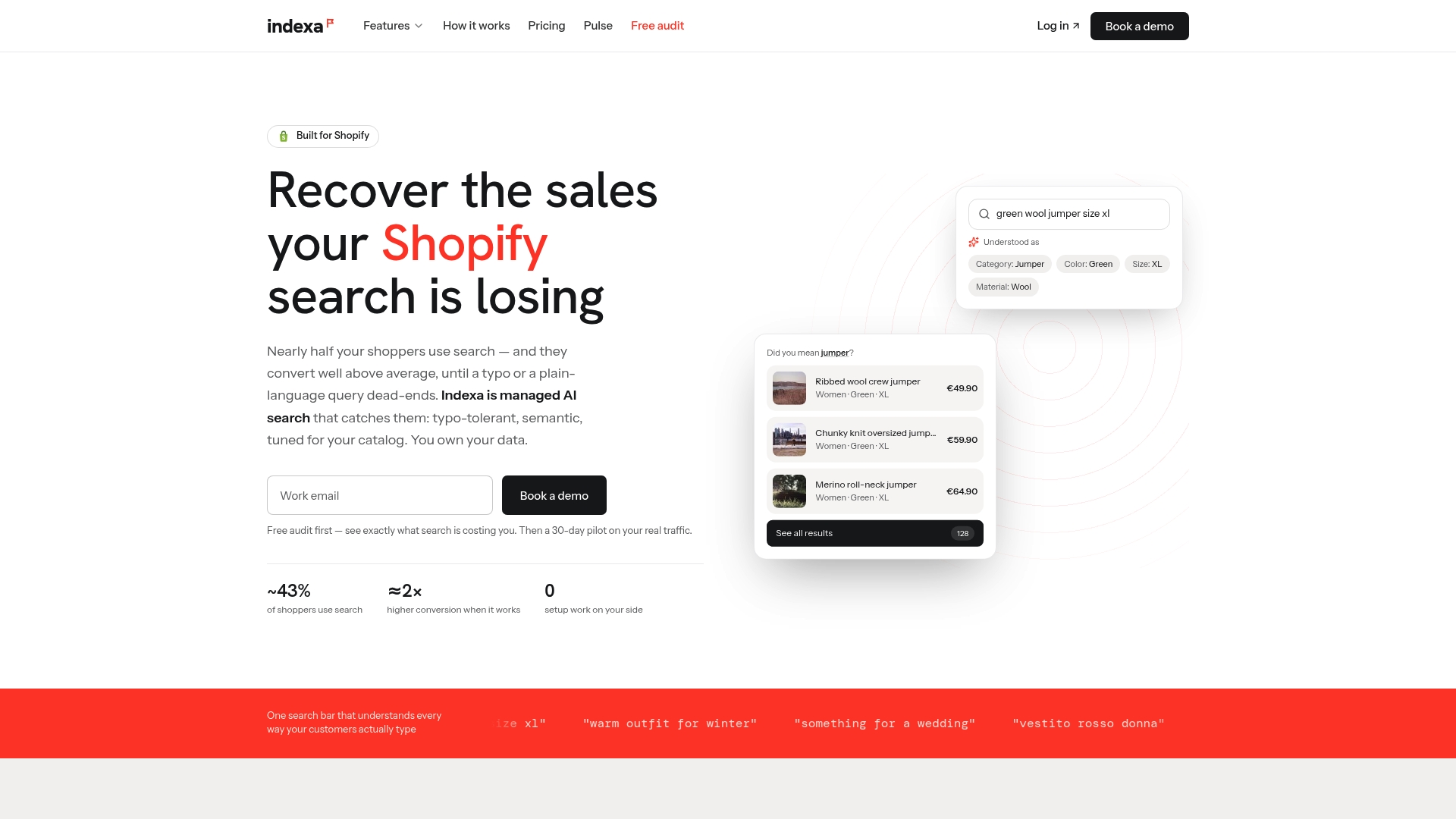
From there, a 30-day pilot measures zero-result rate, click-through lift, and recoverable revenue against your own catalog, billed as a flat monthly retainer with a one-time setup fee. Start with the audit and see the numbers for your store.
FAQ
What is search relevance on Shopify?
Search relevance measures how well the products returned for a query match what the shopper actually meant, combining factors like keyword match, purchase popularity, and navigational intent. Shopify’s engineering team describes it as a multi-signal problem that needs continuous tuning rather than a one-time setup.
How do I reduce zero-result searches on Shopify?
Start by fixing product titles, SKUs, and metafields for your highest-traffic products, then add synonym mapping and typo correction to catch common query variations. Research into zero-hit query behavior found that term dropping, term replacement, rephrasing, and typo correction recover the large majority of failed queries in the dataset studied.
Does Shopify’s native search support semantic matching?
Shopify’s built-in search combines keyword retrieval with ranking signals like purchase popularity and brand weight, but it has known limits with long natural-language queries. Many merchants add a dedicated semantic and typo-tolerant layer, such as a managed service, to cover gaps the native tools do not address.
How do I measure whether a search fix actually worked?
Track zero-result rate, click-through rate, and revenue per search before and after the change, and validate with an A/B test rather than relying on offline numbers alone. Shopify’s own evaluation process uses labeled datasets and metrics like MAP and NDCG to test ranking changes before they reach live traffic.
What does a managed Shopify search pilot cost?
Pricing for a managed engagement is structured as a flat monthly retainer plus a one-time setup fee, with exact figures available on request through the pricing page. A free audit is the usual first step before committing to a pilot.
Sources
Recommended
Make discovery work harder.
See what your Shopify search could do better with a free, hands-on audit.
Get your free search audit