Product Tagging for Search: When to Use APIs or Custom Models
Learn how ecommerce catalog teams build searchable product tags, set a controlled schema, and choose vision or LLM APIs versus custom models for automation.

Product Tagging for Search: When to Use APIs or Custom Models
Product tagging organizes the attributes search needs to match shoppers to the right SKUs. Done well, it improves relevance, powers filters, and lifts conversion rates. The sections below cover what tags actually are, why they move the numbers that matter, how to design a schema that scales, and where AI fits into the workflow.
TL;DR:
- Keep stable product facts in PIM attributes, reserve tags for cross category discovery, and cap each tag field at 15 to 20 approved values.
- Track search conversion, zero result rate, and facet coverage before and after tagging; test one fully tagged category for 30 days before expanding.
- For large catalogs, use models trained on a fixed schema for consistent tags and send low confidence outputs to human reviewers rather than publishing them automatically.
- Prioritize tagging for large catalogs, attributes shared across categories, or recurring zero result searches; smaller catalogs with fast turnover may need ranking or feed fixes first.
Table of Contents
- What product tagging and metadata actually mean
- Why product tags improve search and shopper discovery
- Tagging best practices and schema design
- Scaling tagging with AI and automation
- Implementation checklist: from audit to maintenance
- When tagging deserves priority over other catalog work
- Turning tags into results with managed search
- FAQ
- Sources
What product tagging and metadata actually mean
A tag is a short, searchable label attached to a product, like “waterproof” or “oversized.” An attribute is a structured field in your product information management (PIM) system, usually with a fixed set of allowed values, like color: navy. A taxonomy is the category tree your catalog sits inside, such as Women’s > Outerwear > Jackets.
Common tag types include:
- Color and material tags: “cobalt blue,” “recycled polyester”
- Pattern and fit tags: “striped,” “relaxed fit,” “petite”
- Use-case tags: “office wear,” “rain-ready,” “gift under $50”
- Campaign and visual tags: “summer sale,” “as-seen-on-social”
The practical rule: stable facts that define the product belong in PIM attribute fields. Tags are for cross-cutting, discovery-focused labels that help search and merchandising surface the product in more contexts than its category alone would allow.
Why product tags improve search and shopper discovery
Consistent tags increase both recall (finding every relevant product) and precision (filtering out irrelevant ones) in site search. When a shopper searches “waterproof hiking boots,” the engine needs a tag or attribute tying “waterproof” to boots across every brand and subcategory, not just the ones where it happens to appear in a title.
Good tagging directly powers faceted navigation, merchandising rules, synonym handling, and personalization. It also underpins visual search, where an uploaded photo gets matched against labeled attributes rather than keywords.
Accurate tag coverage materially improves visual search precision, since image-based product search relies on label and tag filters to constrain results. Without those filters, visual matching returns broader, noisier results.
Three KPIs tell you if tagging is working: search conversion rate, zero-result rate, and filter coverage (the share of catalog items that populate at least one facet). Watch these before and after any tagging project to confirm impact.
Tagging best practices and schema design
Tag bloat kills search performance faster than missing tags do. A schema with thousands of one-off tags is as useless as one with none, because neither gives search a reliable signal to match against.
- Build a controlled vocabulary. Define an approved tag list per attribute type (colors, fits, use-cases) and block free-text tag creation in your PIM.
- Set naming conventions early. Decide on singular versus plural, casing, and hyphenation (“rain-ready” not “Rain Ready” and “rainready”) before tagging at scale.
- Keep tags cross-category. Tags like “eco-friendly” or “wide-fit” should cut across your taxonomy rather than duplicate it, since categories already live in your PIM.
- Define cardinality per field. Single-value tags (one fit per product) prevent contradictory facets; multi-value tags (multiple use-cases) support broader discovery. Decide which fields allow which before enrichment starts.
- Assign ownership and a change log. One team or role should approve new tags, and every schema change should be logged so search and merchandising know what shifted.
- Audit quarterly. Pull a sample of recently tagged SKUs and check against your controlled vocabulary for drift.
Separating stable product facts into PIM attributes and reserving tags for cross-cutting or campaign-driven labels keeps both systems reliable and prevents tag bloat as your catalog grows.
Pro Tip: Cap any single tag field at 15 to 20 approved values. If your team keeps requesting new ones, the category probably needs a dedicated attribute instead of a sprawling tag list.
Scaling tagging with AI and automation
Manual tagging does not scale past a few thousand SKUs. Three workflow patterns handle the rest: batch enrichment of an existing catalog, on-upload inference for new products, and a hybrid model where automated tags get human QA before publishing.
The trade-off to understand is general-purpose prompting versus schema-trained models. A general vision or language model prompted to “describe this product” gives broad recall but inconsistent tag names. A model taught a fixed schema through supervised fine-tuning gives tighter precision and predictable output, which matters more once tags feed facets and filters downstream.
- Vision-based matching: Vision API Product Search accepts image input and supports category and label filters for precise image-to-product matching when tags already exist.
- Schema-trained fine-tuning: teaching a model your exact tagging schema through supervised fine-tuning, then tuning precision and recall with reinforcement learning, improves schema adherence over generic prompting.
- Hybrid QA loop: route low-confidence tags to a human reviewer rather than auto-publishing everything.
Measure success with manual correction rate and attribute completeness, not raw model accuracy.
Implementation checklist: from audit to maintenance
Moving from scattered tags to a working system follows a predictable sequence.
- Audit: pull your top 50 to 100 search queries, zero-result searches, and reports of missing filters to find gaps.
- Design: lock controlled vocabularies, map each tag to a PIM field, and set naming and cardinality rules.
- Deploy: bulk-enrich via CSV or PIM import, connect automated inference to your search index, and test on a staging environment before rollback risk hits production.
- Maintain: sample new tags weekly for QA, re-audit quarterly, and track the KPIs below over time.
| Stage | Primary activity | Key output |
|---|---|---|
| Audit | Pull top queries and zero-result reports | Gap list by category |
| Design | Build controlled vocabulary and PIM mapping | Approved tag schema |
| Deploy | Bulk import and connect to search index | Live tags in production |
| Maintain | Weekly QA sampling and quarterly re-audit | Stable, drift-free tags |
Before building banners or merchandising rules on top of new tags, it helps to pull your top queries first so tagging priorities match actual shopper demand.
When tagging deserves priority over other catalog work
Tagging pays off fastest for large catalogs, products with attributes that span many categories, and stores seeing frequent zero-result searches. Small catalogs or SKUs that turn over weekly often get more value from fixing search ranking or feed quality first.
A low-risk starting point: tag one category fully, then track search conversion and zero-result rate for 30 days before expanding.
— Barikreativa
Turning tags into results with managed search
Tagging gives search better signal, but someone still has to connect that signal to ranking, filters, and relevance tuning on an ongoing basis. We provide a fully managed AI search and discovery service designed for Shopify stores, so the tagging work you do can show up in better product search results instead of sitting unused in a PIM export.
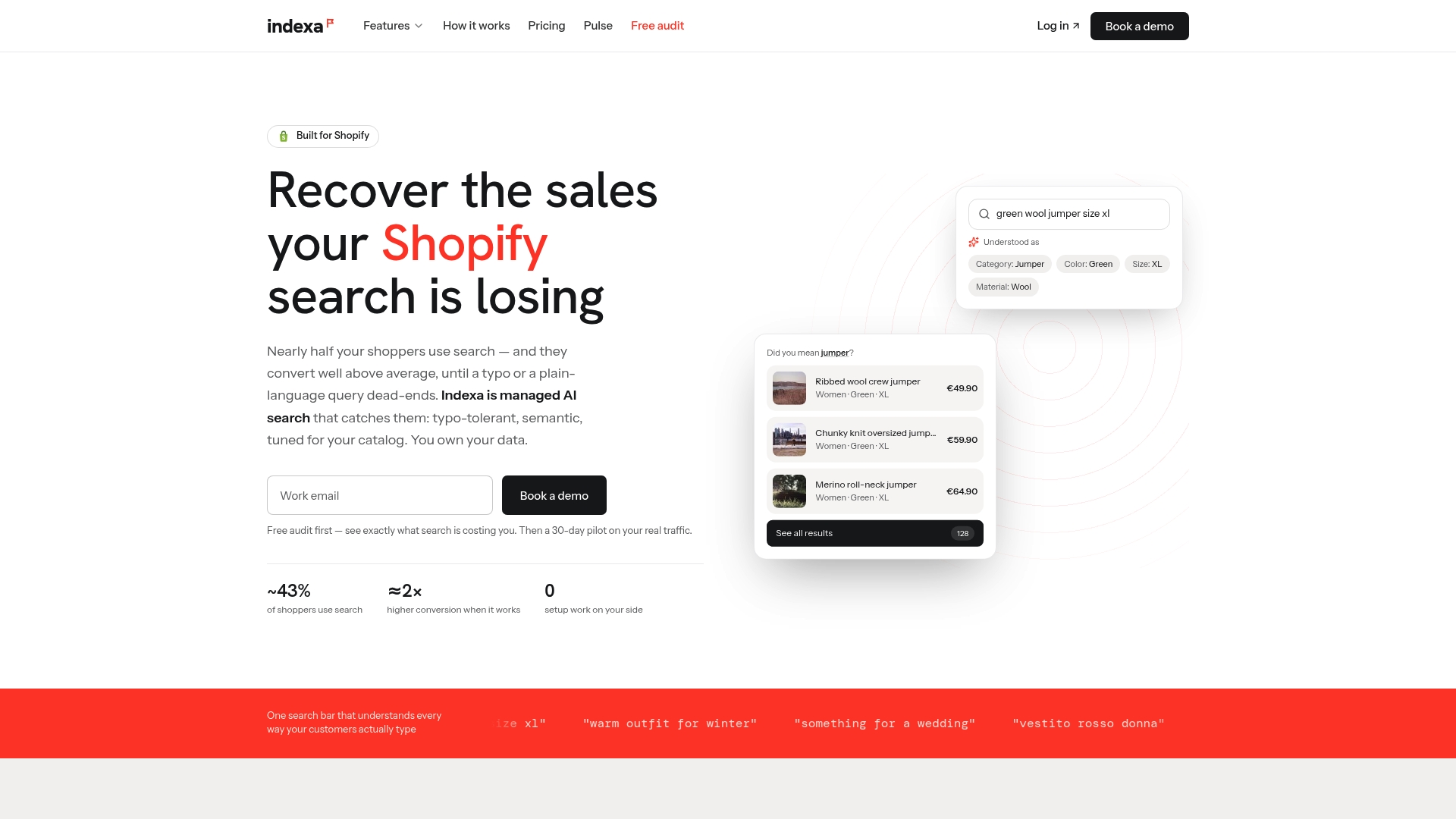
Our service handles typo-tolerant and semantic search, synonym mapping, and a visual merchandising grid editor that uses your tags and attributes directly, with no setup required on your end. Because tuning runs continuously against your store’s real search data, the gap between “tags exist” and “tags improve conversion” closes more rapidly. For AI-driven discovery specifically, optimizing product pages to present clear, confident attributes matters as much as the tags themselves, since AI shopping assistants match against ground-truth product attributes rather than keyword density.
If you want a clear picture of where your current tags and search setup are leaving sales on the table, start with a free audit or look at our 30-day pilot to see the impact before committing to anything long term.

FAQ
Can you give me an example of a product tag?
A product tag is a short label like “waterproof,” “oversized fit,” or “gift under $50” attached to a product to aid search and filtering. Unlike a category, a tag can apply across many different product types at once.
How do I use search tags effectively?
Tags work best when mapped to a controlled vocabulary and connected to your search index so they power filters, facets, and synonym matching. Keep tag names consistent in casing and wording, and reserve them for cross-cutting attributes rather than duplicating your category tree.
Can I upload a picture to find a product?
Yes, image-based product search is a real capability: Vision API Product Search accepts an image and matches it against labeled products using category and attribute filters. The quality of the match depends heavily on how completely the underlying catalog is tagged.
What’s the difference between tagging and mentioning?
Tagging attaches a structured, searchable label to a product record that search engines and filters can query directly. Mentioning a term only in a product title or description, without a corresponding tag or attribute, is far less reliable for search and filtering because it depends on exact text matching rather than structured data.
How does product tagging affect conversion rates?
Tagging improves search conversion by helping shoppers find matching products through filters, synonyms, and visual search rather than abandoning after a zero-result search. Tracking search conversion rate and zero-result rate before and after a tagging project is the most direct way to confirm the impact on your own store.
Sources
- How AI-driven shopping discovery changes product page optimization
- Searching for Products | Vision API Product Search | Google Cloud Documentation
- Build an AI-powered product tagging system with Amazon SageMaker serverless model customization
Recommended
Make discovery work harder.
See what your Shopify search could do better with a free, hands-on audit.
Get your free search audit