Shopify Search Stop Words: Fix Misses Without Editing the List
Shopify does not let you edit its native stop word list. Learn how synonyms, assigned terms, reports, and managed AI address missed searches.

Shopify Search Stop Words: Fix Misses Without Editing the List
Short answer: you cannot edit Shopify’s native stop-word list. Shopify’s search engine automatically excludes common function words from its index, and when a shopper searches using only those words, the storefront can return zero results. The fastest fixes are synonym groups and assigned search terms inside Search & Discovery, and when those aren’t enough, a managed AI search upgrade closes the gap.
TL;DR:
- Shopify removes common function words from its index, so queries containing only those terms can return no results; test plain and quoted searches.
- Track the zero result rate, search conversion, and abandonment; an empty page can send shoppers away while leaving relevant products undiscovered.
- Use Search & Discovery reports to rank zero result queries, assign terms or boosts to urgent misses, and recheck results after 7 to 14 days.
- Compare identical queries on the storefront and native search first, because a third party app may use its own rules for excluding common words.
- Consider managed AI search when a growing or multilingual catalog produces more zero result queries than manual synonym mapping can keep up with.
Table of Contents
- How Shopify handles stop words in storefront search
- Why stop-word misses hurt conversions
- Fixing search with Shopify Search & Discovery
- When a third-party search app changes the rules
- Native limits versus a managed search upgrade
- Getting a managed AI search running on your store
- FAQ
- Sources
How Shopify handles stop words in storefront search
Shopify excludes a set of common words, including “and,” “or,” “the,” “a,” “an,” and “for,” from its search index across the languages it supports, according to Shopify’s own search behavior documentation. This indexing choice exists to reduce noise: those words appear in nearly every product title and description, so keeping them in the index would add weight without adding useful signal.
The catch is what happens when a query consists only of excluded terms. Shopify documents that a search made up entirely of stop words can return no results at all, since there’s nothing left in the index to match against. A shopper typing a short, natural phrase can hit a wall that looks like a bug but is actually documented behavior.
Query structure matters too. Shopify’s developer docs on search syntax describe phrase queries and fielded searches that target specific product fields, and stop-word exclusion interacts differently with each:
- A plain keyword search drops stop words before matching.
- A phrase query wrapped in quotes can behave differently depending on which fields it targets.
- A fielded search (title, tag, or vendor-specific) narrows the index Shopify checks, which can either dodge or worsen a stop-word miss.
Pro Tip: Test any suspicious query as both a plain search and a quoted phrase search before assuming the product itself is unindexed.
Why stop-word misses hurt conversions
A zero-result page isn’t a minor inconvenience. It’s a dead end that sends shoppers either back to Google or off to a competitor. Tracking the zero-result rate, the share of searches that return nothing, is one of the clearest early warning signs that stop words or related indexing quirks are costing sales.
Two KPIs are worth watching alongside it:
- Search-to-conversion rate: the percentage of searchers who complete a purchase, segmented by whether their query returned results.
- Search abandonment: how often a shopper leaves the site within a few seconds of an empty or poor result set.
Some of the worst cases involve branded or short titles. A product named with a short function word in it, or a collection title that leans on “the” for style (“The Weekender Bag”), can get quietly excluded from meaningful matching if a shopper searches that exact phrase. The store owner never sees the miss unless they’re actively reviewing search reports.
Zero-result queries are a direct, trackable signal of lost revenue, and Shopify’s own Search & Discovery reporting surfaces them so merchants can prioritize fixes instead of guessing.

Fixing search with Shopify Search & Discovery
Shopify’s Search & Discovery app is the merchant-facing toolkit for working around stop-word limitations, since the underlying exclusion list itself isn’t editable, per Shopify’s guide to modifying search behavior. Here’s a practical sequence:
- Pull the top zero-result queries from the Search & Discovery analytics report and sort by frequency.
- Group queries by intent, separating true stop-word misses from genuine out-of-catalog searches.
- Build synonym groups for phrase variants, compound words, and common misspellings tied to your highest-volume misses.
- Assign search terms directly to products when a specific query should always surface a specific item, bypassing the index entirely.
- Use product boosts for urgent, revenue-impacting queries that need faster visibility than synonym propagation allows in some themes.
- Tighten metadata and tags on affected products so the indexed fields carry the right keywords without relying on excluded words.
- Re-run the same queries as both plain and phrase searches to confirm the fix landed, then document the change.
- Re-check zero-result rate after 7 to 14 days to measure the real impact before moving to the next batch.
Synonym groups come with limits on how many synonyms and terms a store can maintain, so prioritize by query volume rather than trying to map every variant at once. Multiword synonyms are also treated as phrase searches, which matters when you’re mapping a compound term.
Pro Tip: Assign search terms and boosts first for anything losing sales today; synonym groups are better suited to steady, ongoing cleanup.
When a third-party search app changes the rules
Not every Shopify store runs on native search. Many run a third-party app layered on top, and those apps often deploy their own language analyzers and stop-word handling, sometimes disabling stop-word filtering entirely. Platform-level search tools illustrate how differently this can work: Redis, for example, documents a configurable stop-word list that merchants or developers can customize or turn off at index creation, which is a meaningfully different default than Shopify’s fixed exclusion list.
Before assuming native Shopify behavior is the cause of a search miss, run a quick verification:
- Run the identical query on the live storefront and note the result count.
- If safe to do so, temporarily disable the third-party search app and re-run the same query against native search.
- Where possible, query the API directly to see which layer is actually parsing the request.
- Check the app vendor’s documentation for its language analyzer, typo tolerance, and synonym scope, since these vary widely between providers.
This verification step avoids wasted effort fixing a problem in the wrong layer, and it clarifies who to escalate to when a query still fails.
Native limits versus a managed search upgrade
Native Search & Discovery works fine for stores with a smaller catalog, a low zero-result rate, and a team willing to keep synonym groups current. If that describes your store, there’s no need to change anything.
The calculation shifts once a catalog grows, spans multiple languages, or keeps generating a steady stream of zero-result queries that manual synonym mapping can’t keep up with. At that point, the cost isn’t the software, it’s the lost conversions piling up while someone manually chases each miss.
Information-retrieval practice has been moving the same direction for years: large stop-word lists are giving way to semantic and NLP-based approaches that treat function words as context rather than noise, a shift well documented in the literature on stop-word evolution. A managed AI search layer applies that same shift directly to a Shopify catalog, continuously tuning results instead of waiting for someone to notice a report.
— Barikreativa
Getting a managed AI search running on your store
We run a fully managed AI search and discovery service, designed to address issues like stop-word problems rather than just patch around them. Instead of mapping synonym groups one query at a time, our semantic and typo-tolerant search understands intent directly, so a shopper searching a short, natural phrase gets relevant products instead of an empty page.
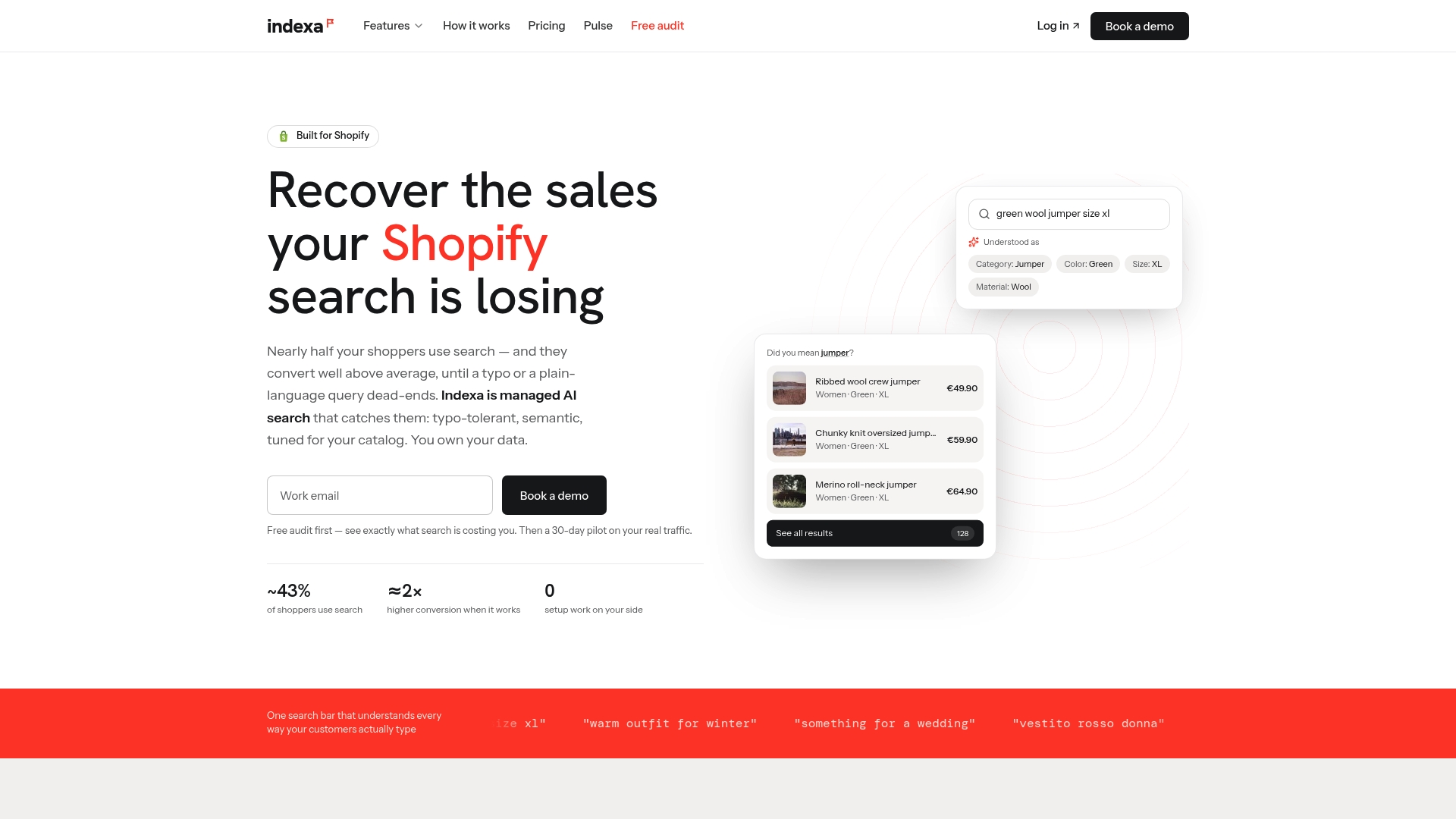
Setup runs without any work on your end, with ongoing tuning as real shoppers search your store. Our service includes capabilities such as typo tolerance and semantic matching, synonym management with visual merchandising for search and category pages, and continuous relevance tuning based on actual query data.
If you want to see what’s actually being missed before committing to anything, start with our free Shopify search audit, or run through our search audit checklist yourself. From there, our 30-day pilot shows the recoverable revenue directly against your own catalog.
FAQ
Can I edit or disable Shopify’s stop-word list?
No. Shopify’s stop-word exclusion is built into native storefront search and isn’t exposed as a merchant setting, according to Shopify’s documentation. Merchants work around it using synonym groups, assigned search terms, and product boosts in Search & Discovery instead.
Why does my product search return zero results for common terms?
If a query consists only of excluded words like “the,” “and,” or “for,” Shopify’s index has nothing left to match, which produces a zero-result page by documented design. Checking your top zero-result queries in Search & Discovery reporting is the fastest way to confirm this is the cause.
Will a third-party search app fix stop-word issues automatically?
It depends on the app. Some third-party and platform-level tools, such as Redis, allow stop-word filtering to be customized or disabled, so results can differ from native Shopify search, but you need to verify each app’s analyzer and documentation to know for sure.
How do I know if stop words are actually costing me sales?
Track your zero-result rate and search-to-conversion rate over a few weeks; a persistently high zero-result rate on otherwise normal queries is the clearest sign. A free Shopify search audit can quantify the recoverable revenue behind that number.
When should I consider a managed AI search instead of native tools?
Native Search & Discovery is usually sufficient for small catalogs with a low zero-result rate and a team that can maintain synonyms. A managed AI search becomes worth evaluating once your catalog grows, spans multiple languages, or keeps generating zero-result queries faster than manual mapping can fix them.
Sources
For verification or deeper reading, these are the primary sources behind the behavior described above:
For a broader SEO context beyond storefront search behavior, see BabyLoveGrowth’s guide to Shopify SEO automation.
Recommended
Make discovery work harder.
See what your Shopify search could do better with a free, hands-on audit.
Get your free search audit