Shopify Search Special Characters: Escape Colons, Move to Metafields
Escape colons and quotes in Shopify search, prevent tag collisions from symbols, and learn when metafields, filters, or a free audit fit your store.

Shopify Search Special Characters: Escape Colons, Move to Metafields
Colons, backslashes, and parentheses are functional operators in Shopify’s search syntax, so they must be escaped with a backslash or wrapped in quotes to search for them literally. Product tags only recognize letters, numbers, and hyphens, which means other symbols collapse or get ignored. For anything beyond a quick fix, move matching logic into metafields and filters, or audit your setup with a free search audit.
TL;DR:
- Shopify treats colons, parentheses, and backslashes as operators; escape literal characters with backslashes or quote the full value, including multiword terms.
- Symbols can collapse into tag collisions, so convert accented letters, replace spaces with hyphens, and use one canonical tag per concept.
- Metafields provide typed values, and Search & Discovery supports filters; audit tag rules, define product attribute fields, map values, resolve duplicates, and test busy collections before rollout.
- Storefront API queries with characters beyond basic ASCII can fail from encoding mismatches; apply encodeURIComponent, and use products(query:) when keyword searches broaden filters.
Table of Contents
- Shopify search query syntax: functional special characters and escaping patterns
- Tags: official limits, how special characters actually behave, and practical sanitization rules
- Filters and metafields: why structured data is safer and how to migrate
- Developer workarounds and common API quirks: encoding, non-ASCII, and endpoint differences
- Why special characters quietly erode search accuracy at scale
- Get a free audit before you rebuild your search setup
- FAQ
- Sources
Shopify search query syntax: functional special characters and escaping patterns
Before sanitizing anything, you need to know which characters Shopify’s search grammar actually reads as instructions. The search syntax documentation identifies a small set of functional characters: the colon separates a field from its value, parentheses group expressions, and the backslash escapes a character you want treated as literal text rather than an operator.
- A colon (
:) tells Shopify you are filtering a field, as intag:summer. - Parentheses group multiple conditions, useful for combining filters with AND or OR logic.
- A backslash (
\) escapes a character so it is read literally instead of as an operator. - Single or double quotes wrap complex values, like dates or multi-word strings, to stop the parser from splitting them incorrectly.
Product names can include hyphens, apostrophes, and quotation marks, but only when those characters are escaped or the whole value is quoted. A query like title:'O\'Brien Jacket' keeps the apostrophe literal instead of breaking the string. Skip the escaping and Shopify may parse your apostrophe as the start of a new clause, returning unrelated results or throwing a query warning. The same logic applies whether you are testing queries in the Admin search bar or building them programmatically through the GraphQL Admin API: unescaped special characters get interpreted as grammar, not content.
Tags: official limits, how special characters actually behave, and practical sanitization rules
Shopify’s tag formatting guidance is stricter than most store admins expect. Tags officially support ordinary letters, numbers, and hyphens. Accented characters and symbols either get stripped or treated as equivalent to a plain version of the tag, which creates collisions you will not notice until a collection pulls in the wrong products.
A tag written as red-new behaves identically to red_new, red+new, and red&new in many storefront contexts, because the underscore, plus sign, and ampersand are not part of the supported character set. Automated collections built on these tags will quietly merge products you meant to keep separate, or exclude ones you meant to include.
A short sanitization routine prevents most of this, supported by tools like Shopify SEO automation with BabyLoveGrowth:
-
Normalize accented characters to their plain-letter equivalents before saving a tag.
-
Replace spaces with hyphens rather than leaving them as separate words.
-
Keep tags under a reasonable length so they stay readable in collection rules.
-
Settle on one canonical tag per concept and avoid near-duplicate variants.
Intentional misspelling tags are the one exception worth keeping. If customers routinely search a common misspelling of a brand or material, a deliberate tag for that variant can catch traffic a clean taxonomy would miss. Help Center guidance also notes that tags are not indexed for SEO the way titles and descriptions are, so treat them as an internal filtering tool, not a search ranking lever.
Pro Tip: Run a quarterly export of your tag list and sort it alphabetically. Collisions and duplicate-with-symbols variants jump out immediately once they are sitting next to each other.
Filters and metafields: why structured data is safer and how to migrate
Tags are plain strings with no type checking. Metafields are typed, which means a color value, a size range, or a material name gets validated and matched consistently rather than depending on exact character sequences. Search & Discovery’s filter documentation confirms that custom filters can be built on metafields, giving you structured, variant-level filtering that does not break when someone types an accent mark differently.
Migrating away from fragile tag strings follows a predictable sequence:
- Audit your current tag-based queries and collection rules to find where collisions or missed matches are happening.
- Define metafields for the attributes customers actually filter by, such as material, fit, or certification.
- Map existing tag values into the new metafield structure, resolving duplicates as you go.
- Add the metafields as filters inside Search & Discovery.
- Test the storefront experience across your highest-traffic collections before rolling out store-wide.
| Approach | Matching reliability | Best fit |
|---|---|---|
| Tags | Low, prone to collisions | Small catalogs, loose organization |
| Metafields with Search & Discovery filters | High, typed values | Growing catalogs, variant-level filtering |
| Managed AI search | High, typo-tolerant and semantic | Large or multilingual catalogs |
For stores selling in more than one language, filter labels and values can be translated so the structured filters behave the same way regardless of locale, which matters more as catalog size grows and manual tag cleanup stops scaling.
Developer workarounds and common API quirks: encoding, non-ASCII, and endpoint differences
Community reports surface two recurring Storefront API problems. One is that queries containing non-ASCII characters such as Æ, Ø, or Å can fail outright, with developers tracing the issue to encoding mismatches between the client and the API. The other is that combining a free-text keyword with a field filter can broaden results instead of narrowing them, because the keyword acts as a ranking signal rather than a strict filter.
Three fixes cover most of these cases:
- Run
encodeURIComponenton any user-supplied string before embedding it in a GraphQL variable. - Hex-encode characters that still misbehave after percent-encoding.
- Wrap multi-word or symbol-containing values in quotes at the query level, not just in client-side code.
When the storefront search field keeps broadening results in ways your filter logic cannot predict, switch to products(query:) for stricter server-side field matching, or build a thin normalization layer that cleans queries before they reach Shopify. Our guide to SKU search troubleshooting walks through a similar normalization pattern for field-based lookups.
A practical reliability check: Shopify’s storefront search behavior documentation confirms that search applies stemming, prefix matching, and trigram support for scripts like Japanese, which means it is tuned for flexible matching, not exact string precision, and special-character edge cases sit right at that seam.
When a query fails, collect the raw query string, the request ID, a couple of example product titles or tags involved, and the API version before filing a support thread. That context turns a vague bug report into one a developer can actually reproduce.
Why special characters quietly erode search accuracy at scale
Most store teams treat special-character bugs as cosmetic annoyances rather than what they actually are: silent leaks in a store’s single highest-intent traffic channel. A shopper who types a product name with an accent, an ampersand, or an apostrophe and gets zero results does not usually try again with cleaner syntax. They leave.

The conventional fix, tightening tag rules and adding more escaping logic, treats the symptom. It does not address the deeper mismatch: Shopify’s native search was built around exact and prefix matching with a layer of stemming, not around understanding what a shopper meant despite imperfect input. Every workaround in this guide, from backslash escaping to metafield migration, is a way of making a string-matching system behave more predictably. None of it makes the system understand intent.
That gap matters more every year as catalogs grow more multilingual and long-tail queries make up a larger share of search traffic. A rules-based system can be patched indefinitely, but each patch adds maintenance debt that someone has to remember and re-test every time a product naming convention changes.
— Barikreativa
Get a free audit before you rebuild your search setup
We offer a managed search service designed to bridge the gap between what shoppers type and what a rules-based system can reliably match. Our typo-tolerant and semantic search understands a query even when it contains an accent mark, a symbol, or a slightly off spelling, so a mismatched special character stops costing a sale.
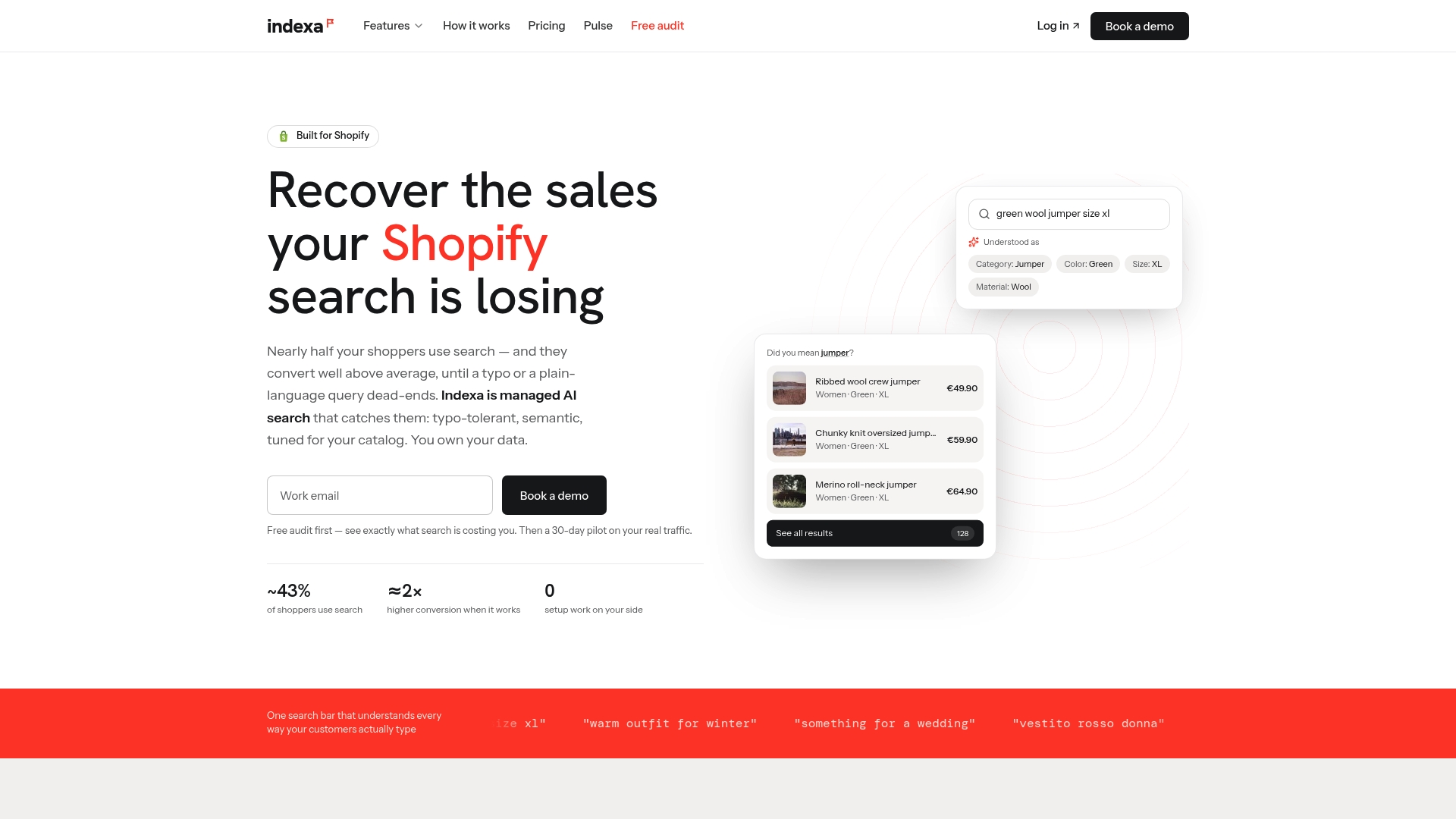
Our service activates without requiring setup on your end and continuously tunes results using store data, reducing the need for manual patches related to special-character issues. We also provide query understanding and merchandising controls so you can see exactly which searches were failing and why.
- A free audit surfaces your zero-result keywords, flags tag collisions, and suggests metafields worth building.
- A 30-day pilot lets you measure the difference in zero-result rate and conversion before committing to anything.
Start with the free Shopify search audit and see exactly where special characters are costing you sales.
FAQ
Should I escape special characters or just avoid them in search queries?
Escape them when you need the literal character in a query, using a backslash or wrapping the value in quotes, as described in Shopify’s search syntax docs. For tags and collection rules, it is simpler to avoid special characters entirely and stick to letters, numbers, and hyphens.
Why do two tags with different symbols show the same products?
Shopify tags only recognize letters, numbers, and hyphens, so symbols like underscores or ampersands often get ignored or normalized, according to Shopify’s tag documentation. That means red_new and red-new can end up treated as the same tag, causing unexpected matches in automated collections.
When should I use metafields instead of tags for filtering?
Switch to metafields once your catalog is large enough that tag collisions start affecting collection accuracy or filter reliability. Search & Discovery’s filter documentation confirms metafields support typed values, which match more predictably than plain tag strings.
Why does the Storefront API fail on non-ASCII characters?
Developers have reported that Storefront API queries containing non-ASCII characters can fail due to encoding mismatches. The common workaround is applying encodeURIComponent before sending the query, or switching to products(query:) for stricter field matching.
Can special characters hurt my product search conversion rate?
A shopper whose query returns zero results because of an unescaped symbol or an accent mark usually leaves rather than retrying with different syntax. Structured filters, careful tag sanitization, or a managed search service built to tolerate input variation all reduce that risk.
Sources
- Search query syntax — Shopify Developer Docs
- Adding filters with Shopify Search & Discovery — Shopify Help Center
- Storefront API ‘query’ search syntax fails with non-ASCII characters — Shopify Community
Recommended
Make discovery work harder.
See what your Shopify search could do better with a free, hands-on audit.
Get your free search audit